A reliable dog collar manufacturer should do more than produce a strap with a buckle. For pet brands, wholesalers, distributors, retailers, and e-commerce sellers, the real sourcing challenge is creating a collar that combines consistent sizing, reliable hardware, durable materials, attractive branding, repeatable quality, and a cost structure that fits the target market.
The best supplier is therefore not always the factory offering the lowest quotation. Buyers should evaluate whether the manufacturer can control materials, printing, cutting, sewing, assembly, inspection, packaging, and repeat orders under one clear specification.
For private-label projects, this becomes even more important because the collar represents the buyer’s own brand. Problems with buckle operation, stitching, sizing, color consistency, logo placement, or packaging can quickly become customer complaints and returns.
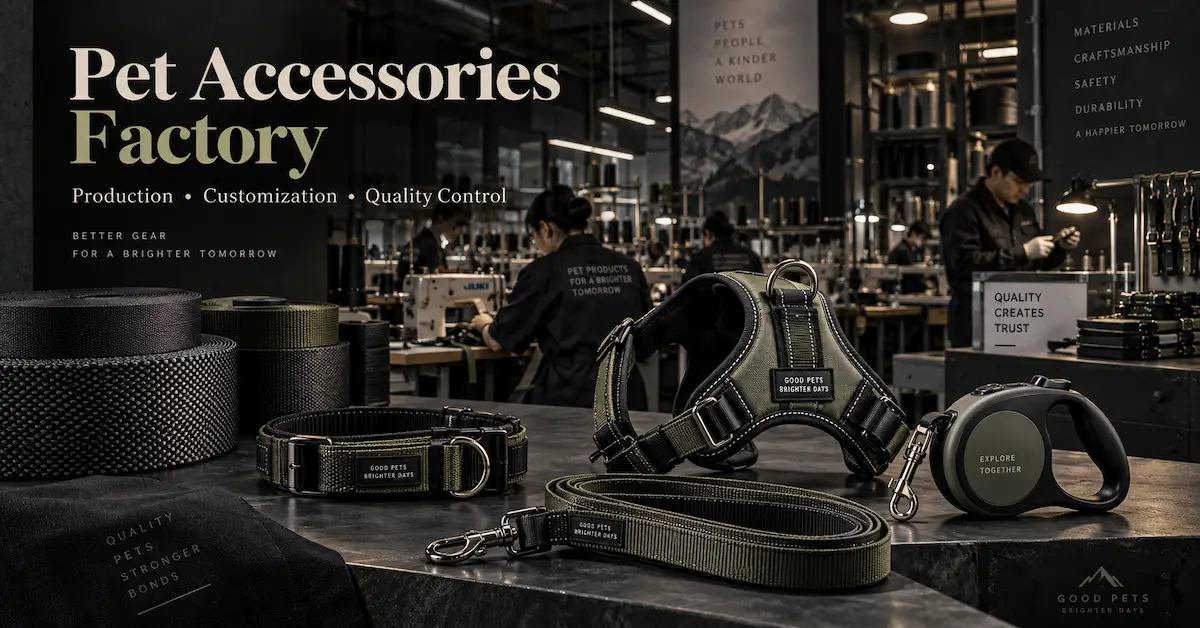
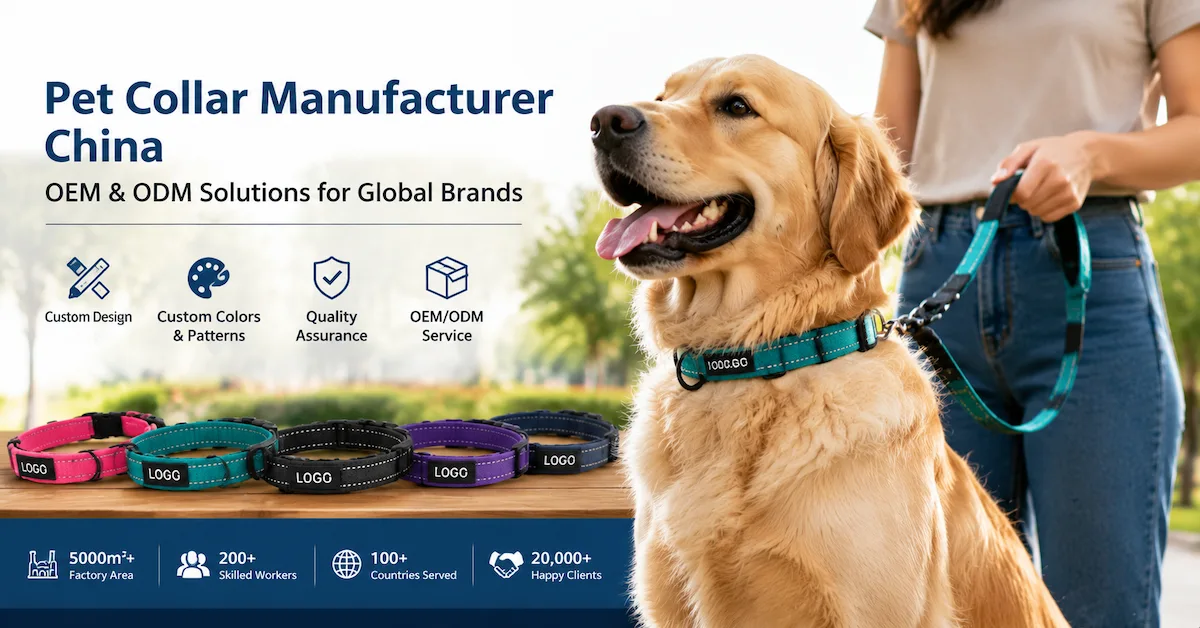
QQPETS positions itself as an OEM/ODM pet accessory manufacturer covering custom collars, harnesses, leashes, retractable leashes, and LED pet accessories. Its About Us page states that its 5,000 m² facility includes heat-transfer printing, silk-screen printing, weaving, cutting, sewing, and packaging workshops.
What Should You Expect From a Professional Dog Collar Manufacturer?
A professional manufacturer should support the complete path from product concept to finished retail-ready goods.
For most B2B projects, that means helping buyers define:
- Collar type
- Target dog size
- Webbing width
- Material
- Adjustment range
- Buckle type
- Metal hardware
- Logo method
- Printed pattern
- Color
- Label
- Packaging
- Order quantity
- Inspection requirements
A buyer should be able to provide an existing sample, specification sheet, reference image, artwork, or general product concept and then refine the details through physical sampling.
This is especially important for buyers developing a custom dog collar, because a physical sample can reveal problems that digital mockups cannot show, such as buckle feel, webbing stiffness, edge comfort, adjustment movement, stitching appearance, and actual color perception. QQPETS' current collar listing describes OEM/ODM support for private-label branding, custom logos, patterns, material choices, and packaging options.
Which Buyers Need a Custom Dog Collar Manufacturer?
Dog collar manufacturing serves several different B2B buyer groups, and each has different priorities.
Pet Brands
Established pet brands usually care about product differentiation, stable quality, custom colors, packaging consistency, and the ability to expand into matching harness and leash collections.
Start-Up Private Label Brands
New brands often need lower development risk.
Their priorities usually include:
- Manageable MOQ
- Sampling support
- Logo customization
- Simple packaging
- Two or three initial SKUs
- Clear specifications
- Easy repeat ordering
Wholesalers and Distributors
Wholesale buyers care more about:
- Unit cost
- Product range
- Repeat supply
- Production consistency
- Packaging efficiency
- Regional market suitability
Amazon and E-Commerce Sellers
Online sellers often place additional emphasis on:
- Differentiated appearance
- Retail packaging
- Barcode labels
- Consistent sizing
- Reduced return risk
- Product bundles
- Branded inserts
Pet Store Chains and Retailers
Retail chains may need standardized colors, size labeling, retail-ready packaging, carton markings, and consistent specifications across repeated batches.
Buyers Who May Not Need OEM Production
A custom manufacturer may not be the best option for a buyer who only needs a very small quantity of immediate stock, does not require branding, and cannot wait for sample confirmation.
In that situation, ready-made wholesale products may be more efficient than a full OEM development project.
What Materials Should Buyers Compare for Dog Collars?
Material selection affects comfort, durability, printing, appearance, positioning, and cost.
Nylon Webbing
Nylon webbing is commonly considered when buyers want flexibility, a relatively soft hand feel, and strong everyday performance.
When evaluating nylon, buyers should check:
- Width tolerance
- Thickness
- Surface feel
- Edge finish
- Color consistency
- Adjustment movement
- Sewing performance
Polyester Webbing
Polyester is frequently selected for fashion-focused or printed pet accessory collections because it can support stable color presentation and decorative surface printing.
For printed private-label collars, the buyer should review not only the artwork but also:
- Color accuracy
- Pattern sharpness
- Pattern alignment
- Print durability
- Batch-to-batch consistency
QQPETS lists heat-transfer printing as one of its in-house production processes, and its existing collar product uses heat-transfer printing for decorative patterns.
Reflective Materials
Reflective thread, piping, strips, or webbing can be added to products positioned for evening walking or visibility-focused collections.
Buyers should inspect reflective placement under actual low-light conditions rather than judging the product only in daylight.
Padding and Soft Layers
Some premium collars may include softer backing or padding to improve comfort.
However, adding padding also affects:
- Thickness
- Sewing complexity
- Drying behavior
- Product weight
- Cost
Material choices should therefore match the intended retail positioning rather than simply adding more layers.
Which Dog Collar Components Matter Most?
A dog collar is simple in appearance, but several components directly influence its quality.
| Component | What Buyers Should Check | Why It Matters |
|---|---|---|
| Webbing | Width, thickness, surface, color | Controls strength, feel, and appearance |
| Buckle | Locking feel, release action, molding quality | Affects daily convenience and security |
| Adjuster | Movement and holding performance | Controls sizing and fit |
| D-ring / attachment ring | Material, finish, connection point | Used for tags or leash attachment depending on design |
| Stitching | Density, alignment, reinforcement | Holds structural parts together |
| Printed surface | Color, registration, abrasion | Affects branded appearance |
| Label / logo | Position, clarity, durability | Defines private-label identity |
| Packaging | Fit, barcode, protection | Supports retail and e-commerce sales |
The current QQPETS collar listing specifically highlights a quick-release buckle and heat-transfer printed design, showing why hardware and printing should both be included in buyer inspections.
How Should Dog Collar Size and Fit Be Developed?
One of the biggest mistakes in private-label collar sourcing is treating size only as a label such as S, M, or L.
For manufacturing, size should be defined using measurable specifications.
A buyer should normally confirm:
- Minimum adjustable circumference
- Maximum adjustable circumference
- Webbing width
- Buckle dimensions
- Adjuster position
- Tolerance
- Size label
- Target dog category
This matters because breed and body size vary significantly. The American Kennel Club recognizes breeds ranging from very small dogs to large working breeds, making a single collar structure unsuitable for every market segment.
For a product line, it is better to build a controlled size chart than simply request “small, medium, and large.”
Which Dog Collar Types Can a Manufacturer Develop?
Different collar designs serve different channels and price points.
| Collar Type | Main Features | Best For | Relative Complexity |
| Standard Webbing Collar | Basic adjustable structure | Wholesale, mass retail | Low |
| Printed Dog Collar | Custom graphics and colors | Fashion pet brands | Low to Medium |
| Reflective Dog Collar | Reflective details | Night-walking collections | Medium |
| Padded Dog Collar | Added comfort layer | Premium daily-use lines | Medium |
| Heavy-Duty Collar | Wider material and stronger hardware | Large-dog collections | Medium to High |
| Private Label Collar Set | Branded collar with coordinated packaging | E-commerce and retail | Medium |
| Collar + Leash Set | Matching material, color and logo | Brand collections | Medium |
| Collar + Harness + Leash Set | Coordinated walking system | Premium private label brands | High |
A manufacturer with several related pet accessory categories can make it easier to maintain consistent color, branding, material style, and packaging across a collection.
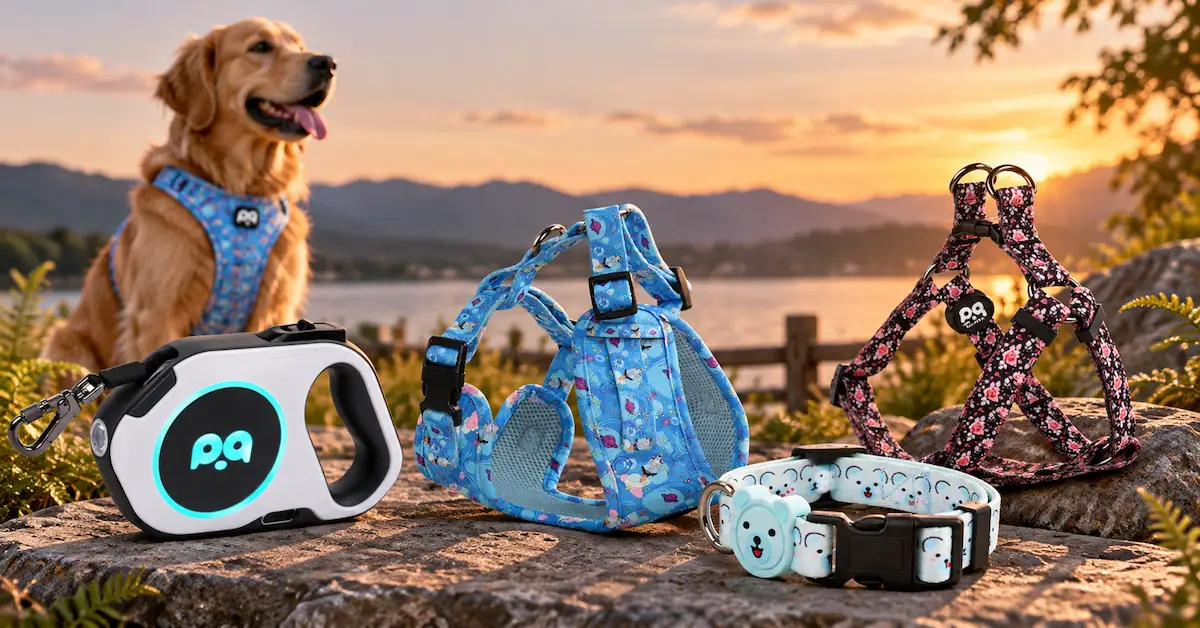
QQPETS' product range currently includes dog collars alongside harnesses, leashes, retractable leashes, and LED walking products.
How Are Custom Dog Collars Manufactured?
The exact process varies by collar structure, but a practical OEM workflow normally includes several controlled stages.
Requirement Confirmation
The buyer defines the market, price level, size range, color, material, logo, packaging, and estimated quantity.
Material Preparation
Webbing, buckles, adjusters, rings, labels, printing materials, and packaging components are prepared according to the approved specification.
Printing or Branding
If the collar includes graphics, heat-transfer printing, screen printing, sewn labels, woven labels, or other branding methods may be applied.
Cutting
Webbing is cut to defined dimensions.
Cutting tolerance matters because inconsistent lengths can cause differences in finished adjustment range.
Sewing
Structural areas are stitched and reinforced.
Sewing quality should be evaluated for:
- Straightness
- Thread consistency
- Reinforcement
- Loose threads
- Missed stitches
- Position accuracy
Assembly
Buckles, adjusters, rings, labels, and other components are assembled into the final collar.
Inspection
Finished collars should be compared with the approved sample and specification before packaging.
What Quality Control Should a Dog Collar Manufacturer Perform?
For buyers, quality control should not be limited to a final visual inspection.
A stronger QC system checks quality throughout production.
Incoming Material Inspection
Check:
- Webbing
- Hardware
- Buckles
- Color
- Printed materials
- Labels
- Packaging
Cutting Inspection
Confirm:
- Length
- Direction
- Quantity
- Size grouping
Printing Inspection
Review:
- Artwork
- Color
- Registration
- Pattern alignment
- Surface defects
Sewing Inspection
Inspect:
- Stitch position
- Reinforcement
- Thread tension
- Loose threads
- Alignment
Hardware Function Inspection
Operate buckles and adjusters repeatedly and inspect attachment points.
Finished Product Inspection
Confirm:
- Correct size
- Correct color
- Logo placement
- Adjustment
- Appearance
- Packaging
- Barcode
- Carton marking
This process-based approach is consistent with the purpose of ISO 9001, which focuses on managing and continually improving quality processes rather than acting as a blanket product safety certification. Buyers can review the official ISO 9001 quality management guidance when evaluating supplier quality systems.
What Certifications and Material Claims Should Buyers Verify?
Certificates are useful, but buyers should always check what a document actually covers.
QQPETS states on its About Us page that it maintains ISO 9001, BSCI, SGS, and OEKO standards.
However, buyers should not assume that every certification automatically applies to every collar, every material, or every shipment.
For example, OEKO-TEX STANDARD 100 relates to textiles tested for harmful substances, and certification applies to the specific certified article or components within its stated scope.
Before approving an order, ask for:
- Certificate name
- Certificate number
- Validity period
- Scope
- Applicable product or material
- Relevant test report
- Buyer-specific compliance requirements
This is more reliable than simply counting the number of logos displayed on a supplier website.
What Can Be Customized in an OEM Dog Collar Project?
A custom dog collar manufacturer may support several levels of customization.
Appearance Customization
- Pantone color
- Printed patterns
- Brand graphics
- Logo
- Labels
- Seasonal colors
Structural Customization
- Width
- Length
- Adjustment range
- Buckle
- Ring
- Webbing thickness
- Padding
Brand Customization
- Woven label
- Printed logo
- Rubber patch
- Hang tag
- Barcode
- Packaging
Collection Customization
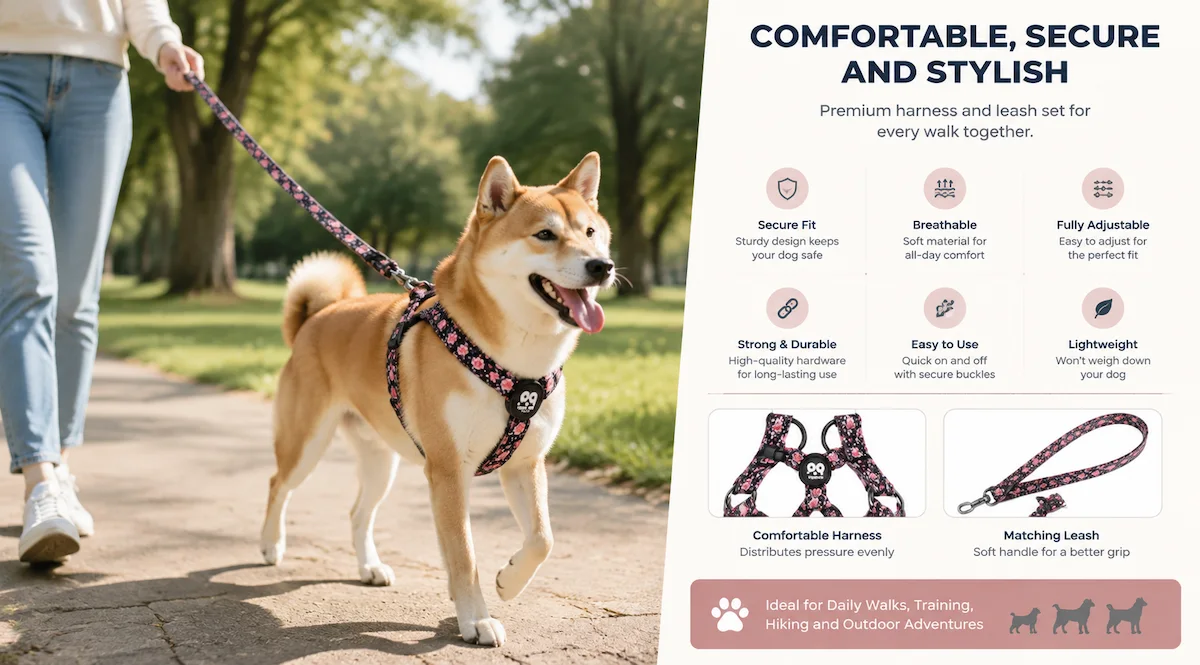
Many brands achieve stronger visual consistency by extending one design across collars, leashes, and harnesses.
For example, buyers developing a private-label walking collection can coordinate the collar with a custom dog leash line using similar colors, logo treatment, packaging, and market positioning.
What Affects Dog Collar MOQ and Pricing?
There is no useful universal price for a custom collar because the final quotation depends on its specification.
Major cost factors include:
- Webbing material
- Webbing width
- Thickness
- Buckle quality
- Metal hardware
- Custom color
- Printing
- Logo method
- Padding
- Reflective elements
- Packaging
- Number of sizes
- Number of colors
- Number of SKUs
- Order quantity
- Inspection requirements
MOQ is also affected by customization.
For example, one current QQPETS dog collar product page mentions a 30–40 piece minimum for that specific custom product. This should be treated as a product-specific reference rather than a universal MOQ for every collar design.
A buyer should therefore ask:
What is the MOQ for this exact material, color, logo method, packaging, and number of sizes?
That question is far more useful than simply asking:
What is your MOQ?
What Common Sourcing Risks Should Buyers Avoid?
Choosing Only by Unit Price
A lower quotation can reflect differences in webbing thickness, buckle quality, printing, stitching, or packaging.
Always compare the complete specification.
Approving Only a Digital Mockup
A digital design cannot confirm material feel, buckle operation, edge comfort, or actual color.
Approve a physical sample before bulk production.
Launching Too Many SKUs
Five colors across five sizes already create 25 SKUs.
New brands often reduce inventory risk by beginning with a focused selection.
Not Defining Tolerances
Without measurable specifications, buyers and manufacturers may interpret “same as sample” differently.
Define critical dimensions in writing.
Ignoring Packaging Until Production Is Finished
Packaging affects carton size, barcode accuracy, retail presentation, and shipping protection.
It should be approved during development rather than after production.
Assuming Every Certificate Covers Every Product
Always verify document scope and validity.
How Should Buyers Compare Dog Collar Manufacturers?
Use a structured supplier comparison rather than relying on price alone.
| Evaluation Area | Questions to Ask |
| Manufacturing | Which processes are completed in-house? |
| Materials | Can you provide defined webbing and hardware specifications? |
| Sampling | Can I approve a physical sample before production? |
| Customization | Can you customize color, pattern, size, logo, and packaging? |
| QC | Which checks are performed during production? |
| Product Range | Can you develop matching leashes and harnesses? |
| Certification | Can you provide valid documents and scope? |
| MOQ | How does customization affect minimum order quantity? |
| Repeat Orders | How are approved specifications controlled for future batches? |
| Packaging | Can you support barcode, hang tag, retail, and e-commerce requirements? |
| Communication | Are final specifications confirmed clearly in writing? |
A suitable supplier should reduce sourcing uncertainty rather than create more of it.
Why Consider QQPETS as a Dog Collar Manufacturer?
QQPETS supports custom dog collars as part of a broader pet accessory manufacturing range.
According to its company information, the factory includes dedicated departments for heat-transfer printing, screen printing, weaving, cutting, sewing, and packaging. The company also states that it has a 5,000 m² facility, a team of more than 200 people, and experience serving buyers in more than 100 countries.
For buyers developing custom collars, potential project discussions can include:
- Material selection
- Collar dimensions
- Custom patterns
- Logo application
- Buckle options
- Packaging
- Sampling
- Bulk production
- Quality inspection
- Matching leash and harness collections
You can review the current QQPETS product range, learn more about its manufacturing background, or submit your specifications through the Contact Us page.
FAQ
1. What does a dog collar manufacturer do?
A dog collar manufacturer produces collars according to defined materials, dimensions, hardware, branding, packaging, and quality requirements. OEM and ODM manufacturers may also support product development, sampling, private labeling, and related accessory collections.
2. Can I add my own logo to dog collars?
Yes. Depending on the product structure, branding may use printing, woven labels, sewn labels, patches, hang tags, or branded packaging.
3. What materials are commonly used for dog collars?
Webbing collars commonly use nylon or polyester, while some designs add reflective materials, padding, or decorative layers. Buyers should confirm material availability and specifications during sampling.
4. How should I choose the right collar width?
Width should match the target dog size, product positioning, buckle, hardware, and comfort requirements. It should be defined as part of the size specification rather than chosen only for appearance.
5. What is the MOQ for custom dog collars?
MOQ depends on material, color, printing, logo method, hardware, packaging, size range, and total SKU count. Some existing products may support lower quantities, but buyers should request the MOQ for their exact specification.
6. Is a physical sample necessary?
Yes. A physical sample allows buyers to inspect material feel, buckle operation, adjustment, stitching, printing, logo placement, size, and packaging before bulk production.
7. How do I evaluate dog collar quality?
Check webbing consistency, buckle function, adjustment, hardware finish, stitching, reinforcement, printing, dimensions, logo placement, and final packaging.
8. Can a manufacturer produce matching collars, leashes, and harnesses?
Yes, if the supplier manufactures multiple pet accessory categories. Matching collections can use coordinated colors, patterns, branding, and packaging.
9. Does ISO 9001 mean every dog collar is product-certified?
No. ISO 9001 is a quality management system standard. Buyers should separately verify applicable product tests, material certifications, and compliance documentation for the specific order.
10. What information should I send for a dog collar quotation?
Provide the collar type, material, width, size range, color, buckle requirements, logo, pattern, packaging, quantity, target market, and any testing or quality requirements.
Conclusion: Choose a Dog Collar Manufacturer That Reduces Sourcing Risk
Choosing a dog collar manufacturer is ultimately a product-development and quality-control decision, not simply a price comparison.
Pet brands should evaluate materials, collar structure, hardware, sizing, printing, sewing, sample development, quality inspection, packaging, certification scope, MOQ, and repeat-order capability before committing to bulk production.
A manufacturer that can clearly document these details is more likely to support consistent products and long-term brand development.
QQPETS supports OEM and ODM pet accessory projects involving dog collars, dog harnesses, dog leashes, retractable leashes, and related walking products. Buyers who want to develop a custom dog collar or a complete private-label collection can send their target market, product specifications, artwork, packaging requirements, and estimated quantity through the QQPETS Contact Us page for project evaluation.