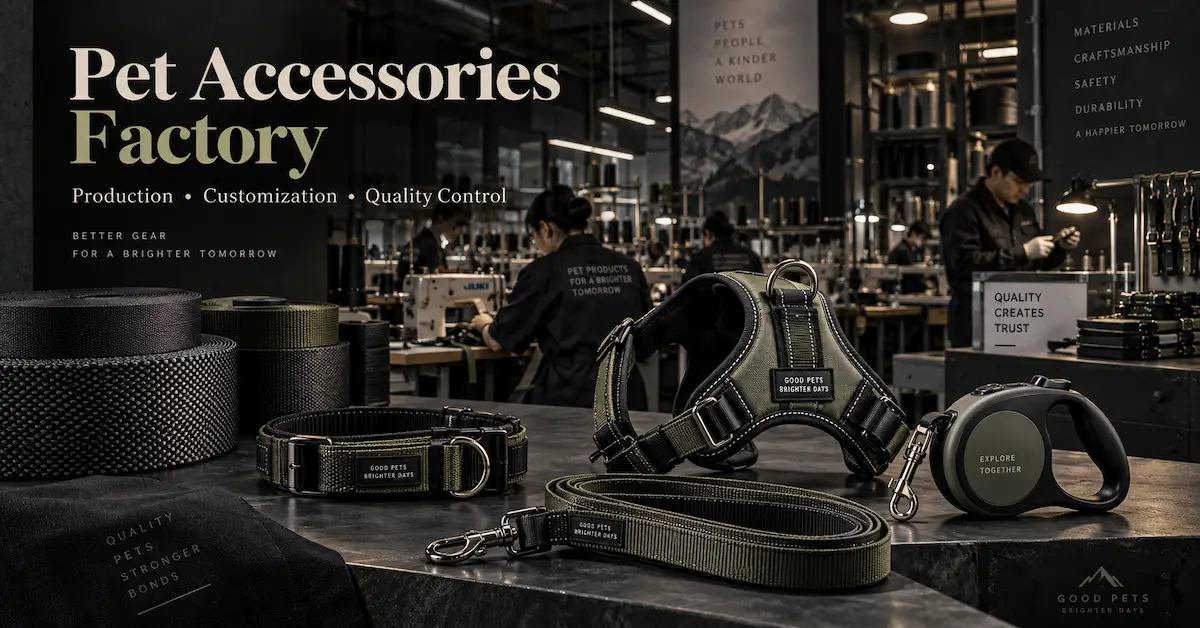
A reliable pet accessories manufacturer does more than sew webbing, attach hardware, and pack finished goods. The right manufacturing partner helps a brand convert a market idea into a repeatable product specification that can be sampled, tested, produced, inspected, packed, and reordered consistently.
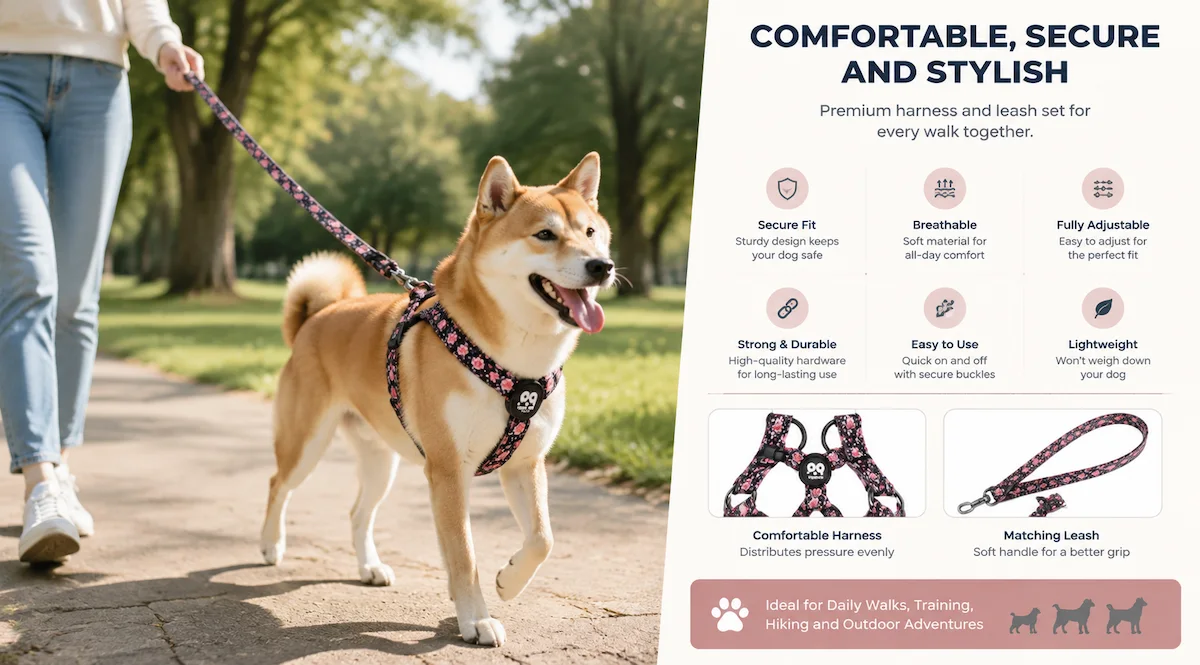
This is especially important for dog harnesses, collars, leashes, retractable leashes, and LED walking products. These accessories are used frequently and often carry pulling force. Material selection, buckle structure, stitching reinforcement, fit, visibility, packaging, and labeling all affect customer experience.
Pet brands that select a supplier based only on the lowest quotation may encounter color differences, weak hardware, inconsistent sizing, uncomfortable materials, inaccurate logos, packaging errors, or unstable repeat-order quality.
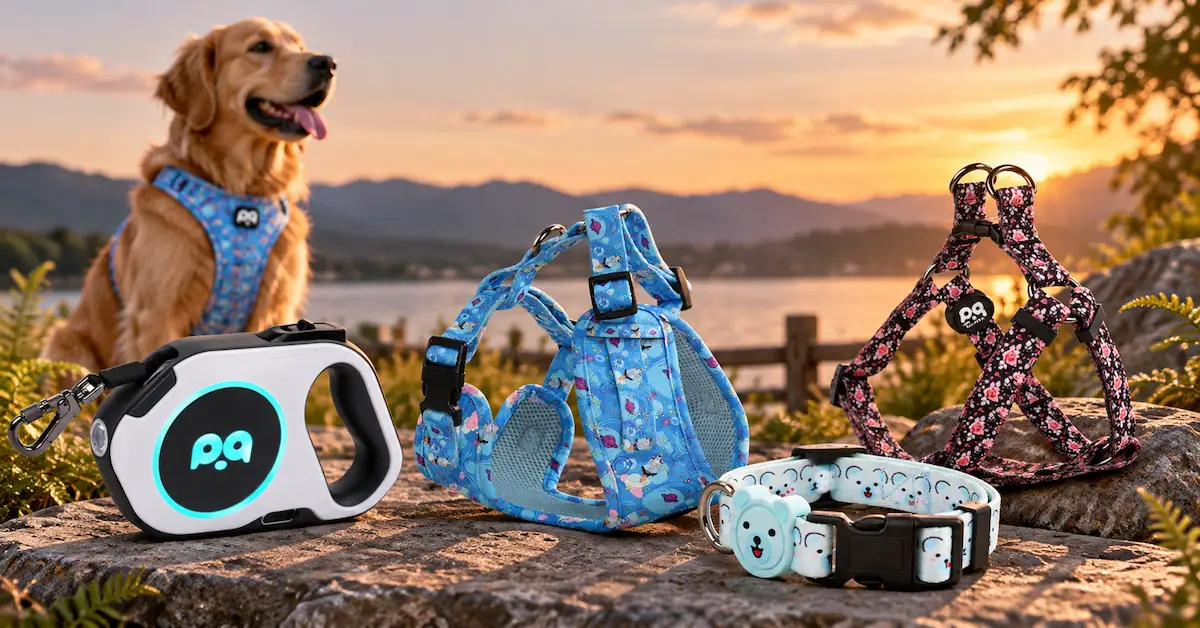
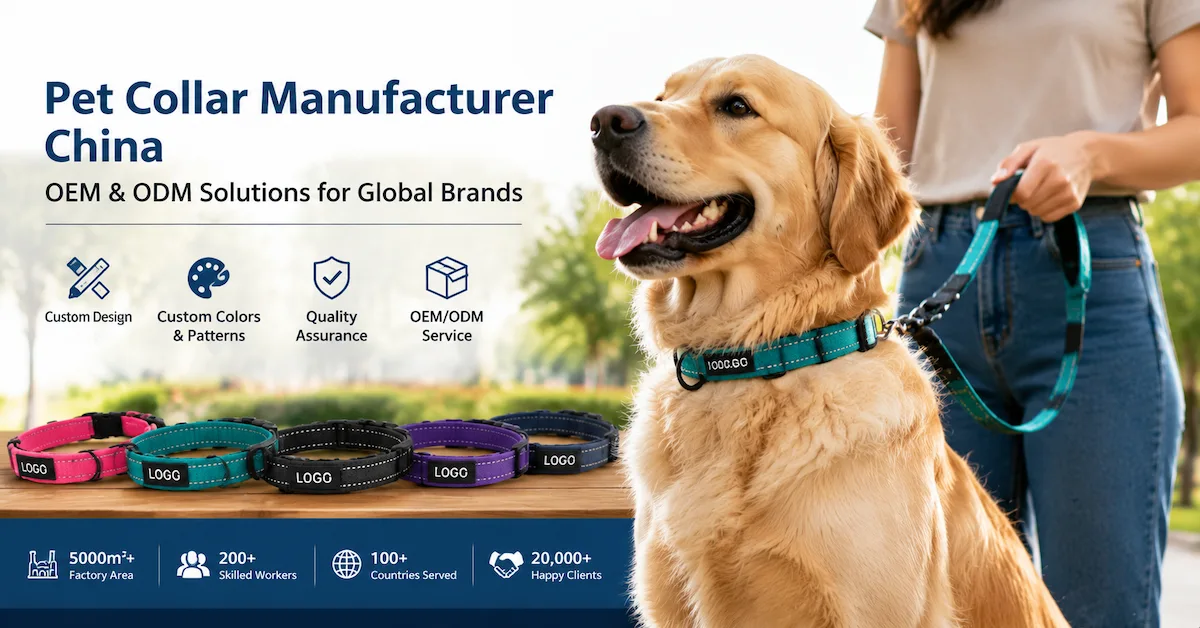
SIXPET / QQPETS is an OEM and ODM pet accessories manufacturer specializing in custom dog harnesses, dog collars, dog leashes, retractable dog leashes, LED dog harnesses, and LED dog collars. The company supports product development from material and structure selection through sampling, bulk production, quality inspection, packaging, and export delivery.
Quick Answer: What Should You Expect from a Pet Accessories Manufacturer?
A professional pet accessories manufacturer should help buyers define and control the complete product, not just provide a unit price.
The supplier should be able to support:
- Product and market positioning
- Material and component selection
- Size and structure development
- Logo, color, and pattern customization
- Physical sampling and revision
- Hardware and stitching evaluation
- Packaging and labeling
- Production planning
- In-process and final inspection
- Export packing and repeat-order management
For buyers, the objective is not simply to receive one acceptable sample. The objective is to establish a specification that can be reproduced across hundreds or thousands of units.
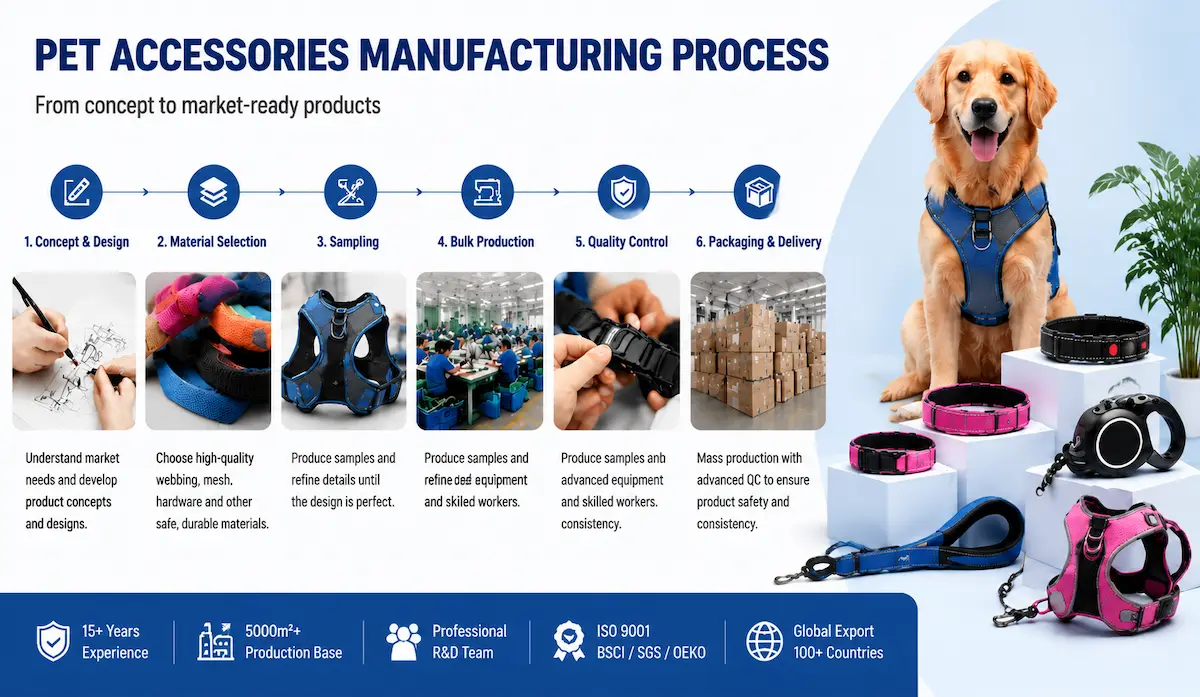
The Pet Accessory Development Lifecycle
Bringing a custom pet product to market usually involves several connected stages.
| Stage | Main Task | Buyer Outcome |
|---|---|---|
| Market Validation | Identify customer need and selling point | Clear product positioning |
| Product Definition | Select category, features, sizes, and materials | Initial specification |
| Manufacturer Selection | Evaluate factory capability and communication | Qualified production partner |
| Sampling | Produce and evaluate a physical sample | Approved reference product |
| Production Planning | Confirm materials, quantity, lead time, and packaging | Controlled order plan |
| Quality Control | Inspect components and finished products | Lower defect risk |
| Packing and Delivery | Apply labels, cartons, and shipping requirements | Market-ready inventory |
| Repeat-Order Management | Record approved specifications and revisions | Stable future supply |
Skipping one stage may create problems later. For example, unclear dimensions can cause inconsistent sizing, while an unapproved hook substitution can change strength, appearance, and cost.
Validate the Product Before Starting Production
Before contacting a manufacturer, a buyer should understand the customer problem the product is meant to solve.
A product concept should answer:
- Who will use the product?
- What dog sizes will it serve?
- Is the main benefit comfort, safety, control, style, visibility, or durability?
- Will it be sold online, through distributors, or in retail stores?
- What is the target retail price?
- Which features are essential?
- Which features are optional?
- How will the product differ from existing alternatives?
A product positioned for night walking may require reflective details or LED components. A large-dog leash may require wider webbing, reinforced stitching, and heavier hardware. A fashion collar collection may depend more on pattern quality, color consistency, and matching sets.
Clear positioning prevents unnecessary customization and helps the pet accessories manufacturer recommend a suitable structure.
Prepare a Pet Accessory Tech Pack
A tech pack is the manufacturing reference for a custom product. It helps the supplier understand the design and prepare a more accurate quotation.
For dog harnesses, collars, and leashes, the tech pack should include:
- Product name and intended use
- Product drawings or reference photographs
- Overall dimensions
- Size chart
- Webbing width and thickness
- Fabric or mesh requirements
- Buckle, D-ring, and hook specifications
- Stitching method and reinforcement areas
- Logo size and position
- Pantone or other color references
- Label and care information
- Packaging format
- Barcode and SKU requirements
- Target quantity
- Testing or inspection requirements
A leash tech pack may show the total length, handle loop size, hook type, webbing width, logo location, stitching pattern, and packaging.
A harness tech pack should also include neck and chest measurements, adjustment range, buckle positions, D-ring locations, lining, edge binding, and size tolerances.
The more precise the specification, the easier it is to compare quotations fairly.
Choose the Correct Manufacturing Model
Different buyers require different levels of product development.
Wholesale Stock Products
The buyer selects existing products with limited changes. This approach is faster and may have lower development cost, but differentiation is limited.
Private Label Production
The buyer applies its own logo, colors, labels, and packaging to an existing product structure. Private label production is suitable for brands that need a faster market entry.
OEM Production
The pet accessories manufacturer produces a product according to the buyer’s approved specifications. Materials, dimensions, hardware, colors, branding, and packaging can be customized.
ODM Development
The manufacturer helps develop or modify a product concept based on the target use, sales channel, budget, and brand positioning.
A new seller may start with private label products, while an established brand may need OEM or ODM development for exclusive collections.
Product Categories a Manufacturer Should Support
A broad product range allows buyers to build coordinated collections with one manufacturing partner.
| Product Category | Typical Customization | Main Buyer Concern |
| Dog Harness | Structure, mesh, webbing, buckle, D-ring, print | Fit, comfort, escape resistance |
| Dog Collar | Width, buckle, print, D-ring, size | Comfort, adjustment, hardware |
| Dog Leash | Length, width, hook, handle, reflection | Pulling strength and grip |
| Retractable Dog Leash | Cord, tape, housing, brake, lighting | Retraction and control |
| LED Dog Harness | Reflective area, lighting, fit, charging | Visibility and electrical function |
| LED Dog Collar | Size, light mode, battery, charging | Night visibility and runtime |
| Matching Sets | Shared color, pattern, logo, packaging | Brand consistency |
SIXPET / QQPETS supports these core categories, allowing buyers to create matching harness, collar, and leash collections or coordinated night-walking products.
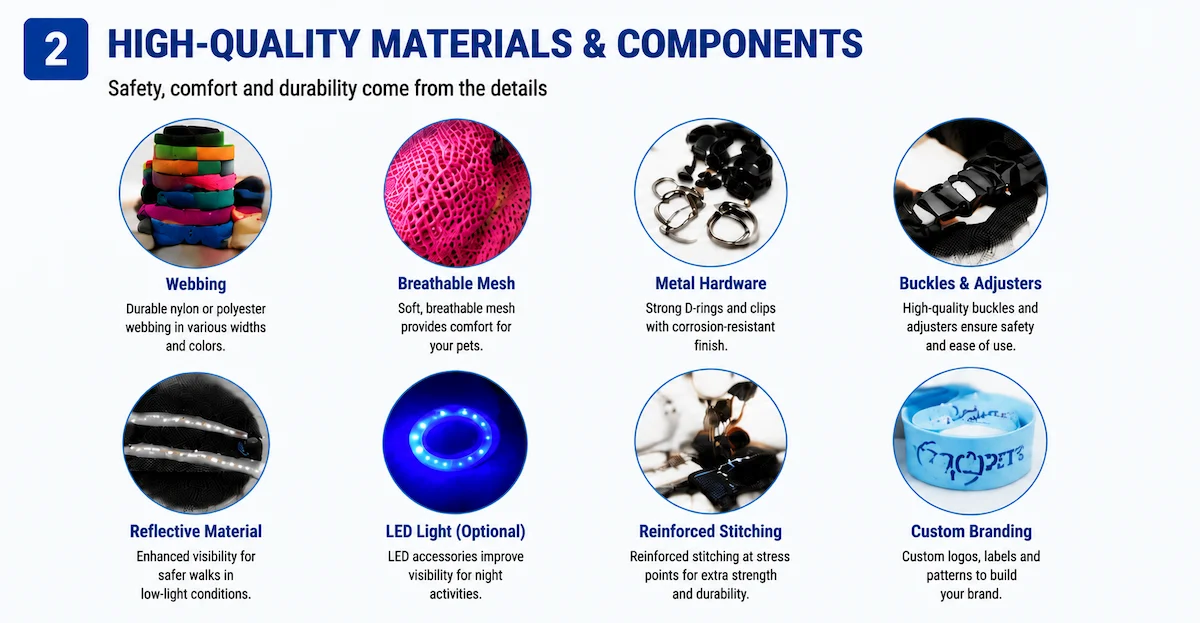
Material Selection for Dog Accessories
The material should match the product function rather than being selected only by appearance or price.
Nylon and Polyester Webbing
Webbing is widely used for leashes, collars, and harness straps.
Buyers should evaluate:
- Width and thickness
- Tensile performance
- Surface texture
- Flexibility
- Color consistency
- Abrasion resistance
- Printing compatibility
- Edge finishing
- Suitability for repeated adjustment
Polyester webbing is often selected for stable colors and printed designs. Nylon may provide a different hand feel and flexibility. The final choice should be confirmed through physical samples.
Breathable Mesh and Padding
Mesh and padding can improve harness comfort, but thicker material is not automatically better.
Buyers should check:
- Breathability
- Softness
- Compression recovery
- Edge binding
- Skin-contact comfort
- Moisture behavior
- Sewing stability
- Bulk under the dog’s legs or chest
The structure must balance comfort with fit and control.
Reflective Materials
Reflective thread, strips, piping, and webbing can improve low-light visibility.
The buyer should confirm:
- Reflective area
- Position
- Continuity
- Appearance in daylight
- Visibility under directed light
- Sewing compatibility
- Consistency across the production batch
Reflective material should support the product’s safety positioning without weakening the webbing or making the product uncomfortable.
Metal Hardware
Hooks, D-rings, sliders, and other metal components affect safety and perceived value.
Important factors include:
- Size
- Weight
- Material
- Surface finish
- Spring action
- Swivel movement
- Edge smoothness
- Corrosion resistance
- Compatibility with webbing width
- Suitability for the target dog size
Premium fabric should not be combined with undersized or poorly finished hardware.
Plastic Buckles and Adjusters
Plastic components should open and close smoothly, remain secure during use, and fit the selected webbing.
Buyers should inspect:
- Buckle engagement
- Release force
- Surface finish
- Mold quality
- Slider movement
- Compatibility with webbing thickness
- Stability during repeated operation
Material Safety and Certification Documents
For textile-based pet accessories, buyers should focus on material documentation that is relevant to the actual product.
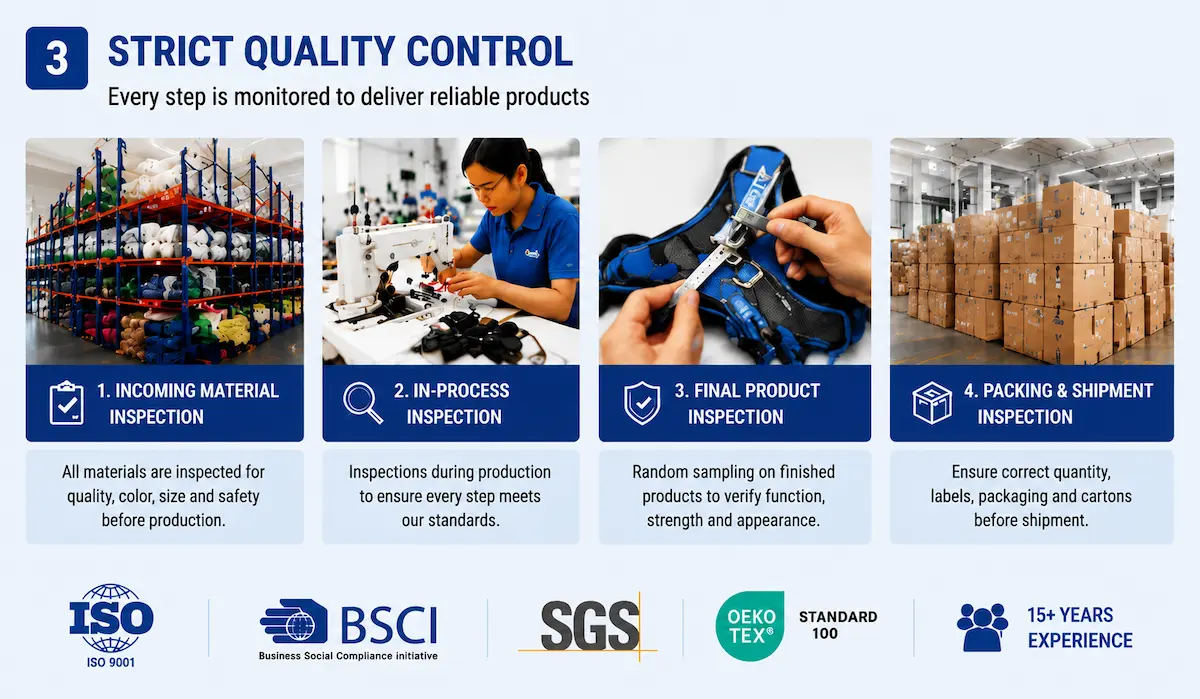
OEKO-TEX STANDARD 100 is commonly associated with textiles tested for harmful substances. When an OEKO-TEX claim is important to the buyer, the certificate number, product scope, validity, and covered components should be checked.
ISO 9001 relates to the manufacturer’s quality management system. It does not mean that every finished pet accessory has automatically passed a specific product safety test. Buyers should therefore distinguish between:
- Management-system certification
- Material certificates
- Product test reports
- Social-compliance documentation
- Buyer-specific inspection reports
SIXPET / QQPETS states that it maintains ISO 9001, BSCI, SGS, and OEKO standards. Buyers with specific market or retailer requirements should request the current documentation relevant to the selected product and destination.
Workmanship That Determines Product Reliability
Even suitable materials can perform poorly if the workmanship is inconsistent.
Cutting Accuracy
Cut parts should match approved dimensions. Inconsistent cutting can affect harness fit, leash length, and logo alignment.
Reinforced Stitching
Stress points should receive additional reinforcement.
Typical areas include:
- Leash hook connection
- Leash handle loop
- Harness D-ring area
- Harness buckle connection
- Collar buckle and D-ring area
- Traffic handles
- Multi-layer webbing joints
The stitching pattern should be defined in the approved sample or specification.
Edge Finishing
Edges should be smooth and stable. Rough or poorly sealed webbing may affect comfort and product appearance.
Printing and Branding
Heat-transfer printing, silk-screen printing, woven labels, rubber patches, and sewn labels can be used depending on the product.
Buyers should confirm:
- Color
- Position
- Size
- Alignment
- Adhesion or sewing method
- Durability expectations
- Consistency across sizes
Assembly
Buckles, hooks, D-rings, sliders, LED components, and labels should be assembled in the correct orientation and location.
Quality Control Should Begin Before Final Inspection
Final inspection alone cannot correct every manufacturing problem. Quality should be controlled throughout the order.
| Control Stage | Inspection Focus |
| Incoming Material | Webbing, fabric, mesh, hardware, colors |
| Cutting | Dimensions, direction, component count |
| Printing | Color, registration, clarity, pattern position |
| Sewing | Stitch density, reinforcement, alignment |
| Assembly | Hardware position, buckle operation, D-ring security |
| Functional Check | Adjustment, connection, retraction, LED operation |
| Packaging | SKU, barcode, quantity, labels, carton marks |
| Final Inspection | Random sampling against approved specification |
For LED products, the inspection plan may also include charging, light modes, switch function, cable or port condition, and visual consistency.
Specifications Table for Custom Pet Accessories
| Item | Typical Custom Options |
| Product Category | Harness, collar, leash, retractable leash, LED accessory |
| Main Material | Polyester webbing, nylon webbing, mesh, padded fabric |
| Webbing Width | Customized by dog size and product structure |
| Color | Stock color, Pantone reference, printed pattern |
| Hardware | Plastic buckle, metal D-ring, snap hook, swivel hook |
| Logo | Heat transfer, screen print, woven label, rubber patch |
| Safety Detail | Reflective thread, strip, piping, LED lighting |
| Size | Custom size chart and adjustment range |
| Packaging | Poly bag, hang tag, card, box, barcode label |
| Service | OEM, ODM, private label, wholesale |
| Inspection | Material, dimensions, sewing, hardware, packaging |
How to Compare Pet Accessories Manufacturers
Buyers should compare suppliers using a structured checklist.
| Evaluation Area | Questions to Ask |
| Product Experience | Does the factory specialize in the required category? |
| Production Capability | Which processes are completed in-house? |
| Materials | Can the supplier document and control materials? |
| Sampling | Is there a clear sample and revision process? |
| Hardware | Are different buckle, hook, and D-ring options available? |
| Quality Control | Which inspections occur during production? |
| Certification | Can current and relevant documents be provided? |
| Customization | Can the supplier customize size, logo, pattern, and packaging? |
| Capacity | Can it support the required order and repeat orders? |
| Communication | Are specifications confirmed clearly in writing? |
| Export Support | Can it prepare labels, cartons, and shipping documents? |
| Product Range | Can it develop coordinated collars, harnesses, and leashes? |
A low quotation is not automatically a low total cost. Rework, returns, replacements, delayed launches, and poor customer reviews can cost more than the initial saving.
MOQ, Lead Time, and Capacity Planning
Order planning should include more than the final quantity.
MOQ may be affected by:
- Product structure
- Custom webbing
- Custom printed patterns
- Logo method
- Hardware color
- Packaging
- Number of sizes
- Number of colors
- Number of SKUs
Lead time may include:
- Requirement confirmation
- Material sourcing
- Artwork preparation
- Sample production
- Sample revision
- Bulk material preparation
- Cutting and printing
- Sewing and assembly
- Inspection
- Packaging
- Shipping preparation
SIXPET / QQPETS states that its 5,000㎡ facility includes heat-transfer printing, silk-screen printing, weaving, cutting, sewing, and packaging departments. A vertically coordinated production process can help control communication between manufacturing steps.
Illustrative Buyer Scenario: Building a Night-Walking Collection
Consider a pet brand planning a reflective night-walking collection.
The initial concept includes:
- Reflective dog harness
- Reflective dog collar
- Reflective dog leash
- LED collar as an upgraded SKU
The brand should not begin only by selecting colors. It should first define:
- Dog size range
- Required reflective area
- Harness structure
- Webbing width
- Buckle and D-ring options
- Leash length and handle
- LED charging and light modes
- Logo position
- Packaging format
- Target retail price
The manufacturer can then prepare coordinated samples. The buyer can review fit, visibility, hardware, hand feel, branding, and packaging before confirming production.
This approach creates a more consistent collection than sourcing each product from a different supplier.
Common Sourcing Risks
Unclear Specifications
Words such as “strong,” “premium,” or “soft” are subjective. Dimensions, materials, hardware references, and tolerances should be written down.
Selecting by Price Alone
A lower price may reflect thinner webbing, lighter hardware, less reinforcement, or simpler packaging.
Skipping Samples
Photos cannot confirm fit, grip comfort, buckle force, hook operation, or material feel.
Too Many SKUs
Launching many sizes, colors, and styles increases inventory and quality-control complexity.
Unverified Certificates
Buyers should request current documents and check whether they apply to the relevant factory, material, or product.
Packaging Errors
Incorrect barcodes, missing labels, or poorly fitting packaging can delay retail and fulfillment operations.
Uncontrolled Component Changes
Hardware or material substitutions should require buyer approval, especially when they affect appearance, fit, strength, or compliance.
Why Choose SIXPET / QQPETS as Your Pet Accessories Manufacturer?
SIXPET / QQPETS has focused on pet accessory manufacturing since 2008 and supports international buyers with custom dog harnesses, collars, leashes, retractable leashes, LED harnesses, and LED collars.
Its production facility covers key processes including:
- Heat-transfer printing
- Silk-screen printing
- Webbing production
- Cutting
- Sewing
- Assembly
- Packaging
For buyers, this supports coordinated OEM and ODM development across several product categories.
SIXPET / QQPETS can help with:
- Material and structure selection
- Custom patterns and colors
- Logo application
- Size and fit development
- Hardware selection
- Reflective and LED product options
- Physical sampling
- Private label packaging
- Bulk production
- Quality inspection
- Export order preparation
Learn more about the company and manufacturing background on the About Us page. Review the main product categories on the Products page. Submit specifications, artwork, target quantity, and packaging requirements through the Contact Us page.
FAQ
1. What does a pet accessories manufacturer do?
A pet accessories manufacturer develops and produces items such as dog harnesses, collars, leashes, retractable leashes, and LED walking products. Services may include design support, sampling, branding, packaging, quality control, and bulk production.
2. What information should I send for a quotation?
Provide the product category, dimensions, materials, colors, logo, hardware requirements, packaging, target quantity, destination market, and reference images or drawings.
3. Can SIXPET / QQPETS produce private label products?
Yes. Private label options may include custom logos, colors, patterns, labels, hang tags, barcode labels, and packaging.
4. What pet accessories can be customized?
Dog harnesses, collars, leashes, retractable leashes, reflective accessories, LED harnesses, and LED collars can be customized according to project requirements.
5. Why is a physical sample important?
A physical sample allows the buyer to evaluate material feel, sizing, hardware, adjustment, stitching, logo placement, and packaging before bulk production.
6. How should buyers evaluate material safety?
Ask for relevant material certificates or test reports, confirm their scope and validity, and ensure the documents match the selected material and product.
7. Does ISO 9001 certify the finished pet product?
ISO 9001 is a quality-management-system standard. Buyers may still need product-specific material documents, testing, inspections, or retailer-required reports.
8. Can matching harness, collar, and leash sets be produced?
Yes. Coordinated colors, patterns, webbing, logos, labels, and packaging can be used to build matching collections.
9. What affects the price of custom pet accessories?
Pricing depends on material, size, hardware, printing, stitching, logo method, packaging, order quantity, number of SKUs, and inspection requirements.
10. How can buyers reduce manufacturing risks?
Use a detailed specification, approve physical samples, define tolerances, verify documents, control substitutions, and request inspection before shipment.
Conclusion: Choose a Pet Accessories Manufacturer That Supports Long-Term Growth
The right pet accessories manufacturer should help a brand control the complete product lifecycle—from market positioning and specifications to materials, sampling, production, inspection, packaging, and repeat orders.
Material safety is important, but it is only one part of a reliable product. Buyers must also evaluate structure, fit, hardware, stitching, printing, component consistency, documentation, packaging, and communication.
SIXPET / QQPETS supports global pet brands, wholesalers, distributors, and e-commerce sellers with OEM, ODM, and private label development across dog harnesses, collars, leashes, retractable leashes, and LED pet accessories.
To begin a project, prepare your product references, dimensions, target market, logo files, packaging requirements, quantity, and expected price level. Submit the information through the Contact Us page for evaluation and sampling.