Retractable Dog Leash Private Label: The Short Answer
A successful retractable dog leash private label program starts with a controlled product platform, not a logo added to a catalog item. The buyer must choose the intended dog-size range, tape or cord construction, housing, brake and lock behavior, hook, handle, color system, packaging, and evidence required for the target market. The supplier must then prove that the approved configuration can be assembled consistently, inspected functionally, and reproduced for future orders.
This guide addresses one commercial investigation intent: how should a pet brand evaluate and launch a private-label retractable leash without creating mechanical, quality, or inventory risk? It is written for pet brands, distributors, retailers, and e-commerce teams that want a branded walking product with a clear reason to exist. It does not treat a retractable leash as a simple strap; the housing, spring, brake, line, swivel hook, and assembly tolerances all influence the customer experience.
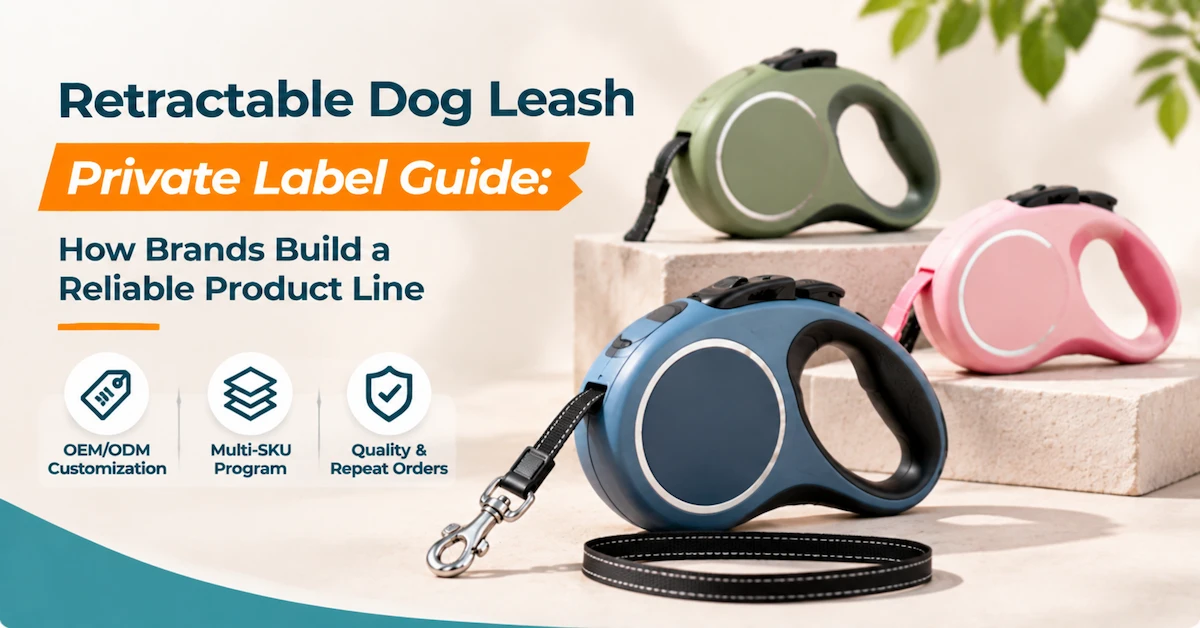
What Private Label Means for a Retractable Leash
Private label is often used loosely. For a retractable leash, it can mean applying a logo and retail packaging to an existing product, selecting an existing housing with new colors, or developing a more defined product version around a brand’s specification. The commercial responsibilities are different in each case, so the buyer should describe the level of change before asking for price and lead time.
Three practical levels of customization
| Program level | Typical changes | Best fit | Main buyer risk |
|---|---|---|---|
| Branded stock platform | Logo, label, color selection, basic packaging. | Fast market test or simple retail assortment. | Limited differentiation and less control over the mechanism. |
| Configured private label | Housing color, tape or cord, hook option, handle detail, packaging, and selected features. | Growing brands seeking a recognizable SKU family. | More components and approvals can increase MOQ and lead time. |
| Defined OEM/ODM project | New housing details, mechanical requirements, dimensions, materials, branding, and retail system. | Brands with a clear positioning and forecast. | Tooling, testing, development cost, and engineering responsibility. |
The most useful question is not “Can you add my logo?” It is “Which parts of this retractable leash can be controlled, documented, sampled, and repeated under my brand specification?” That wording moves the discussion from decoration to product ownership and quality control.
Choose the Market Position Before Choosing the Mechanism
A retractable leash private label line should solve a defined customer problem. A compact urban model, a premium comfort model, and a large-dog model cannot be evaluated with the same assumptions. The expected dog weight, walking environment, retail price, and usage frequency influence the appropriate line width, housing size, brake feel, hook, and packaging claims.
Define the buyer and use case
Document whether the primary buyer is a city dog owner, a pet-store customer, an outdoor user, a distributor, or a professional walking service. Then specify the likely dog-size range, climate, walking surface, frequency of use, and storage conditions. If the leash will be sold as part of a matching harness and collar collection, record the visual and packaging rules that must remain consistent across products.
| Positioning question | Decision to make | Product consequence |
|---|---|---|
| Target dog size | Small, medium, large, or separate size classes? | Changes line, hook, housing, brake, and warning information. |
| Walking environment | Urban pavement, park, travel, or mixed outdoor use? | Influences housing durability, handle comfort, visibility, and cleaning needs. |
| Price position | Entry, mid-market, premium, or professional? | Guides component finish, packaging, color development, and feature scope. |
| Sales channel | Pet store, distributor, marketplace, or direct-to-consumer? | Determines barcode, carton, retail education, and SKU planning. |
| Brand promise | Convenience, comfort, visibility, style, or controlled exploration? | Sets the claims that must be supported by the product and instructions. |
Positioning also protects the brand from over-customization. A first launch does not need every color, line length, and hook combination. Start with the variants that support the commercial story, then expand after the sample and initial sales data validate the fit.
Mechanical Architecture: The Parts That Need Proof
Unlike a fixed webbing leash, a retractable model contains a moving mechanism. The tape or cord extends and retracts through the front guide while a spring, spool, brake, and lock operate inside the housing. A private-label buyer does not need to design every internal part, but does need to know which characteristics are fixed, which are configurable, and which are tested.
Housing and front guide
The housing protects the mechanism and creates the first impression in the hand. Review the resin or housing material, surface finish, color consistency, seam fit, button position, and front-guide geometry. Check whether the line exits smoothly without scraping, twisting, or catching. A housing that looks attractive but creates inconsistent line movement can produce returns and negative reviews.
Tape or cord system
Tape and cord have different handling characteristics. Tape can present a broad visual surface and may be easier to read as a branded product, while cord may offer a different weight and flexibility profile. The buyer should define width or diameter, length, color, end attachment, edge finish, and the intended dog-size class. Do not publish a load or weight claim until the exact line, hook, mechanism, and test method have been confirmed.
Brake, lock, and return behavior
The button should be easy to identify and operate, but the product should not be marketed as foolproof. Evaluate the brake’s engagement, release, lock position, reset behavior, and consistency across repeated cycles. Ask the supplier how functional inspection is performed and what constitutes a failure. If the product has more than one operating mode, show the modes clearly in the packaging artwork and instructions.
Hook and swivel connection
The hook connects the retractable leash to a collar or harness and must match the target product class. Inspect gate action, spring return, swivel movement, finish, connection hardware, and attachment method. A heavy-looking hook is not enough; the complete connection, including the line end and internal anchor, should be assessed. If a private-label program offers multiple hook options, sample each option rather than approving one hook and assuming the others behave the same.
Buyer decision rule: Treat the retractable leash as a system. Upgrading the hook while leaving the line anchor, spool, or brake unchanged can simply move the weakest point to another component. Ask the supplier to explain the complete load and movement path for the selected configuration.
Brand Differentiation Beyond a Printed Logo
A private label is stronger when the customer can recognize a consistent product system. For retractable leashes, differentiation can come from a controlled color family, tactile handle, clear operating language, matching harness and collar, retail packaging, or a specific use-case story. The change must still be manufacturable and inspectable.
Build a coherent SKU family
Define a naming and color architecture before ordering components. For example, a brand may use one housing shape across small and medium models, with line colors and package accents distinguishing size classes. Another brand may use a premium housing finish for an outdoor collection and a softer palette for everyday walking. Document Pantone or physical color references, logo placement, label hierarchy, and packaging rules so a new color does not look like a separate brand.
Coordinate with collars and harnesses
Matching products can increase perceived value, but matching does not mean copying one specification into another. A collar, harness, fixed leash, and retractable leash each have different dimensions, hardware, and stress points. Approve each item independently while sharing the color, logo, and packaging system. Buyers can review Sixpet’s dog harness private-label guide when planning a broader walking collection.
Make packaging part of the product
Retail packaging should explain the line length, intended dog-size class, operating controls, warnings, care, and brand contact information accurately. A package that shows a different housing color, hook, or button mode than the product creates confusion at the shelf and in online reviews. Approve the packaging proof with the pre-production sample rather than treating it as a late graphic task.
Sampling a Private Label Retractable Leash
Sampling is the buyer’s opportunity to find mechanical and brand problems before inventory is committed. A single photograph cannot show brake consistency, return movement, handle comfort, or packaging accuracy. Request a physical sample that uses the intended housing, line, hook, artwork, and packaging whenever the project changes more than a logo.
Use a controlled sample sequence
- Platform sample: confirm housing, line, mechanism, hook, button, and basic handling.
- Configured sample: confirm selected color, line option, handle details, and hardware finish.
- Branding sample: confirm logo position, print or label quality, barcode, instructions, and package layout.
- Pre-production sample: confirm that the final components and assembly match the specification that will enter bulk production.
Mark every sample with a revision number and date. Record open questions such as button feel, logo scale, line color, package copy, or hook finish. The sample becomes a useful production reference only when its component list and changes are documented. If a supplier proposes a substitution after approval, require a new review rather than accepting “equivalent” by email.
What to inspect by hand
- Operate the brake and lock repeatedly and note engagement, release, and reset.
- Extend and retract the line through different angles without forcing the mechanism.
- Inspect the front guide for rough edges, snagging, or visible abrasion.
- Check hook gate action, swivel movement, finish, and connection security.
- Review housing seams, button alignment, handle comfort, and surface defects.
- Compare every dimension and color with the approved drawing or swatch.
- Open the retail package and verify labels, instructions, barcode, and carton protection.
Quality Control for Moving Parts and Private Label Details
Quality control for a retractable dog leash private label program must cover both appearance and function. A visually clean housing can still hide a problem with the spool or brake. Conversely, a mechanism can work correctly while the brand artwork, size label, or package instruction is wrong. Agree on inspection checkpoints before production begins.
| Inspection stage | Checks to discuss | Evidence for the buyer |
|---|---|---|
| Incoming components | Housing, line, spool or spring components, brake parts, hook, labels, packaging. | Component list, approved swatches, and substitution policy. |
| Assembly | Line routing, anchor, spring or spool behavior, button fit, housing closure. | Assembly instructions and in-process checklist. |
| Functional test | Extension, return, brake, lock, release, hook action, and abnormal noise or catching. | Defined test method, sample count, and failure disposition. |
| Appearance | Color, logo placement, surface finish, seams, scratches, and contamination. | Approved sample and visual acceptance standard. |
| Packaging | Correct model, size, line length, warnings, barcode, quantity, and carton marks. | Approved artwork, packing list, and final inspection record. |
Do not confuse a company certificate with SKU evidence
Sixpet’s published information references standards and certifications including ISO 9001, BSCI, SGS, and OEKO at the company or stated scope level. Buyers should verify the current document, issuing body, validity, and scope. A certificate does not automatically prove that every retractable leash, resin, hook, or printed package complies with every market requirement. Request product- or component-specific evidence when the destination market requires it.
Define defect priorities
A brake that does not engage, a hook that fails to close, an exposed sharp edge, a wrong line length, or an incorrect warning can be more serious than a small cosmetic mark. Define critical, major, and minor defects with the supplier and inspection company, if used. The right acceptance plan depends on the product, market, and risk tolerance; it should not be copied mechanically from a fixed leash or harness order.
MOQ, Lead Time, and Cost for Private Label Programs
Private-label pricing is shaped by both the product and the number of custom decisions. A stock housing with a logo may have a different MOQ from a new color, special finish, custom insert, or multiple packaging versions. Ask the supplier to quote the exact SKU structure rather than giving one attractive number for an unspecified product.
| Commercial variable | Questions for the supplier | Why buyers should care |
|---|---|---|
| MOQ | Is the minimum per model, color, line length, hook, or total order? | Prevents unexpected inventory commitments across a SKU matrix. |
| Development cost | Are samples, artwork setup, tooling, and packaging proofs charged separately? | Shows the real cost of launching the line. |
| Lead time | When does the clock start: brief, sample approval, deposit, or component confirmation? | Separates development from production and dispatch. |
| Price basis | Which packaging, inspection, Incoterm, and quantity assumptions are included? | Makes competing quotations comparable. |
| Reorder terms | How are the approved mechanism, color, and package maintained? | Protects margin and customer recognition over time. |
A supplier may quote a low MOQ for an existing reference product while applying a higher minimum to a custom housing color or printed box. That is normal; the buyer simply needs the condition in writing. Build a launch plan that separates hero SKUs from experimental colors and confirms whether mixed quantities are allowed.
Calculate total launch exposure
Include sample fees, artwork and tooling, custom packaging, inspection, freight, duties, marketplace preparation, and the cost of slow-moving variants. A lower unit price can become expensive if the brand orders too many colors before validating the mechanism and size positioning. A staged launch can protect cash flow while preserving a clear private-label identity.
Supplier Scorecard for a Retractable Leash Brand
Use the same written brief with every candidate and score evidence, not promises. A supplier comparison should reveal where a partner is strong, where information is missing, and which issues must be resolved before a pilot order.
| Evaluation area | Evidence to request | Decision signal |
|---|---|---|
| Product platform | Mechanism description, model options, dog-size class, and component list. | Supplier can explain what is fixed and configurable. |
| Functional control | Sample operation, inspection method, and defect response. | Brake, return, hook, and line behavior are measurable. |
| Private-label scope | Housing color, logo, labels, packaging, and matching product options. | Brand changes are realistic for the target order. |
| Sampling discipline | Revision records and pre-production sample process. | Bulk production has one controlled reference. |
| Quality system | Incoming, assembly, functional, appearance, and packing checks. | Inspection reflects mechanical and brand risks. |
| Commercial clarity | SKU-level MOQ, lead-time assumptions, price basis, and reorder policy. | Finance can model the actual launch. |
| Documentation | Material records, certificates, test reports, and packaging proofs. | Claims can be supported for the intended market. |
| Long-term fit | Product range, communication, change control, and capacity discussion. | Partner can support the next product or reorder. |
Mark “not supplied” separately from “failed.” Missing evidence is a sourcing risk even when the factory appears capable. Likewise, attractive product photos should receive no score unless they connect to the exact mechanism, branding, and quality process being purchased.
How Sixpet Fits a Private Label Walking Collection
Sixpet’s company profile describes a China-based manufacturing entity established in 2008, with printing, weaving, cutting, sewing, and packaging processes in a 5,000 m² facility. It states that the company serves customers in more than 100 countries and works across custom dog harnesses, collars, leashes, and other pet accessories. This provides the entity and manufacturing context a buyer needs when evaluating a potential private-label partner.
The published profile does not replace an order-specific retractable leash specification. The buyer must confirm the mechanism, housing, line, hook, colors, logo route, packaging, functional inspection, MOQ, lead time, and applicable documentation. A retractable model should be sampled and approved as its own product, even when it shares branding with a harness, collar, or fixed leash.
For adjacent sourcing decisions, review Sixpet’s retractable dog leash manufacturer guide for general construction questions and the retractable dog leash supplier guide for broader supplier evaluation. The dog leash OEM service guide explains how branding, sampling, packaging, and matching leash collections can be organized across a wider line.
Common Private Label Mistakes to Avoid
Starting with the logo instead of the product promise
A logo cannot compensate for an unclear target dog, weak positioning, or an untested mechanism. Define the customer problem first, then decide which product and brand changes support it.
Ordering too many variants
Different line lengths, colors, hooks, and package versions can create a large SKU matrix. Launch the variants that prove the commercial concept, then expand after the mechanism and customer feedback are validated.
Approving a housing sample without functional review
The outer shell may look correct while the brake, spool, line guide, or hook behaves differently from the expected product. Operate the sample repeatedly and record the result.
Using unsupported safety language
Do not promise that a retractable leash prevents escape, replaces training, or supports every dog. Packaging should communicate intended use, operating instructions, warnings, and the actual scope of any documented test.
Leaving repeat orders to memory
Color, hook, spring, label, and packaging substitutions can change a recognizable SKU. Store the approved sample, BOM, artwork, size or model code, and inspection criteria as the reorder reference.
FAQ: Retractable Dog Leash Private Label Buying
1. What is a retractable dog leash private label program?
It is a program in which a manufacturer produces a retractable leash for a buyer’s brand, using an existing or configured product platform and agreed branding, colors, packaging, and product specifications. The exact level of customization should be defined before quotation.
2. Can I put my logo on an existing retractable leash?
Often, yes, depending on the housing surface, printing method, label area, and supplier process. The buyer should approve logo size, position, color, durability expectations, and packaging rather than assuming every housing supports the same branding method.
3. What should I customize first?
Start with target dog size, line type and length, housing platform, brake and lock behavior, hook, color, logo, and packaging. These decisions affect function, cost, MOQ, and customer communication more than decorative details alone.
4. Is a retractable leash suitable for every dog?
No product should be marketed as suitable for every dog or every environment. The buyer should define the intended dog-size class and usage conditions, follow the supplier’s documented limits, and include clear operating and safety instructions.
5. How do I test the brake and return mechanism?
Agree on a functional method with the supplier for the exact configuration. At sample stage, operate the brake, lock, release, and return through repeated cycles and different extension positions. Record the method and result rather than publishing an unsupported cycle count.
6. What affects MOQ for private label retractable leashes?
MOQ may depend on housing color, line type, hook, logo method, packaging, model, number of variants, and component purchasing requirements. Request the minimum for each exact SKU and clarify whether colors or models can be mixed.
7. How long does a private label project take?
Timing depends on platform selection, sample revisions, custom colors, component availability, artwork, packaging, quantity, inspection, and shipping. Ask the supplier to separate sample development, component preparation, production, final inspection, and dispatch.
8. Do I need custom tooling?
Not always. Branding or color changes may use an existing platform, while a new housing shape, button, or structural feature may require tooling or engineering work. Ask which changes are platform-compatible and which create development cost or minimum requirements.
9. What documents should I request?
Request the product specification, component list, approved artwork, packaging proof, functional inspection method, applicable test reports, certificate scope, MOQ, lead-time assumptions, and change-control process. The exact documentation depends on the destination market and product claims.
10. Can the supplier make matching harnesses and collars?
A supplier with multiple pet accessory categories may coordinate colors, logos, and packaging across a collection. Each product still needs its own sample and specification because a retractable leash has mechanical components that do not exist in a collar or harness.
11. What should I send with my first inquiry?
Send your target market, customer type, dog-size class, line preference, desired length, housing or color references, logo files, packaging concept, estimated quantity by SKU, target launch date, and required testing or documentation. Mark undecided items as open questions.
12. How can I protect repeat-order consistency?
Approve a physical production reference and written BOM, including housing, line, hook, brake components, colors, logo, labels, packaging, and inspection criteria. Require written approval for any substitution or process change before the next batch.
Conclusion
A retractable dog leash private label program should be managed as a product system, not as a logo exercise. The best supplier relationship connects the brand promise to a defined mechanism, line, housing, hook, handle, packaging, inspection method, and reorder reference. Buyers who validate these points before bulk production can create a more credible product line, reduce avoidable returns, and make future variants easier to control.
Use the scorecard in this guide to compare suppliers on evidence, request a physical configured sample, and confirm SKU-level MOQ, lead time, packaging, and documentation before committing inventory. For a private-label retractable leash or coordinated walking collection, send Sixpet your specification so the team can review the product platform, branding route, sampling plan, and production requirements for your market.