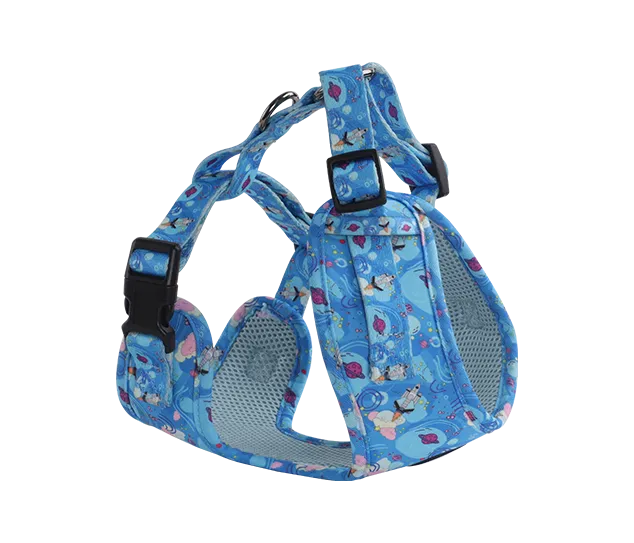
Dog training harnesses serve a different purpose than standard walking harnesses. Instead of prioritizing appearance or lightweight comfort alone, training harnesses must support leash control, behavioral correction, and repeated adjustment during training sessions. A professional training dog harness supplier designs harness systems that maintain control without restricting natural movement, ensuring consistent performance across wholesale programs.
Problem Insight: Why Standard Harnesses Often Fail in Training Scenarios
Walking Harnesses Are Not Designed for Training Control
Many harnesses sold for daily walking lack the structural features required for controlled training. Without properly positioned control points or balanced strap geometry, these harnesses cannot redirect pulling force effectively.
In training environments, this results in inconsistent leash control, which reduces training efficiency and frustrates both trainers and dog owners.
Repeated Training Use Reveals Structural Weakness
Training harnesses are typically used more intensively than regular walking harnesses. Frequent adjustments, stronger pulling behavior, and repeated tension cycles expose weaknesses in hardware, stitching, and strap stability.
When these components are not designed for training use, durability complaints quickly appear in wholesale markets.
Technical Breakdown: What Defines a Professional Training Harness Design
Multiple Control Points for Behavior Management
Training harnesses commonly incorporate dual or multi-point leash attachment systems. A front control point helps redirect forward pulling, while a back attachment allows normal walking once the dog responds correctly.
This combination gives trainers flexibility to manage behavior without changing equipment.
Balanced Load Distribution for Safe Correction
Training corrections should guide the dog rather than apply excessive pressure. Properly designed training harnesses distribute load across the chest and shoulders, preventing pressure concentration around the neck or sternum.
This balanced structure helps maintain comfort while still providing effective behavioral feedback.
Adjustable Structure for Rapid Fit Changes
Training sessions often involve adjusting harness fit to ensure proper positioning during different exercises. A professional training dog harness supplier designs adjustment systems that allow quick, stable fitting without compromising load balance.
Stable adjustment mechanisms also prevent strap slippage during active training.
Market Comparison: Standard Walking Harness vs Training-Oriented Harness
| Training Metric | Standard Walking Harness | Training-Oriented Harness |
|---|---|---|
| Control point configuration | Single leash point | Dual or multi-point system |
| Pull redirection capability | Limited | Effective front control |
| Strap stability under correction | Moderate | Reinforced for repeated tension |
| Adjustment speed during training | Slow | Quick multi-point adjustment |
| Durability under training cycles | Variable | Tested for repeated load |
| Training-related return rate | 8–14% | Reduced to 4–6% |
These differences become particularly noticeable in professional training environments and high-frequency use.
Differentiation by Dog Size and Training Purpose
Training Needs for Different Dog Sizes
Small dogs often require lighter harnesses with precise adjustment ranges to avoid restricting movement. Medium and large dogs involved in obedience or leash training require stronger structural reinforcement to handle higher pulling force.
A professional training dog harness supplier defines structural profiles for each size category to ensure consistent control performance.
Urban Training vs Outdoor Training Environments
Urban training sessions typically focus on leash discipline in controlled spaces, requiring responsive harness adjustment and moderate load capacity. Outdoor or working-dog training environments involve higher pulling forces, longer sessions, and exposure to environmental stress.
Harness systems designed for these environments incorporate stronger reinforcement and hardware ratings to maintain reliability.
Structural Design Strategies That Improve Training Performance
Control Without Restricting Natural Movement
Training harnesses must guide behavior while preserving natural gait. Manufacturers achieve this by positioning straps away from the shoulder rotation zone and distributing tension across the chest rather than restricting leg movement.
Durability Under Repeated Training Cycles
Training harnesses experience more repeated stress than standard harnesses. Professional suppliers design reinforcement patterns and hardware selection to withstand thousands of tension cycles without structural degradation.
FAQ: Practical Questions from Buyers
Q: Are training harnesses different from no-pull harnesses?
A: Yes. Training harnesses focus on behavior control and flexibility during training sessions, while no-pull harnesses primarily aim to reduce forward pulling.
Q: Can a training harness be used for daily walking?
A: Many training harnesses support both uses when designed with balanced load distribution and comfortable padding.
Q: What features are most important for training harness durability?
A: Reinforced stitching, stable adjustment hardware, and balanced strap geometry are critical for repeated training use.
Conclusion: Effective Training Harnesses Depend on Structural Design
Dog training harnesses must combine control, durability, and comfort to support consistent behavior correction. Without proper structural design, harnesses intended for training quickly fail to deliver reliable results in real use.
As a specialized training dog harness supplier, Sixpet develops harness systems with multi-point control, balanced load distribution, and reinforced durability, ensuring reliable performance for training environments and wholesale markets.
If you’d like to explore our training dog harness solutions and structural design options, you can visit our official website:
👉 https://www.sixpet.com/
If you are planning a wholesale or OEM program and want to discuss training harness structures, control systems, or production timelines, our team is ready to support you directly:
👉 https://www.sixpet.com/contact-us