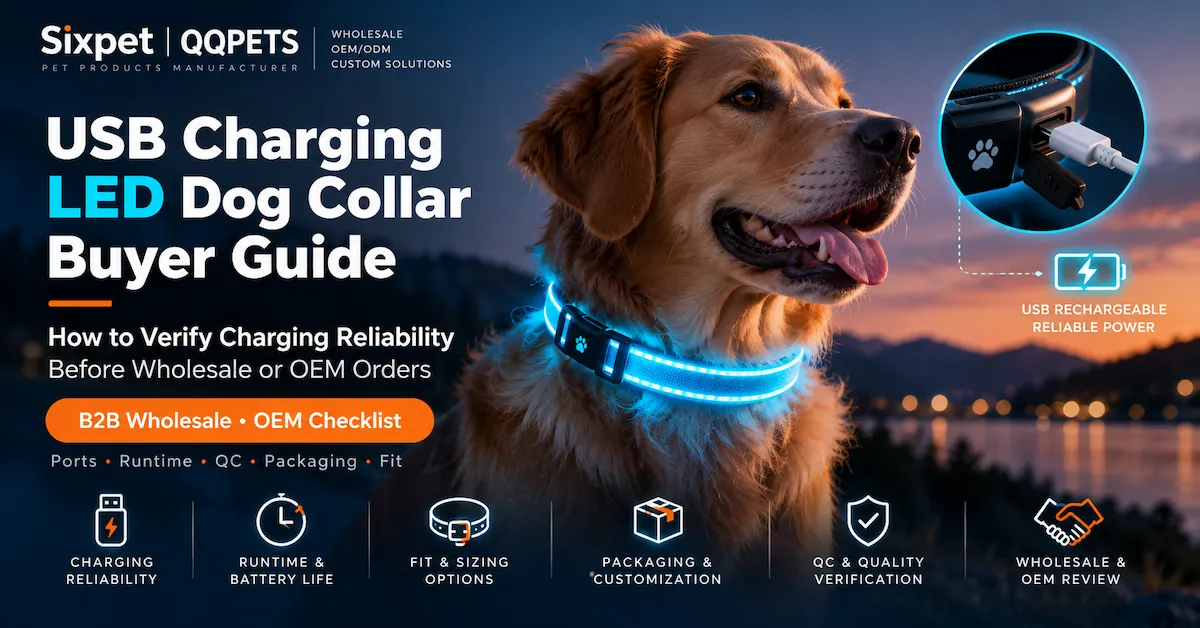
USB Charging LED Dog Collar: The Short Answer for B2B Buyers
A USB charging LED dog collar is ready for wholesale or OEM production only when the complete charging and lighting system is defined, tested, and repeatable. A buyer should approve more than a sample that turns on: confirm the exact charging interface, battery specification, charging indication, runtime by lighting mode, protection around the port, cleaning limits, finished weight, size range, packaging, and the inspection method for bulk orders.
The practical buying rule is simple: treat the collar as an electronic pet product integrated with a wearable product. The USB port, battery, switch, light module, wiring, housing, webbing, buckle, and packaging all need one controlled specification. If a supplier has not confirmed a value for the selected model, record it as “to be confirmed” instead of borrowing a number from another LED collar.
This article is written for pet brands, importers, distributors, retail buyers, e-commerce sellers, and private-label teams evaluating a rechargeable visibility product. It is a commercial investigation guide, not a claim that every USB configuration is available from every factory. The current LED dog collar product page and the pet safety accessories category should be checked with the manufacturer for the exact current model.
What Makes USB Charging Different From a Standard LED Collar?
“USB rechargeable” sounds like a single feature, but it describes only the way power is supplied to the product. It does not tell a buyer whether the port is protected, which cable is included, how charging status is shown, how long the collar operates, or what happens when the product is exposed to rain, dirt, repeated bending, or incorrect handling.
For a normal textile collar, the main commercial risks may be material consistency, stitching, buckle strength, sizing, and color. A USB charging LED dog collar adds electrical and lifecycle risks. The product must continue to charge, switch, illuminate, and fit after assembly and packing. A small change in the battery, charging board, connector, light strip, or protective cover can change the customer instructions and the finished product experience.
The product has two connected systems
The first system is the wearable collar: body material, adjustment, closure, edge finish, buckle, D-ring if present, and the position of the illuminated section. The second is the powered visibility system: battery, charging port, cable, switch, controller, LED elements, wiring, and protective housing. A reliable quotation should describe how these systems work together rather than treating the electronics as an invisible accessory.
This distinction matters in a B2B launch. A product listing may promise a rechargeable night-walking accessory, while the buyer's operations team must answer practical questions about charging, cleaning, storage, replacement, packaging, returns, and customer support. Those answers should come from the approved product configuration, not from generic wording.
It is a visibility accessory, not automatically a restraint system
Some illuminated collars are designed mainly to make a dog easier to see in low light. Buyers should confirm whether the selected finished construction is intended to hold a leash or whether it should be worn with a separate walking collar or harness. Do not infer load-bearing suitability from the presence of a D-ring or from the product's appearance. The intended use must be stated in the specification, instructions, packaging, and product listing.
Who Should Source a USB Charging LED Dog Collar?
The best buyer profile is a business that needs a rechargeable night-safety product with controlled operation and repeatable supply. The exact requirement changes by sales channel, so the quotation should begin with the market and use case.
| Buyer type | Commercial objective | Evidence to request before approval |
|---|---|---|
| Pet brand | Build a differentiated night-walking collection | Approved color, light behavior, brand application, packaging, care wording, and repeat-order controls |
| Wholesaler or distributor | Carry a simple, replenishable product range | SKU structure, size range, component continuity, carton details, MOQ by variant, and inspection scope |
| Retail buyer | Offer an easy-to-explain rechargeable accessory | Charging instructions, included cable, mode sequence, fit information, warnings, and retail-ready packaging |
| E-commerce seller | Reduce returns caused by unclear operation or fit | Product photographs, accurate dimensions, operating claims, cleaning limitations, and a sample test record |
| Private-label buyer | Launch a branded product with controlled presentation | Logo method, packaging artwork, product revision, electronic component list, sample approval, and change-notification process |
A buyer who only says “we need a bright rechargeable collar” has not supplied enough information for a reliable price or lead-time comparison. The factory still needs to know the target dog sizes, intended market, light modes, material direction, quantity by SKU, branding, package format, and environmental claims. These inputs define the actual project.
USB Charging Design: What Buyers Should Verify First
The charging interface is a small part of the collar, but it can create a large share of customer questions and early failures. Review it as a finished-product feature with a defined user process.
1. Identify the exact charging interface and included accessories
Do not treat “USB” as a complete specification. The buyer should record the connector type used by the selected model, the cable supplied with each retail unit, whether a wall adapter is supplied, how the port is opened, whether an indicator shows charging status, and how the user knows that charging is complete. If the connector or cable changes between samples and bulk production, product photography, instructions, packaging artwork, and customer support content may all become inaccurate.
The quote should also state whether the cable is packed inside the individual box, polybag, accessory pocket, or a separate carton. Missing cables create a simple but expensive failure: the collar may function correctly in inspection but arrive at retail without the item needed to use it.
2. Inspect the port location and the surrounding structure
Look at the port from the user's perspective. Can it be reached without twisting the collar? Is the opening protected from normal contact with the ground, clothing, or leash hardware? Does the cover stay closed during ordinary use? Can the user connect the cable without pulling on a flexible section or bending the collar sharply?
The port area should also be reviewed from a production perspective. A flexible collar may repeatedly bend near the charging opening. A housing may be joined to fabric or transparent material. The charging connection and its protection must survive the expected movement without leaving exposed wiring or an easily detached cover. Ask the supplier to show the relevant assembly and inspection points for the approved configuration.
3. Separate rain resistance, splash resistance, washing, and immersion
These are different use conditions. A collar that tolerates a damp evening walk is not automatically suitable for swimming or machine washing. Charging-port covers, switches, joints, cable entries, and housing seams can have different limitations from the textile body.
Before publishing a water-related claim, ask for the evidence tied to the complete finished collar and the exact model revision. The evidence should identify the test condition or use limitation clearly. If the electronics must be removed before cleaning, the package and product page should say so. If the collar must be wiped only, do not use general “waterproof” wording that encourages misuse.
4. Define the charging process in customer language
A technically correct product can still generate returns if the charging steps are unclear. The instructions should answer: what cable is used, what the indicator means, how long the product is intended to charge under the approved specification, whether the collar should be switched off while charging, what to do when the light does not appear, and how the product should be stored.
Do not print a charging time or runtime on packaging until that value has been confirmed for the selected battery and light configuration. A number copied from a different revision is not a product specification.
How to Verify Battery Runtime Before a Wholesale Order
Battery runtime is one of the most persuasive selling points of a rechargeable LED collar and one of the easiest claims to make vaguely. “Long-lasting” is not a test method. A buyer needs a repeatable way to compare samples and a clear definition of when the runtime ends.
Use a mode-by-mode test, not one generic number
Steady light, fast flashing, slow flashing, and other modes may consume power differently. If the product has more than one setting, record runtime for each applicable mode. Use the same starting condition, the same product revision, the same ambient conditions, and the same end point for every comparison.
For a buyer-side sample check, record the sample ID, product revision, charging procedure, start time, selected mode, visible changes during operation, and end condition. The end condition might be complete shutdown or a mutually agreed output threshold, but it must be defined. The purpose is not to create a laboratory claim from a casual observation. The purpose is to expose differences between samples before the order is scaled.
Check consistency across samples
One sample can demonstrate that a design works. Several samples show whether the configuration is consistent. Compare more than one item from the approved sample batch when possible. Note whether the light output appears even, whether the switch follows the same sequence, whether charging begins reliably, and whether the collar behaves differently at the minimum and maximum adjustment settings.
If the buyer needs a formal runtime statement for a destination market, retailer, or product listing, request a supplier record that identifies the exact battery, electronic module, light mode, test condition, and product revision. Do not turn an informal sample test into a universal claim.
Observe charging behavior over repeated use
A first-charge test is useful but incomplete. A private-label program should discuss whether the factory can provide a limited repeated-charge observation or another agreed validation method for the selected component set. The purpose is to identify obvious changes in charging response, switch behavior, light output, or connector stability before the product reaches customers.
The buyer does not need to promise a specific cycle count without evidence. Instead, include a “charging lifecycle validation” line in the quality plan and ask the factory what test method and acceptance criteria apply. This is more defensible than publishing a cycle number that was never measured on the finished collar.
Materials, Fit, and Comfort Still Control Product Returns
The electronics do not remove the basic requirements of a dog collar. A product may have reliable LEDs and still fail commercially because the size range is unclear, the battery housing is bulky, the adjustment area folds the illuminated section, or the edge causes discomfort.
Do not assume the body material
The selected model may use webbing, a light-transmitting band, tubing, a plastic housing, or a combination of materials. The article should not label the material as nylon, TPU, PVC, silicone, or another specification until the product sheet confirms it. The buyer should request the exact material name, construction, finish, color method, and any relevant material documentation for the selected configuration.
Material information affects more than marketing. It can influence flexibility, weight, cleaning instructions, print adhesion, color consistency, edge feel, and compatibility with the electronic module. When a buyer changes the textile or transparent section, the factory should review whether the change affects the light distribution, assembly process, or packaging.
Evaluate the collar at both ends of its adjustment range
Measure and wear-test the collar at its smallest and largest intended settings. Check whether the illuminated section becomes folded, hidden, overly compressed, or displaced. Check whether the battery or controller sits in a single heavy area. Confirm that the buckle and adjuster remain usable when the collar is tightened and loosened.
For a wholesale assortment, create size guidance based on the actual neck range rather than a generic small, medium, or large label. A product listing that uses inaccurate size language can create returns even when every unit meets the production specification.
Clarify whether it is a visibility collar or a primary walking collar
If the collar is primarily intended to improve night visibility, the packaging should avoid implying that it replaces a tested restraint product. If the finished construction is also intended for leash attachment, the buyer should request the relevant mechanical requirements and inspection method for that use. The two applications should not be merged by marketing language alone.
Bulk Quality Control for a USB Charging LED Dog Collar
A bulk QC plan should follow the product through incoming materials, assembly, finished inspection, and packaging. The exact sample size and acceptance limits need to be agreed for the project, but the inspection categories should be clear before production starts.
| Inspection stage | What to check | Why it protects the buyer |
|---|---|---|
| Incoming components | Body material, translucent parts, buckle, switch, battery, charging parts, housing, labels, and packaging | Prevents unapproved substitutions from entering assembly |
| In-process assembly | Component position, wiring or connection, protective structure, stitching or joining, size identification | Catches defects before the product is sealed and packed |
| Functional check | Charging response, indicator behavior, switch sequence, light modes, visible output, and shutdown behavior | Confirms that the electronic product works as approved |
| Mechanical and fit check | Dimensions, adjustment, closure, edge finish, housing stability, and intended leash function if applicable | Controls comfort, sizing accuracy, and use-related complaints |
| Environmental and care check | Only the agreed product-specific exposure and cleaning requirements | Prevents unsupported water or washing claims |
| Packaging check | Cable, instructions, warnings, barcode, logo, carton quantity, and packaging revision | Reduces missing accessories, listing errors, and retail confusion |
Build one approved sample record
Sample approval should cover more than “the collar lights up.” The record should include the sample revision, neck range, finished dimensions, weight, body materials, buckle, light module, battery reference, charging interface, cable, light colors, mode sequence, packaging, labels, instructions, and the checks that the buyer and factory agreed to perform.
Photographs are useful, but they should be tied to the revision and date. If the buyer approves a change after the first sample, mark the new version clearly. Multiple unlabelled samples create an avoidable dispute: purchasing may approve one configuration while production uses another.
Control component substitutions
A replacement component may look similar and still change charging behavior, runtime, light appearance, dimensions, or customer instructions. The product file should identify which components are critical and require notification before substitution. This is especially important for rechargeable products because a change in battery or charging part can affect the entire retail experience.
USB Charging LED Dog Collar vs. Disposable-Battery Collar
The better choice depends on the customer, use case, price position, and supply requirements. A rechargeable design can provide a simpler repeat-use experience, but it also introduces charging, battery, cable, and care questions. A disposable-battery design can avoid a charging cable, but it creates its own replacement, storage, and packaging considerations.
| Decision factor | USB charging LED collar | Disposable-battery collar |
|---|---|---|
| Customer routine | Requires a charging habit and clear charging instructions | Requires battery replacement and correct battery handling |
| Packaging | May need a cable, charge instructions, and relevant warnings | May need battery information, replacement instructions, and battery-related packaging controls |
| Product differentiation | Rechargeability can support a repeat-use, premium or practical positioning | Can suit buyers prioritizing simple operation without a charging cable |
| Quality risk | Port protection, battery consistency, charging response, and runtime must be controlled | Battery fit, contact stability, switch operation, and replacement process must be controlled |
| Repeat-order risk | Changes to battery, port, controller, or cable can affect the full product system | Changes to battery type or contact structure can affect operation and instructions |
| Best comparison method | Compare the same mode, charge condition, revision, and runtime definition | Compare the same battery type, starting condition, and operating mode |
For either design, do not select a supplier based only on the lowest unit price. Normalize the product specification first, then compare what is included: electronics, battery, cable, logo, packaging, inspection, sample revisions, and delivery assumptions.
OEM and Private-Label Requirements for Rechargeable LED Collars
Private-label customization and engineering customization are not the same project. Logo printing, woven labels, color selection, retail cards, and packaging may be presentation changes. A new battery, port, light layout, switch, housing, collar width, or material is a technical change that may require a new sample and a new validation plan.
Lock the product brief before artwork
Before designing the box or listing, confirm the product's intended use, neck-size range, light modes, colors, charging arrangement, cable, care instructions, material description, packaging dimensions, and any market-specific wording. Otherwise, the brand team can finish artwork around information that later changes.
Use a controlled SKU file
A repeat-order file should connect the SKU to the approved physical sample and the written specification. Include:
- Product revision and sample approval date
- Size range, finished dimensions, weight, and adjustment method
- Body material, light-transmitting material, buckle, housing, and critical components
- Battery reference, charging interface, cable, indicator, and operating modes
- Logo files, label position, package artwork, barcode, and instruction version
- Agreed inspection categories, sample method, and defect handling
- Change-notification requirement for any component or process substitution
This file reduces a common repeat-order problem: the second production run is treated as the same product by name, although the cable, battery, housing, light color, or packaging has changed. A controlled record gives the buyer a practical basis for reviewing that change.
Use factory capability as context, not as product proof
The QQPETS About Us page states that the company has operated since 2008, lists a 5,000 m² factory, 200+ professionals, production departments for heat-transfer printing, screen printing, weaving, cutting, sewing, and packaging, and says it serves 20,000+ customers in 100+ countries. The page also lists ISO 9001, BSCI, SGS, and OEKO standards.
These are useful company-level signals for evaluating a manufacturing partner. They are not, by themselves, evidence that a specific USB charging LED dog collar has a particular battery, runtime, port protection, water-resistance result, MOQ, price, or lead time. The buyer should request model-specific confirmation before using those claims in a product listing or purchase order.
Evidence discipline for this article: company-level manufacturing facts are linked to the current About page. Product-level fields that are not confirmed publicly are intentionally presented as buyer verification items: exact battery capacity, interface type, charging time, runtime, port protection, water-resistance result, body material, MOQ, lead time, packaging contents, and model-specific test reports.
Cost, MOQ, Packaging, and Lead-Time Questions
A rechargeable LED collar quotation can look inexpensive until the buyer adds the details required for a real retail launch. Cost may be influenced by the electronic module, battery, charging cable, body material, buckle, light configuration, size, colors, logo method, packaging, instruction insert, inspection requirements, and the number of variants in the order.
Ask MOQ by actual SKU, not only by total order
Three sizes, multiple body colors, multiple light colors, different logo files, and different regional packages can turn one product idea into many SKUs. Ask whether the minimum applies to the overall order, each size, each color, each electronic configuration, each logo, or each packaging version. A small initial assortment can reduce risk, but it should still be large enough for stable production and meaningful sell-through data.
The correct MOQ is the one tied to the actual configuration. A headline MOQ that excludes packaging, color splits, or component purchasing is not enough for planning.
Separate sample timing from bulk timing
Project timing may include requirement review, available-model selection, artwork preparation, component confirmation, sample production, buyer testing, revision, final approval, material purchasing, bulk assembly, finished inspection, packaging, and shipment preparation. Ask when the quoted production lead time begins. It may start after deposit, final sample approval, artwork approval, or material readiness.
For repeat orders, ask whether the approved battery, controller, light module, switch, housing, and cable remain available. A supplier may need to review the schedule when a critical component changes. A realistic plan explains these dependencies instead of promising one unqualified number.
Make the package support the actual product
Retail packaging should tell the customer what is included and how the product is used. At minimum, the buyer should review the product name, size guidance, charging method, included cable, mode operation, care limitations, warnings, barcode, logo, country or market requirements, and any claim about rain or outdoor use. Packaging changes should be approved together with the physical sample because a new connector or material can make existing instructions inaccurate.
Recommended Buyer Specification Sheet
Use the following structure when sending an inquiry. It makes supplier replies easier to compare and shows which fields are mandatory, preferred, or still open.
| Specification area | Buyer should provide or ask for | Status to record |
|---|---|---|
| Buyer and market | Company type, destination market, sales channel, target customer, and launch timing | Required before quotation |
| Product function | Visibility accessory, primary collar, or use with a separate restraint product | Required before sampling |
| Size and fit | Minimum and maximum neck range, collar width, adjustment, closure, and target dog sizes | Measure on approved sample |
| Body construction | Exact body material, light-transmitting section, buckle, housing, edge finish, and weight target | Model-specific confirmation |
| Lighting | Light colors, steady or flashing modes, switch sequence, visible coverage, and intended claim | Approve sample behavior |
| Power system | Battery reference, charging interface, cable, indicator, charging instructions, and runtime by mode | Model-specific confirmation and test |
| Environmental use | Rain, splash, cleaning, storage, and any prohibited exposure | Use only supported evidence |
| Branding | Logo method, label, color, artwork, barcode, language, and packaging format | Lock before bulk |
| Commercials | Quantity by size and color, MOQ by SKU, sample cost, price basis, and payment terms | Quote after configuration |
| Quality | Incoming, in-process, functional, fit, packaging, and component-substitution checks | Agree before production |
| Supply continuity | Component availability, repeat-order process, change notification, and inspection records | Confirm for long-term program |
Buyer Checklist Before Approving a Sample
- Record the exact sample revision and the supplier's model reference.
- Measure the neck range, width, finished weight, closure, and adjustment at both ends of the range.
- Confirm whether the collar is a visibility accessory or a primary leash collar.
- Identify the exact body and light-transmitting materials instead of using a generic material label.
- Confirm the charging interface, supplied cable, indicator, and port access.
- Check charging response and switch operation on more than one sample when available.
- Record runtime separately for every applicable lighting mode using the same test basis.
- Inspect the port cover, housing, joints, wiring protection, and areas that bend during adjustment.
- Review the product's cleaning and outdoor-use limits; do not assume immersion or machine washing.
- Check light distribution from front, side, and rear under repeatable conditions.
- Review logo, label, barcode, instructions, cable, warnings, and retail packaging together.
- Ask what happens if a battery, controller, cable, or light module becomes unavailable.
- Confirm MOQ, lead-time starting point, sample revisions, and bulk inspection responsibilities.
- Store the approved sample and the written specification as one controlled product record.
Frequently Asked Questions
What should I ask a USB charging LED dog collar supplier first?
Start with the exact model and intended use. Then ask for the battery reference, charging interface, cable, charging indicator, runtime by mode, port protection, body material, neck range, weight, cleaning limits, packaging contents, MOQ by SKU, lead time, and model-specific test evidence. A supplier should be able to separate confirmed values from items still under review.
Is a USB rechargeable LED dog collar automatically waterproof?
No. Rechargeability and water protection are separate properties. Ask what the complete finished collar is designed to tolerate and whether the claim covers rain, splashes, immersion, or cleaning. Port covers, switches, joints, and housing seams may set the real limitation. Use only evidence for the exact product configuration.
How should buyers compare LED collar runtime?
Compare the same product revision, battery, charging condition, lighting mode, ambient condition, and end point. A steady-light result should not be compared directly with a flashing-mode result. Record the test method and avoid publishing a number that is not tied to the approved configuration.
Does USB charging make a collar better than a disposable-battery design?
Not in every market. USB charging can support a repeat-use product experience, but it adds charging, cable, battery, port, packaging, and care requirements. A disposable-battery design has replacement and battery-handling requirements. The right choice depends on the target customer, price position, channel, and ability to support the operating instructions.
Can a private-label buyer customize the charging port or battery?
Possibly, but that is an engineering change rather than a simple branding change. A different port, battery, controller, or housing can affect runtime, fit, water protection, packaging, instructions, documentation, MOQ, and lead time. Request a new technical review and sample approval before treating the change as part of the original quotation.
What material should a USB charging LED dog collar use?
There is no universal answer. The material must support the intended fit, flexibility, comfort, light distribution, cleaning method, color, and assembly process. Ask the factory to identify the exact material and finish for the selected model. Do not copy a material description from another collar or assume that a transparent section has the same properties as the body.
What should be included in a bulk inspection?
Inspect the approved dimensions, adjustment, closure, material appearance, housing, switch, charging response, indicator, light modes, visible coverage, included cable, labels, instructions, barcode, logo, and packaging. Add any model-specific environmental or mechanical tests that the project requires. The inspection plan should match the approved sample and written specification.
How can a buyer reduce repeat-order failures?
Keep a controlled SKU file that identifies the approved sample, body materials, electronic components, battery, charging interface, modes, dimensions, branding, packaging, and inspection points. Require notification before a critical component or process is substituted. This makes the second and third orders measurable instead of dependent on memory or a product name alone.
Conclusion
A USB charging LED dog collar should be evaluated as a complete B2B product system. The central purchasing question is not whether the sample lights up; it is whether the approved collar will charge consistently, operate as described, fit the target dogs, protect its charging area under the intended conditions, arrive with the correct accessories and instructions, and remain repeatable when the order scales.
For wholesale and OEM buyers, the most useful next step is to send a written brief covering the target market, size range, light modes, charging preference, material direction, quantity by SKU, branding, packaging, environmental claims, and launch schedule. Then require the supplier to return the exact model specification, sample plan, QC plan, MOQ, lead-time assumptions, and any product-level evidence that supports the final claims.
QQPETS presents company-level manufacturing capability, custom dog accessory production, and international supply experience through its website. Product-level values for the selected USB charging LED dog collar still need to be confirmed directly before a purchase order or public product claim. Use the contact page or inquiry channel to submit the specification and request a project-specific reply.