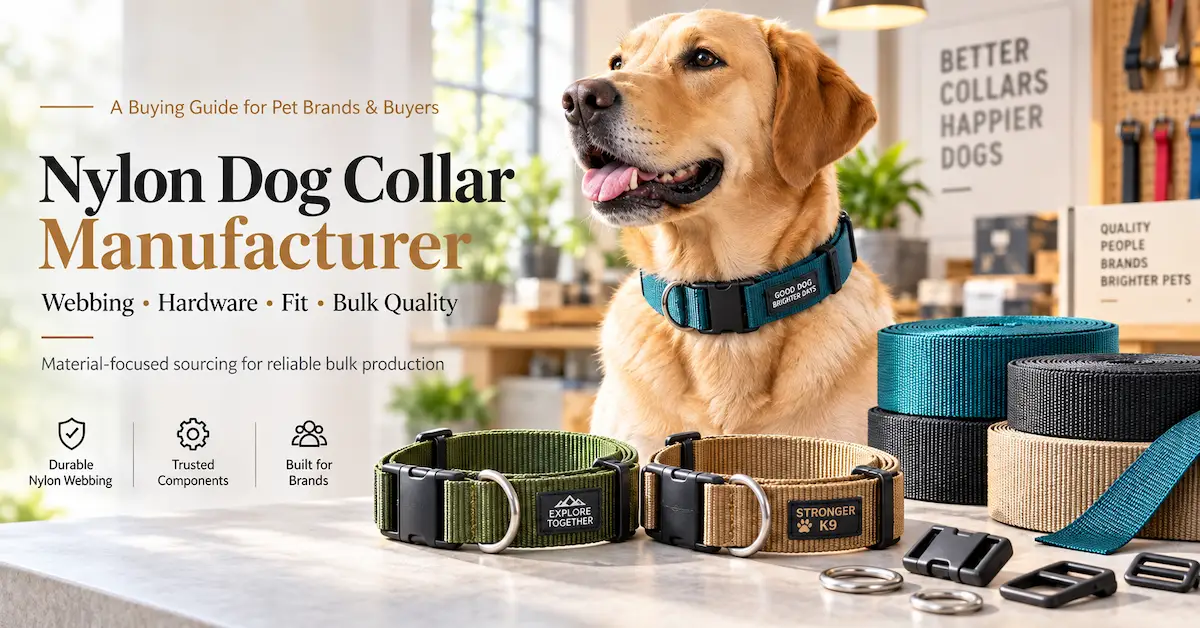
This guide focuses on the practical side of dog collar OEM branding: how to prepare artwork, define logo placement, control colors, document customization requirements, approve samples, and manage repeat orders. It is designed to help buyers move from an initial design idea to a clearer and more manageable production brief.
Planning a Branded Dog Collar Collection?
Review the current dog collar product page to understand the product direction and discuss which branding options are suitable for your specific design.
| View Dog Collar Products |
1. What Dog Collar OEM Branding Really Includes
In a private-label project, a dog collar performs two jobs. It is a functional pet accessory, and it is also a physical representation of the buyer's brand. Customers notice its color, pattern, logo, label, hardware finish, and packaging before they know anything about the manufacturing process behind it.
A collar may meet the buyer's basic expectations as a product but still fail to match the intended brand identity. A logo might be too close to a buckle, the pattern may appear different from the approved artwork, the size label may confuse customers, or the packaging may look inconsistent with other products in the collection.
For this reason, dog collar OEM branding should be managed as a group of connected specifications rather than a single artwork request.
- Product identity: collar style, intended market, target size range, SKU name, and retail positioning.
- Visual identity: approved logo, brand colors, printed pattern, logo scale, orientation, and placement.
- Construction: collar width, adjustment range, confirmed material, buckle, adjuster, ring, stitching, and finishing requirements.
- Brand identification: woven label, printed mark, hangtag, size label, barcode, or other approved identification.
- Packaging: packaging format, artwork, product presentation, barcode placement, pack quantity, and carton identification.
- Production control: approved sample, final artwork version, inspection criteria, and repeat-order records.
These elements influence one another. For example, moving a logo can change its distance from a seam. Changing collar width can affect the apparent proportions of the design. A hangtag may cover a decorative feature, while a new packaging insert may change how the product is displayed.
OEM branding is therefore most effective when the buyer reviews the complete finished product, not just the logo file or a digital mockup.
The current QQPETS dog collar product page describes a patterned collar with heat-transfer printing and a black quick-release buckle. It also presents customization options involving logos, patterns, materials, and packaging. The exact options available for a particular project should be confirmed against the requested design and specifications.
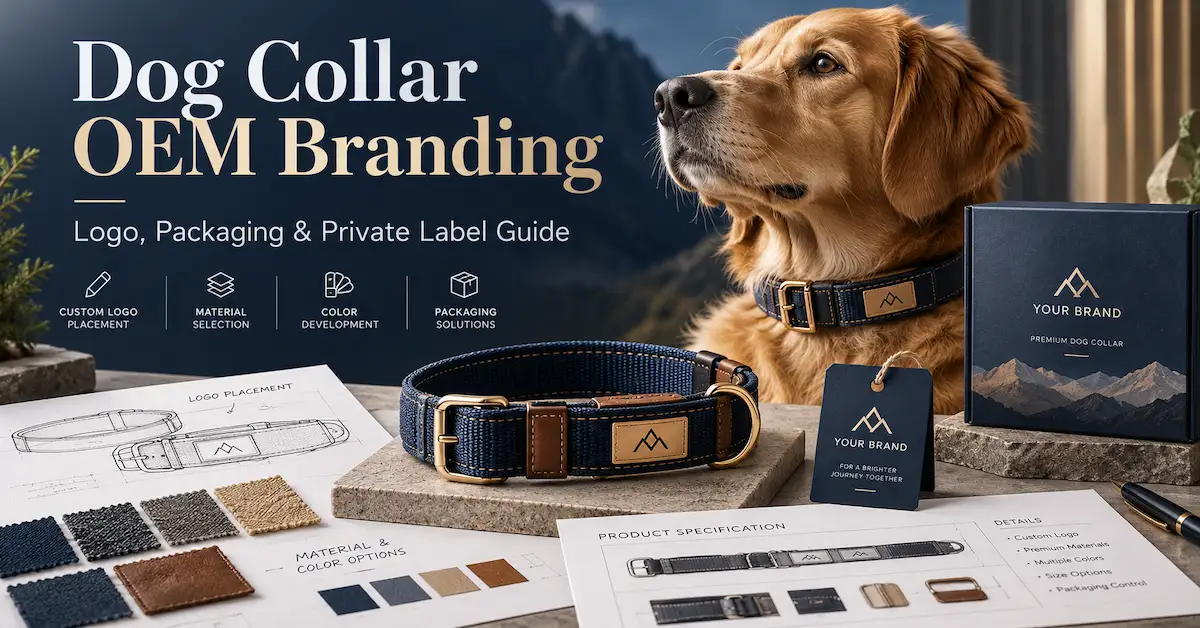
2. Start with a Brand Brief Before Sending Artwork
A common cause of unnecessary revision is starting with a logo file before the product brief is complete. A logo may be technically usable while being unsuitable for the collar's available surface, the target price level, or the intended customer.
Before requesting artwork placement or sampling, clarify what the product needs to accomplish in the market.
Define the target customer and sales channel
A fashion-oriented pet brand may prioritize recognizable graphics, coordinated colors, and distinctive product presentation. An everyday walking collection may require a simpler visual system that works across multiple sizes. An e-commerce seller may need packaging and size information that are easy to communicate through product listings, while a retail buyer may have specific requirements for labels, barcodes, or shelf presentation.
Wholesale buyers may focus on assortment planning, SKU control, pack quantities, and consistent replenishment. These differences affect the design brief and should be discussed before production details are finalized.
Turn general preferences into usable specifications
Instructions such as “make it premium,” “use our normal size,” or “put the logo in the best position” communicate preferences but leave important decisions open to interpretation.
Replace these phrases with measurable or visually verifiable requirements wherever possible.
| Brief Item | What to Define | Why It Matters |
|---|---|---|
| Product purpose | Daily walking, fashion collection, matching set, or another defined use | Establishes the design priorities and market positioning. |
| Size architecture | Required adjustable circumference, width, and size labels for each SKU | Prevents size names from replacing actual measurements. |
Defined size range, adjustment range, and SKU structure Helps prevent mismatched labels, packaging, and product listings. Logo application Approved artwork, method, scale, orientation, and position Reduces interpretation differences between design and production. Brand colors Color references, approved material samples, and visual tolerances Creates a practical reference for evaluating production samples. Hardware Component type, finish, color, dimensions, and approved appearance Keeps the collar consistent with the intended product design. Packaging Format, artwork, labels, barcode information, and packing quantity Connects the product specification with retail and warehouse operations.
A useful brand brief should also identify the decision-maker responsible for approving the sample and artwork. If the designer, sourcing manager, and merchandising team work from different files, conflicting instructions can enter the production process.
For a multi-SKU collection, create one master brief and a separate specification sheet for each collar variation. The master brief controls shared brand rules, while the individual sheets define product-specific details.
3. Choose a Logo Application Method That Fits the Collar Design
The logo application method affects appearance, placement, production requirements, and how the finished collar should be inspected. The correct choice depends on the collar construction, material, available application area, artwork, target price, and expected product use.
There is no single method that is automatically best for every dog collar OEM branding project. Buyers should compare the available methods against the actual product rather than selecting one based only on a supplier's general capability list.
Heat-transfer printing
Heat-transfer printing is relevant when the design requires printed graphics or a logo integrated into a suitable product surface. QQPETS describes heat-transfer printing on its current dog collar product page.
Before approving this method, buyers should confirm that the intended material and surface are suitable for the proposed transfer process. They should also review the finished appearance, logo dimensions, edge definition, color reproduction, and positioning on an actual sample.
Artwork that looks clean on a computer screen may contain details that become difficult to reproduce at the intended physical size. Very small lettering, narrow gaps, fine outlines, and complicated color transitions deserve particular attention.
For a repeatable result, the approved sample should show the actual application rather than a digitally added logo on a product photograph. The final specification should identify the artwork version and the approved placement reference.
Silk-screen printing
Silk-screen printing can be considered for suitable graphic applications where the product surface, artwork, and production requirements support the process. QQPETS lists silk-screen printing among its publicly described manufacturing processes.
Buyers should confirm which collar materials and shapes can accommodate the proposed print. The available printable area, design complexity, number of colors, and position relative to seams or hardware can influence the final result.
For multi-color artwork, approve a production-representative sample that shows the intended color arrangement and positioning. Do not assume that approval of a digital mockup automatically confirms the appearance of the printed product.
Woven labels and separate brand components
A woven label or another separate brand component may be suitable when the brand identity is intended to appear as a distinct element rather than as a graphic printed directly on the collar.
The buyer should specify the label dimensions, artwork, color arrangement, attachment position, orientation, and any visible stitching requirements. Label edges, seams, and contact points should also be reviewed on the finished sample.
A separate label introduces additional components and attachment requirements. Its appearance should therefore be assessed together with the collar rather than approved in isolation.
How to compare branding methods
| Method | Potential Use | Questions to Confirm |
|---|---|---|
| Heat-transfer printing | Suitable printed logos, patterns, and graphic designs | Is the material compatible? Can the required details and colors be reproduced? |
| Silk-screen printing | Suitable graphic applications on compatible surfaces | What is the printable area? How will the design and colors appear on the actual collar? |
| Woven label | A distinct brand identification element | Are the dimensions, attachment position, orientation, and finish approved? |
| Other branding components | Brand identification through approved labels or packaging elements | Is the proposed component available for the specific product and order? |
This comparison is a starting point, not a claim that every method is available on every QQPETS product. The selected method should be confirmed against the specific collar, artwork, order requirements, and approved sample.
4. Prepare Logo Artwork for Physical Production
A branding project can lose time before sampling even begins if the artwork is incomplete or unsuitable for the intended application. The solution is to provide a controlled artwork package with enough information for the production team to interpret the design consistently.
Supply the correct logo files
Whenever possible, provide a clean vector file for a logo that needs to scale across different collar sizes. Suitable vector formats may include AI, EPS, or SVG, depending on the supplier's accepted workflow. If only raster artwork is available, confirm whether its resolution is sufficient for the final print dimensions.
Include the approved color version, monochrome version where applicable, and any reversed version needed for a dark or light background. Clearly identify which version applies to each product.
Do not send several files named “final,” “final-new,” and “final-revised” without identifying which one is approved. Use a simple version convention and keep obsolete files separate from the production-ready package.
Define physical logo dimensions
Specifying only a logo file leaves its physical size open to interpretation. A logo that looks balanced on a wide collar may appear crowded on a narrower size. If the brand uses multiple collar widths, decide whether the logo should retain the same physical dimensions or scale proportionally.
The specification should record the intended width and height, orientation, reference edge, and position relative to a recognizable feature such as a buckle, seam, or label. If the collar has a repeated pattern, clarify how the logo relates to that pattern.
Use a dimensioned layout or annotated reference image whenever placement is important. A statement such as “logo near the buckle” is less reliable than a diagram that shows the approved position.
Check artwork against the finished construction
The usable branding area is determined by the actual collar design. Buckles, adjustment hardware, seams, overlapping material, and curved surfaces can limit where a graphic can be placed.
Review these points before sample approval:
- Will the logo remain visible when the collar is fastened and adjusted?
- Does the logo sit too close to a seam, buckle, ring, or other component?
- Is any part of the design likely to be hidden by overlapping material?
- Does the artwork remain legible at the smallest planned collar size?
- Will the logo orientation look correct when the collar is displayed or worn?
- Does the logo conflict visually with the pattern or other brand elements?
These checks are especially useful for brands that plan to sell several sizes or a coordinated range of printed collars.
5. Control Brand Colors Across Different SKUs
Color consistency is a practical issue in dog collar OEM branding because the same brand color may appear on printed graphics, woven labels, packaging, and other products in a collection. If each component is approved independently without a shared reference, the finished assortment may look less coordinated than intended.
Color differences can arise from the chosen material, printing process, surface texture, lighting, and production conditions. A color displayed on a monitor is not, by itself, a sufficient physical approval standard.
Use a documented color reference
Provide the color codes or other references available to your design team, then ask the supplier to confirm how those references will be interpreted for the intended material and printing process.
Where color accuracy is important, approve a physical sample under agreed viewing conditions. If the project uses multiple materials, evaluate the color on each relevant material rather than assuming that the same reference will look identical everywhere.
The purpose is not to promise that every material will produce an identical appearance. It is to establish an agreed reference and acceptable variation for the finished product.
Separate color approval from artwork approval
A design can have the correct layout but still show an unacceptable color difference. Conversely, the color may look right while the logo proportions or position are incorrect.
Record these as separate approval points:
- Artwork: correct logo, pattern, proportions, orientation, and placement.
- Color: approved color references and acceptable appearance on the intended material.
- Construction: correct collar structure, components, stitching, and finishing.
- Packaging: approved brand colors and artwork on the actual packaging material.
For a collection with several colorways, assign a unique SKU or color identifier to each approved combination. Avoid using informal descriptions such as “dark blue” or “the usual red” as the only production reference.
Set an approval process for color substitutions
If the original material or color is unavailable, the supplier should not automatically substitute another option without approval. A substitution may change the appearance of the collar, its compatibility with the artwork, or its relationship to other products in the range.
Require the proposed alternative to be documented and reviewed before it becomes part of the production specification. If a substitute is approved, record the change and update the relevant product files.
6. Define the Collar Components Alongside the Branding
Brand identity cannot be separated entirely from product construction. A collar's width, adjustment range, buckle, ring, stitching, and material all affect its appearance and intended use. If these elements change after the logo has been approved, the visual balance and product specification may also change.
Collar width and adjustment range
Define the intended collar sizes and the relevant measurement ranges for each SKU. Make sure the size labels and product listings correspond to the approved specifications.
For a multi-size collection, determine whether the artwork scales with the collar or maintains a fixed size. This decision should be made before sampling, particularly when the logo must remain visually consistent across the collection.
A supplier should not infer the full size range from a product photograph. The buyer and supplier should agree on the actual dimensions and adjustment requirements.
Buckles, adjusters, and rings
Hardware affects both product appearance and functional requirements. Buyers should document the required component type, dimensions where specified, color or finish, position, and any relevant performance requirements.
For a branded collar, the hardware should be assessed with the rest of the design. A component may have a different visual finish from the approved reference, or its dimensions may affect the available logo area.
Any change to hardware after sample approval should be treated as a specification change rather than an informal production adjustment.
Material and stitching
Record the confirmed material composition and construction for the specific collar. If a brand has a material requirement, identify it in the product specification instead of relying on a broad description such as “premium fabric.”
Stitching, edges, and component attachment should be reviewed as part of the finished product. Where strength or durability is important, establish suitable inspection or testing requirements and confirm the method with the supplier.
Do not assume that an attractive sample proves the product will meet every durability requirement. Visual inspection and performance verification answer different questions.
Keep the specification consistent with the approved design
A production-ready specification should connect the product structure to its branding requirements. This makes it easier to identify whether a proposed change affects only the artwork or also affects the collar's construction, dimensions, components, and packaging.
Need to Discuss a Custom Collar Specification?
Prepare your reference design, intended sizes, branding requirements, target quantity, and packaging preferences before contacting the supplier.
7. Build a Complete Private Label Packaging Specification
Packaging is part of the brand experience and part of the operational specification. A collar may be correctly manufactured but still create problems if the packaging uses an outdated logo, incorrect size information, an obsolete barcode, or a product description that does not match the final SKU.
For brands selling through e-commerce, packaging information may need to match product listings and warehouse records. For retail programs, packaging may also need to meet the buyer's presentation, labeling, or barcode requirements.
Choose the packaging format for the sales channel
Start by identifying how the collar will be sold, stored, shipped, and displayed. The suitable packaging format depends on the brand's requirements and should be confirmed for the actual product.
Do not assume that every packaging option is available or included in a supplier's standard offer. Ask the supplier to confirm the available formats, artwork requirements, and any additional components needed for the project.
Prepare packaging artwork separately from product artwork
Packaging and collar artwork are related, but they are not interchangeable files. Each should have its own approved version and clear identification.
The packaging brief may need to specify:
- Approved brand logo and color references.
- Product name and SKU identification.
- Size or adjustment information, where applicable.
- Barcode or retailer-required identification.
- Language requirements for the intended market.
- Required warnings or instructions, where applicable and verified.
- Packaging dimensions, format, and presentation requirements.
- Approved artwork version and revision date.
Any market-specific labeling or regulatory requirement should be verified for the destination market and product. Do not assume a single label or package is suitable for every country.
Verify packaging against the final product
Before mass production, compare the approved packaging with the final product specification. Confirm that the SKU, size information, color description, product image, barcode, and brand presentation match the actual collar.
If packaging is printed before the final product specification is approved, a later change may require rework or replacement. Coordinating product and packaging approval reduces this avoidable risk.
8. Use a Controlled Sample Approval Process
Sample approval is one of the most important control points in a dog collar OEM branding project. It gives the buyer and supplier a shared physical reference before the product moves into bulk production.
A sample should not be approved solely because it looks attractive in a photograph. It should be checked against the agreed specification and intended use.
Step 1: Check the sample against the written specification
Start by comparing the physical sample with the approved product brief. Check the collar style, dimensions, adjustment range, material, buckle, ring, stitching, logo application, and packaging requirements that apply to the specific SKU.
Use a checklist rather than relying on a general statement such as “the sample looks good.” A sample can appear attractive while still containing a misplaced logo, incorrect size information, an unapproved component, or a mismatch between the product and its packaging.
Step 2: Review the logo and color separately
Check the logo's dimensions, orientation, position, proportions, and legibility. Compare the sample with the approved artwork and placement diagram.
Then review the colors against the agreed references. Record any difference that requires correction rather than relying on memory or informal descriptions.
If the product includes several colors or patterns, identify each approved version individually. Approval of one colorway should not automatically be treated as approval of every variation.
Step 3: Inspect construction and components
Review the collar's stitching, edges, hardware, adjustment components, and attachment points. Confirm that the components match the agreed specification and that there are no obvious workmanship issues.
Where performance matters, establish the relevant test requirements separately. A visual sample inspection cannot independently establish load capacity, long-term durability, or resistance to repeated use.
Step 4: Review the complete retail presentation
Evaluate the collar together with its label, hangtag, packaging, and other approved brand elements. Verify product names, size information, SKU identification, barcode data, and artwork versions where applicable.
This step helps identify errors that might not be visible when the collar and packaging are approved separately.
Step 5: Record formal approval
Once the sample is accepted, retain an identifiable reference for future production. The record should include the sample version, approved artwork, specification sheet, relevant photographs, packaging files, and any agreed inspection criteria.
Both parties should know which version is approved for production. If revisions are needed, document the changes and review the revised sample before granting final approval.
- Product structure and dimensions match the approved specification.
- Logo artwork, placement, orientation, and size are correct.
- Color and pattern match the agreed references.
- Materials and hardware match the approved configuration.
- Stitching, edges, and finishing have been reviewed.
- Labels and packaging contain the correct information.
- Required functional tests have been defined and completed where applicable.
- The approved version is clearly recorded and available to the production team.
9. Maintain Branding Consistency During Bulk Production
Sample approval establishes the reference, but it does not eliminate the need for production controls. A bulk order may involve different sizes, colors, artwork versions, packaging components, and production batches. Without clear records, small differences can accumulate across the order.
The objective of bulk production control is to ensure that each approved SKU follows its documented specification and that any deviation is identified before the finished products are released.
Create a specification sheet for every SKU
A SKU-level specification should contain the information needed to identify and reproduce that particular collar configuration.
For example, two collars may share the same general design but use different colors, widths, hardware, or packaging. Those differences should be recorded explicitly instead of being left to interpretation.
| Specification Field | Information to Record | Production Control Purpose |
|---|---|---|
| SKU identification | Product code, style name, size, and colorway | Prevents confusion between similar products. |
| Product construction | Confirmed material, dimensions, hardware, and stitching requirements | Defines the approved physical product. |
| Branding artwork | File name, version, logo dimensions, and placement reference | Reduces the risk of using obsolete artwork. |
| Color specification | Approved color references and physical sample where required | Provides a shared basis for color review. |
| Packaging | Packaging format, artwork version, label, and barcode information | Keeps product identification aligned with the finished goods. |
| Inspection requirements | Visual checks, dimensional checks, and relevant functional tests | Defines how conformity will be evaluated. |
Control artwork revisions
Artwork changes should follow a documented revision process. A revised logo, updated pattern, or corrected label should not be introduced into production without confirming which SKUs are affected and whether the change has been approved.
Use version identifiers and dates to distinguish approved files from previous drafts. If a change affects only one colorway, make sure the other approved SKUs remain unchanged unless a broader revision has been authorized.
For repeat orders, compare the new purchase order with the previous approved specification. Do not assume that an old email attachment or an earlier product photograph is sufficient evidence of the intended configuration.
Define inspection criteria before the order begins
Inspection requirements should be agreed before production rather than introduced after a discrepancy appears. The inspection plan can include visual appearance, dimensions, logo position, color consistency, stitching, component conformity, packaging information, and other requirements relevant to the product.
If a buyer requires a specific sampling plan, defect classification, or functional test, the parties should agree on the method and acceptance criteria in writing. No particular inspection standard should be assumed to apply unless it has been specified and confirmed.
For a collar with a functional buckle or other load-bearing components, appearance checks alone may be insufficient. Define any required functional or strength testing separately and confirm that the test method reflects the intended product requirements.
10. Understand the Cost Drivers of Dog Collar OEM Branding
The cost of a branded dog collar is influenced by more than the base product. Artwork complexity, printing method, material selection, hardware, the number of SKUs, packaging, sample revisions, and inspection requirements can all affect the overall project budget.
For this reason, buyers should compare quotations against a consistent specification rather than comparing unit prices that describe different products.
Artwork complexity and branding method
A simple logo and a detailed multi-color pattern may involve different preparation and production requirements. The impact depends on the chosen application method, material, production quantity, and supplier process.
When requesting a quotation, submit the actual artwork and specify the intended placement and approximate dimensions. If the branding method has not yet been decided, ask which options are suitable for the product and request a comparison based on the same design requirements.
SKU count and colorway planning
A project with multiple sizes and colorways creates more specification and approval work than a single, standardized product. Each variation may require separate artwork, identification, packaging information, or sample review.
Before finalizing the assortment, consider whether every planned variation is necessary for the first launch. A more focused initial range can simplify artwork management, stock planning, and quality checks. The appropriate assortment depends on the buyer's market and sales strategy.
Packaging and labeling requirements
Custom packaging can introduce additional artwork, material, printing, and assembly requirements. Retail-specific labeling or barcode requirements may also affect the preparation process.
Ask the supplier to itemize packaging-related costs where practical. This helps distinguish the cost of the collar itself from the cost of brand presentation and order-specific requirements.
Sampling and revisions
Repeated changes to an already approved design can add time and cost. Some revisions may require new samples, updated artwork, replacement packaging files, or renewed approval.
Reduce avoidable revisions by consolidating feedback from design, merchandising, and sourcing teams before submitting a change request. The project brief should also identify who has authority to approve the final design.
Compare quotations on an equivalent basis
A useful quotation comparison should cover the same collar specification, branding method, hardware configuration, size range, packaging requirements, quantity, and inspection expectations.
If one quotation excludes custom packaging or uses a different component, its unit price may not be directly comparable with another quotation.
Ask each supplier to identify exclusions, assumptions, and items that remain unconfirmed. This makes commercial differences easier to evaluate before committing to an order.
11. Prepare a Clear RFQ for Dog Collar OEM Branding
A request for quotation (RFQ) should give the supplier enough information to assess the project and identify missing details. A vague inquiry often leads to a long series of clarification messages before the parties can discuss a meaningful proposal.
For a dog collar OEM branding project, organize the inquiry around the following information.
- Business and sales channel: identify whether the project is for a pet brand, e-commerce store, wholesale distribution, retail, or another channel.
- Product concept: describe the collar style, intended market position, and any reference product or sample.
- Target sizes: provide the planned size range and the required measurement information.
- Material requirements: specify confirmed preferences or ask the supplier to propose suitable options for evaluation.
- Brand artwork: attach the logo, patterns, color references, and a placement diagram if available.
- Hardware and construction: identify required buckles, rings, adjustment components, finishes, and other specifications.
- Packaging: state whether private-label packaging, labels, barcodes, or other retail elements are required.
- Quantity and assortment: list the expected quantities by SKU, size, and colorway rather than giving only one total quantity.
- Quality requirements: describe the inspections, tests, documentation, and acceptance criteria that matter to the project.
- Commercial requirements: state the target delivery window, destination market, and other purchasing requirements that need confirmation.
Not every detail must be finalized before the first conversation. If some specifications are undecided, identify them as open questions. A clear list of confirmed requirements and pending decisions is more useful than an incomplete brief presented as final.
For example, a buyer might know the intended logo and color palette but still need guidance on the most suitable application method. The RFQ can record the branding objective while asking the supplier to confirm which production options are available for the selected collar.
This approach creates a more productive discussion because both parties can distinguish design decisions from technical questions and commercial terms.
Ready to Discuss Your Dog Collar Branding Brief?
Share your artwork, target sizes, estimated quantities, product references, and packaging requirements so the project can be evaluated against a defined specification.
12. Common Dog Collar OEM Branding Mistakes
Mistake 1: Approving a digital mockup instead of the physical application
A digital mockup helps communicate the concept, but it cannot fully demonstrate how a logo will look on the actual material. Approve a representative sample when the physical appearance matters to the brand.
Mistake 2: Giving the supplier multiple conflicting artwork files
Uncontrolled files create uncertainty about which design is approved. Maintain a clear revision history and identify one production-ready version for each SKU.
Mistake 3: Using the same branding dimensions for every collar size without review
A logo that looks balanced on one size may be too large or too small on another. Define whether the logo should scale proportionally or maintain a specified physical size, then review the result across the intended range.
Mistake 4: Treating the packaging as a separate project
Packaging must match the approved product and brand identity. Check the final SKU, size information, barcode, color description, and artwork version before releasing packaging files.
Mistake 5: Changing components after sample approval without reviewing the impact
A change to a buckle, adjuster, material, or collar width may affect the logo position, appearance, dimensions, or functional requirements. Document the proposed change and determine whether a revised sample or additional verification is needed.
Mistake 6: Assuming the first order establishes a permanent production standard
A repeat order still needs controlled specifications. Keep the approved sample, artwork, component details, packaging files, and inspection criteria available for comparison when the next order is prepared.
Mistake 7: Choosing a supplier based only on the quoted unit price
A quotation should be assessed against the actual scope of work. If the branding method, packaging, inspection requirements, or component specifications differ, the quoted prices may not represent the same purchasing scope. Request clarification on what is included, which specifications are confirmed, and which items may create additional costs.
13. Build a Repeat-Order System for Private Label Dog Collars
The first approved production run should become a reference for future orders. Without a reliable record, repeat purchases can involve unnecessary artwork checks, specification questions, and uncertainty about whether a previous design has changed.
For brands planning to sell dog collars over multiple seasons, repeat-order control is part of brand management. Customers expect the product they reorder to remain consistent with the version they previously purchased, subject to any changes that have been formally agreed.
Maintain a central product record
Keep the approved specification, artwork, product photographs, material information, hardware details, packaging files, and inspection requirements in one controlled location. Assign each product a clear SKU and revision identifier.
The record should distinguish the current approved specification from obsolete versions. If a logo is updated or a component is replaced, retain the change history so the team can determine which version applies to each purchase order.
Review changes before placing a reorder
Before repeating an order, confirm that the approved specification remains valid and that no changes have been introduced to the material, hardware, branding, size range, or packaging.
If a change is necessary, document its reason and determine whether it affects the appearance, dimensions, functional requirements, testing, or retail presentation of the collar. The buyer should approve relevant changes before the revised version enters production.
Keep the product and packaging records synchronized
A collar design may remain unchanged while its packaging artwork is updated, or a new product revision may require changes to size information and identification. These records should be reviewed together to avoid inconsistencies between the product, its packaging, and its sales information.
For brands managing many SKUs, this approach also helps sourcing, merchandising, inventory, and customer-service teams refer to the same product version.
14. How to Evaluate an OEM Branding Partner
A suitable supplier should be able to discuss the proposed branding requirements in practical terms. Buyers need more than a general statement that customization is available; they need to understand which options can be applied to the selected collar and how the approved result will be controlled.
When evaluating a dog collar OEM branding partner, consider the following areas.
- Product understanding: Can the supplier explain the collar construction, component options, and limitations of the proposed design?
- Branding feasibility: Can the supplier assess the artwork, available application area, material compatibility, and logo placement?
- Specification management: Can the project requirements be recorded clearly for each size, colorway, and SKU?
- Sample approval: Is there a clear process for reviewing the physical sample and recording revisions?
- Quality requirements: Can the supplier agree on appropriate visual inspections and any necessary functional tests?
- Packaging coordination: Can the product specifications and approved packaging information be reviewed together?
- Repeat-order control: Can the approved design, components, and revisions be referenced when a reorder is placed?
- Commercial clarity: Are MOQ, sampling costs, production lead time, packaging costs, and quotation assumptions clearly stated for the specific project?
These questions help buyers evaluate the working process rather than relying on broad promotional claims. The answers should be supported by relevant product information, written specifications, samples, and other documentation appropriate to the project.
QQPETS publicly describes manufacturing processes including heat-transfer printing, silk-screen printing, webbing weaving, cutting, sewing, and packaging. Its current About Us page provides an overview of these capabilities. The availability of a particular branding method, material, component, or packaging configuration should still be confirmed for the specific collar being developed.
For an initial discussion, buyers can use the QQPETS contact page to share their product requirements and ask which options are suitable for their project.
15. Frequently Asked Questions About Dog Collar OEM Branding
1. What is dog collar OEM branding?
Dog collar OEM branding is the process of developing a collar for a buyer's brand using agreed product specifications and branding elements. Depending on the product and confirmed supplier capabilities, this may involve logo application, colors, patterns, labels, hardware selection, and retail packaging.
2. What information should I prepare before requesting a custom dog collar?
Prepare the intended collar style, target sizes, quantity by SKU, logo files, color references, preferred materials or components, packaging requirements, and any relevant inspection criteria. If some decisions are still open, identify them clearly so the supplier can help assess the available options.
3. Which logo format should I send to a dog collar manufacturer?
A vector file such as AI, EPS, or SVG is often useful for scalable artwork, subject to the supplier's accepted file formats. If you have only a raster image, confirm whether its resolution is sufficient for the intended physical dimensions. Always identify the approved artwork version.
4. Which logo application method is best for custom dog collars?
The suitable method depends on the collar material, surface, design complexity, intended appearance, and production requirements. Heat-transfer printing, silk-screen printing, and separate labels may be considered for suitable products. Ask the supplier to confirm compatibility and evaluate a production-representative sample before approving the method.
5. How can I maintain color consistency across different collar sizes?
Use documented color references and approve the appearance on the actual material. Review the logo dimensions and placement across the planned size range, and record any approved differences between SKUs. A digital color reference alone may not fully represent the finished material's appearance.
6. Can I customize the collar, logo, label, and packaging together?
These elements can be planned as one branding project, but the available options depend on the selected product and supplier capabilities. Confirm which elements can be customized, what specifications are required, and whether each component needs a separate sample or approval.
7. What is the minimum order quantity for dog collar OEM branding?
MOQ depends on the product, material, colorway, branding method, packaging, and supplier's production requirements. Do not assume one MOQ applies to every design. Request confirmation for each SKU and clarify whether quantities can be divided across sizes and colors.
8. Why is physical sample approval important before bulk production?
A physical sample allows the buyer to review the actual product construction, logo placement, color appearance, hardware, stitching, labels, and packaging. It also establishes a reference for the approved design. Any required revisions should be documented and approved before production proceeds.
9. How can I reduce inconsistencies in repeat orders?
Maintain a controlled record of the approved sample, product specifications, artwork versions, component details, packaging files, and inspection requirements. Before reordering, confirm that the same specification remains applicable and formally approve any proposed changes.
10. How do I request a quotation for private label dog collars?
Share the intended product design, sizes, quantity by SKU, logo artwork, color references, component preferences, packaging requirements, destination market, and quality expectations. Ask the supplier to clarify MOQ, sampling costs, lead time, customization availability, and any quotation exclusions before comparing offers. You can start through the QQPETS contact page.
Conclusion
Successful dog collar OEM branding depends on turning a brand concept into a controlled production specification. Clear artwork, documented colors, suitable branding methods, confirmed components, coordinated packaging, physical sample approval, and revision control all help reduce avoidable differences between the approved design and the finished order.
For pet brands, wholesalers, and private-label buyers, the most useful next step is to prepare a complete product brief and confirm the available customization options for the selected collar. Establish the approval criteria before bulk production, retain the approved reference, and use the same controlled specification for repeat orders.
To discuss a custom dog collar project, visit QQPETS Contact Us and provide your design references, target quantities, and branding requirements.
| Send a Project Inquiry |