
What Should a Flashing LED Dog Collar Supplier Help Buyers Confirm?
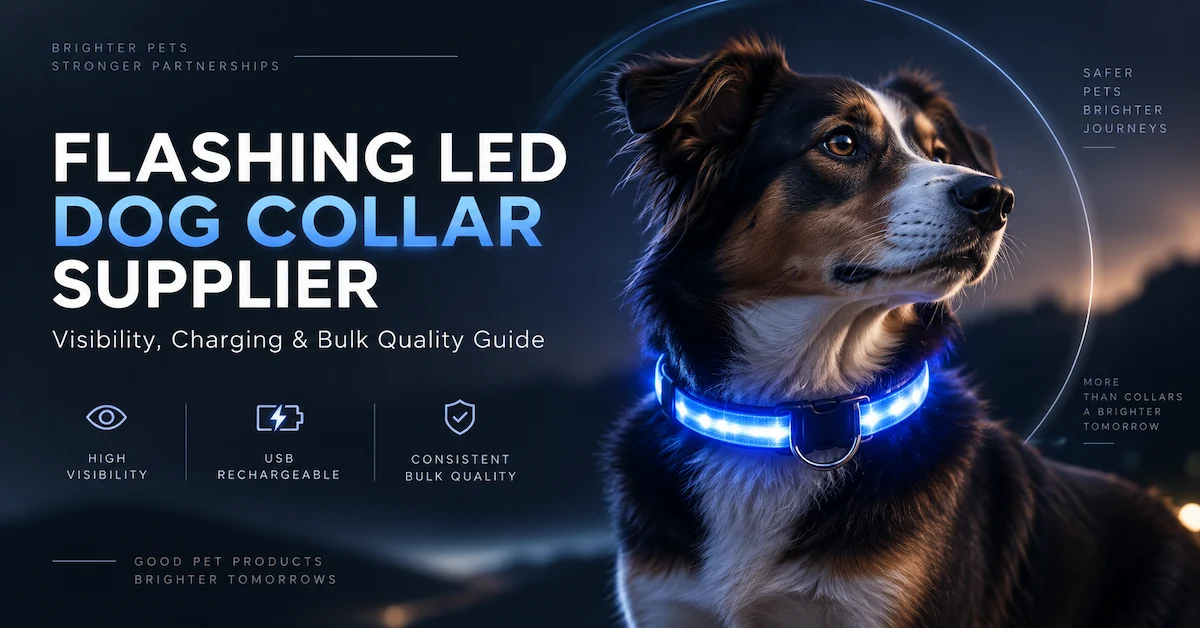
A flashing LED dog collar supplier should help buyers define a complete product specification rather than simply provide a collar that lights up in a sample video. For pet brands, importers, distributors, retailers, and e-commerce sellers, the key purchasing questions include how the collar produces light, which lighting modes are available, how evenly the light is distributed, how the product is charged, how long each mode is intended to operate, how the collar adjusts around the dog's neck, whether the electronic module affects comfort or weight, how the product should be cleaned, and how the approved configuration will be reproduced in bulk production. A flashing collar is primarily a visibility accessory for low-light walking; it should not automatically be presented as a tracking device, traffic-safety guarantee, or substitute for normal leash control. Buyers can first review the current LED Dog Collar category and the broader QQPETS product range before defining a project-specific requirement.
Who Should Source Flashing LED Dog Collars in Bulk?
Flashing LED dog collars can fit several B2B product strategies, but the purchasing priorities differ by buyer type. A pet brand may want a recognizable color palette, private-label packaging, and a coordinated night-walking collection. A wholesaler may care more about SKU simplicity, replenishment, clear operating instructions, and stable component supply. A retailer may need packaging that explains charging and light modes without creating unrealistic claims. An e-commerce seller may focus on visual differentiation, customer-friendly size information, product photography, and reducing returns caused by unclear charging or fit instructions. A flashing LED dog collar supplier is most useful when the buyer has already defined the target channel, expected price position, target dog sizes, quantity, customization level, and product claims. If the project only says “we need a bright LED collar,” too many technical and commercial variables remain undefined for a meaningful quotation.
Start With the Night-Walking Scenario, Not the Light Color
The intended use should determine the specification. For urban evening walks, a buyer may prioritize recognizable illumination from several viewing angles, simple charging, easy operation, and low added weight. For park or campground use, buyers may place more attention on continuous visibility, battery duration, environmental exposure, and ease of cleaning. For retail gift or fashion collections, color, flashing patterns, packaging, and coordinated visual design may be more important. These are different product briefs even if every item is called an LED dog collar. QQPETS' outdoor pet safety gear guide separates low-light visibility products from general walking accessories and also distinguishes powered lighting from passive reflection. That distinction matters: reflective material returns external light, while an LED collar actively emits light and therefore introduces battery, charging, switch, wiring, and electronic-component requirements.
Flashing, Steady, and Reflective Products Should Not Be Treated as the Same
A common sourcing mistake is comparing products only by how bright they appear in promotional images. Flashing LED collars, steady-light LED collars, and reflective collars work differently and create different purchasing requirements. A flashing mode can attract attention through changing light output, while a steady mode provides continuous illumination. A reflective collar does not require a battery but depends on an external light source. Buyers should decide whether the product needs one lighting mode or several and whether a reflective element is also required as part of the textile construction. Do not assume that three modes automatically make a product better; the relevant question is whether those modes match the intended use and whether the supplier can document how they operate.
| Product Direction | Main Function | Buyer Advantage | What Must Be Confirmed |
|---|---|---|---|
| Flashing LED collar | Intermittent active light | Strong visual attention in low light | Flash patterns, runtime, switch sequence |
| Steady LED collar | Continuous active light | Consistent illuminated appearance | Runtime, light uniformity, heat and power behavior |
| Multi-mode LED collar | Several lighting settings | Broader consumer choice | Mode sequence, memory function if any, runtime by mode |
| Reflective collar | Returns external light | No battery or charging requirement | Reflective material, coverage and viewing conditions |
| LED + reflective design | Combines active and passive visibility | Broader visibility concept | Construction, weight, materials and actual tested functions |
This table is a buyer comparison framework, not a statement that every configuration is currently available from QQPETS. Exact LED collar options should be confirmed for the selected project.
Build a Product Specification Before Requesting a Quote
A professional flashing LED dog collar supplier should be able to discuss a controlled specification rather than quote only from a photograph. Buyers should separate required values from supplier-proposed values and unresolved items. For example, “USB rechargeable” is not a complete specification. The project may also need to define the charging interface, supplied cable, charge indicator, expected charging time, battery configuration, operating time by light mode, and packaging instructions. Similarly, “adjustable collar” does not define neck range, collar width, weight, fastening method, or whether the electronic section affects adjustment.
| Specification Area | Information to Confirm | Why It Matters |
|---|---|---|
| Collar type | Full collar, illuminated band, or visibility accessory | Determines how the product is used |
| Neck range | Minimum and maximum adjustment | Controls size suitability |
| Width and weight | Collar dimensions and finished weight | Influences fit and product positioning |
| Lighting area | Full ring, partial strip, or defined sections | Influences visible appearance |
| Light modes | Flashing, slow flashing, steady or other modes | Defines user operation |
| Light colors | Fixed or selectable colors | Affects SKU planning |
| Battery | Battery type and rated specification | Influences charging and runtime |
| Charging | Interface, cable and indicator behavior | Important for retail instructions |
| Runtime | Duration under each tested mode | Prevents vague “long-lasting” claims |
| Materials | Webbing, tubing, housing, buckle and electronics | Defines construction |
| Weather exposure | Intended exposure and limitations | Influences customer instructions |
| Cleaning | Wiping, hand cleaning or removable electronics | Prevents misuse |
| Packaging | Instructions, warnings, barcode and accessories | Supports retail readiness |
The final purchase specification should use model-specific values. If a value has not been confirmed, mark it as “to be confirmed” instead of copying a number from another product.
Light Distribution Matters More Than a Single Brightness Claim
Brightness is only one part of an LED collar's visibility. Buyers should also evaluate where the light is visible around the neck and whether the output appears reasonably consistent around the intended illuminated section. A powerful LED concentrated in one point may look bright in a close-up image but provide a different effect from a collar designed for broader visible coverage. During sample evaluation, photograph or video the collar from the front, sides, and rear under repeatable conditions. Keep the distance, ambient lighting, camera settings where practical, battery state, and selected mode consistent when comparing samples. Do not convert an informal outdoor observation into a universal visibility-distance claim. If a product is to be marketed with a specific distance or performance statement, the flashing LED dog collar supplier should be asked what test method, conditions, and product version support that claim.
Runtime Must Be Specified by Lighting Mode
A single “battery life” number can be misleading when a collar includes multiple modes. Flashing, slow flashing, and continuous light may consume power differently, so buyers should request runtime information for the actual mode being evaluated. Ask how runtime is defined: until complete shutdown, until output falls below an agreed level, or according to another method. Also confirm whether the measurement starts from a fully charged product and under what environmental conditions it was taken. For a wholesale program, create a simple sample test sheet recording sample ID, charging duration, selected mode, start time, observed changes, and end condition. This produces more useful purchasing information than accepting a generic statement such as “works all night.”
Charging Design Affects Both Product Experience and Returns
Rechargeable LED pet products combine textile or plastic construction with consumer electronics, so charging instructions must be easy to understand. Check whether the charging port is accessible without damaging the collar structure, whether the connector feels secure, whether there is a clear indication of charging status, and whether the supplied cable and packaging instructions match the product. If the electronics can be removed before cleaning, that procedure should be explained. If they cannot be removed, cleaning limitations become even more important. Buyers should also decide whether the charging cable is included in every retail unit and how it will be packed. A flashing LED dog collar supplier should confirm these details before bulk production because a small change in cable, charging interface, or module can affect packaging, instructions, customer support, and repeat-order consistency.
Fit and Weight Still Matter Even When Lighting Is the Main Feature
LED functionality does not remove the basic requirements of a collar. Buyers need to verify neck adjustment, collar width, buckle or closure, edge finish, weight distribution, and how the electronic module sits around the dog's neck. A bulky battery or lighting housing can change how an otherwise familiar collar feels. Evaluate samples across the intended adjustment range and check whether the illuminated section becomes folded, covered, twisted, or compressed at smaller settings. If the product includes a D-ring or other leash connection, confirm whether the complete collar is actually designed and tested for that function. Some illuminated products are intended primarily as visibility accessories and may be used alongside a separate walking collar or harness. Do not assume that any LED ring or illuminated collar is automatically suitable as the dog's primary restraint product.
Materials and Electronic Components Must Be Evaluated Together
A custom LED collar is not simply a normal collar plus a light. Textile materials, plastic housings, translucent lighting sections, switches, electronic boards, batteries, charging components, buckles, rings, wiring, and protective structures interact within the finished product. A buyer should ask which parts are produced or assembled by the factory and which are sourced from specialist suppliers. More importantly, ask how incoming components are identified and how substitutions are controlled. A lighting module that looks nearly identical may have different runtime, brightness, charging characteristics, dimensions, or durability. QQPETS describes printing, weaving, cutting, sewing, and packaging capabilities on its About Us page; for an electronic collar project, buyers should additionally confirm which electronic assembly and validation steps apply to the exact proposed product.
Water Resistance, Washing, and Outdoor Use Need Separate Definitions
“Waterproof” is often used too broadly in consumer-product marketing. A collar that tolerates light rain is not automatically suitable for immersion, swimming, or machine washing. Ask what exposure the finished configuration is designed for and what evidence supports that description. Charging ports, switch areas, electronic housings, joints, and cable entries may have different exposure risks from the textile sections. If the product is intended for rainy walks, define that scenario. If customers are expected to wash the collar, clarify whether electronic parts must be removed and how the collar should be dried. Product packaging should communicate those limitations clearly. Avoid extending a test result from an individual electronic component to the complete collar unless the finished assembly was evaluated under the relevant conditions.
Quality Control Should Cover Both Electronics and Collar Construction
A flashing collar requires a broader QC plan than a simple printed textile collar. Incoming inspection may cover webbing, housings, switches, LEDs, batteries, charging components, buckles, and packaging. During assembly, the factory may need to verify component orientation, electrical connection, light operation, sewing or joining, and size identification. Finished-product checks should include the approved dimensions, appearance, lighting modes, switch operation, charging response, labels, included accessories, and packaging. Model-specific mechanical or environmental tests should be defined separately where required. QQPETS' general pet accessories supplier guide discusses material, production, finished-product, and packaging checks as different stages; the same staged logic is especially useful when the product combines pet-accessory construction with electronic functions.
Sample Approval Should Cover More Than Whether the Collar Lights Up
When approving a sample, create a record that can later be used by purchasing, manufacturing, inspection, and repeat-order teams. Record the sample revision, neck range, width, finished appearance, materials, component references, buckle, light colors, mode sequence, charging interface, included accessories, packaging, labels, and agreed functional checks. Confirm how the product behaves after repeated switching and charging observations that are relevant to the project. If changes are made after the first sample, identify the new version clearly rather than allowing several different configurations to be described as “approved.” This revision control is particularly important for private-label products because artwork, color, packaging, electronics, and textile construction may be changing at the same time.
Compare Supplier Offers on the Same Configuration
One supplier may quote a basic single-mode collar while another includes multiple lighting modes, a different battery, retail packaging, a charging cable, custom branding, and additional inspection. Their prices are not directly comparable. Before comparing offers, place the same requirements into each quotation request.The table below illustrates how to structure supplier comparison without assuming specific QQPETS models.
| Comparison Item | Supplier A | Supplier B | Buyer Decision |
|---|---|---|---|
| Neck size range | Confirm | Confirm | Must match target assortment |
| Lighting modes | Confirm | Confirm | Compare actual required modes |
| Runtime by mode | Confirm | Confirm | Require same test basis |
| Charging interface | Confirm | Confirm | Match retail requirements |
| Material and buckle | Confirm | Confirm | Compare equivalent construction |
| Weather exposure | Confirm | Confirm | Check complete-product evidence |
| Logo/customization | Confirm | Confirm | Define exact branding method |
| Packaging | Confirm | Confirm | Include cable/instructions if required |
| MOQ by SKU | Confirm | Confirm | Evaluate style/color/size split |
| Sample approval | Confirm | Confirm | Required before bulk production |
| Repeat-order control | Confirm | Confirm | Protect specification consistency |
MOQ Should Be Discussed by SKU, Not Only by Total Quantity
A wholesale LED collar program can quickly become complex. Three collar sizes, four light colors, two body colors, and two packaging versions can create many combinations even before custom artwork is added. A flashing LED dog collar supplier should therefore explain whether minimum quantities apply per model, size, color, light configuration, logo, or packaging type. Buyers launching a new range may reduce risk by limiting the initial number of variants and expanding after sell-through data becomes available. The lowest possible MOQ is not automatically the best purchasing strategy if the order becomes too fragmented for stable production or too expensive per SKU.
Lead Time Should Separate Samples, Components, and Bulk Production
Electronic pet accessories can involve more dependencies than a standard textile item. A project schedule may include requirement confirmation, electronic configuration, artwork, sample preparation, buyer testing, revision, component purchasing, bulk assembly, functional inspection, packing, and shipment preparation. Ask when the quoted production lead time starts. It may begin after deposit, after final sample approval, after artwork approval, or after key components are available. For repeat orders, verify whether the same battery, light module, switch, charging component, and housing remain available. A realistic schedule is more useful than a single aggressive lead-time promise that does not explain these dependencies.
OEM and Private Label Customization Should Be Separated From Engineering Changes
Logo printing, color adjustment, labels, retail cards, and packaging are different from changes to battery capacity, lighting layout, switches, housings, or collar construction. The first group may be mainly branding work, while the second can affect function and require new engineering or validation. Buyers should ask the supplier to classify requested changes accordingly. QQPETS supports custom pet-accessory development through its company and customization information, but the exact scope of an LED collar project should still be confirmed model by model. A private-label buyer should also define artwork ownership, approved logo files, packaging versions, and whether any design exclusivity has been separately agreed.
Control Repeat Orders With a Product Version Record
Repeatability is a major consideration when choosing a flashing LED dog collar supplier. The second and third production runs should not depend on the sales representative remembering what happened in the first order. Keep one controlled record linking the SKU to the approved physical sample, dimensions, materials, electronic components, battery, light modes, charging interface, artwork, packaging, instructions, labels, and inspection requirements. If a component becomes unavailable, require notification and review before substitution. A replacement part that fits physically may still change light appearance, runtime, charging behavior, or customer instructions. Change control protects both product consistency and the buyer's existing product listing.
What Should Buyers Send Before Requesting a Quote?
A useful inquiry should include the intended market, product type, target neck-size range, preferred collar width, quantity by size and color, requested light colors and modes, charging preference, material direction, logo or artwork files, packaging type, required instructions, expected weather-use description, target launch schedule, and any retailer or destination-market documentation requirements. If you already sell an LED collar, provide the existing sample or photos and identify the issues you want to improve, such as uneven lighting, difficult charging, excessive module weight, unclear sizing, inconsistent colors, or repeat-order component changes. Buyers can submit these requirements through the QQPETS contact page so the exact configuration can be evaluated rather than requesting only a generic wholesale price.
Frequently Asked Questions
1. What should I check first when selecting a flashing LED dog collar supplier?
Start with the complete product specification: collar type, neck range, lighting configuration, battery, charging method, materials, intended environment, packaging, and quantity. Then determine how the supplier samples, tests, manufactures, and controls those items in repeat production.
2. Is a flashing LED dog collar better than a reflective collar?
They serve different visibility functions. An LED collar actively emits light and requires a power source, while reflective material relies on external light. The appropriate product depends on the intended walking environment and product strategy rather than one option being universally better.
3. How many lighting modes should an LED dog collar have?
There is no universal requirement. A product may use flashing, slow flashing, steady light, or another sequence. Buyers should choose modes that fit the intended customer experience and request clear operating instructions and runtime information for the actual configuration.
4. How should battery runtime be compared?
Compare runtime using the same lighting mode, charge condition, sample configuration, and test method. Avoid comparing one supplier's continuous-mode result with another supplier's intermittent-flashing result as though they were equivalent.
5. Can an LED dog collar be used as the main leash collar?
Do not assume this. Confirm whether the specific construction and attachment point are designed and validated for leash connection. Some illuminated products may primarily function as visibility accessories and should be used with another walking collar or harness.
6. Does water resistance mean the collar can be submerged or machine washed?
No. Rain exposure, splashing, immersion, hand washing, and machine washing are different conditions. Follow the model-specific care and exposure instructions supplied for the finished product.
7. Can a flashing LED dog collar be private labeled?
Branding options may include logo, color, labels, artwork, and packaging depending on the product platform. Electronic or structural changes should be evaluated separately because they can require a new sample and additional validation.
8. What affects the MOQ for wholesale LED dog collars?
MOQ can depend on the collar design, sizes, textile colors, lighting colors, electronic configuration, custom logo, packaging, and component purchasing requirements. Ask for the minimum by actual SKU rather than only the total order.
9. What should be included in LED collar quality inspection?
Inspection should cover agreed dimensions, appearance, closure or adjustment, lighting modes, switch function, charging response, accessories, labeling, and packaging, together with any model-specific mechanical or environmental requirements agreed for the project.
10. How can buyers reduce risk on repeat LED collar orders?
Keep a controlled specification linked to the approved sample and record the key textile and electronic components, lighting modes, battery, charging interface, artwork, packaging, and inspection requirements. Require review before relevant component substitutions or design changes.
Conclusion
Choosing a flashing LED dog collar supplier is ultimately a product-definition and quality-control decision, not simply a comparison of brightness, flashing colors, and price. Pet brands and distributors should confirm how the collar is intended to be used, how it fits, how the lighting modes operate, how charging and runtime are defined, how electronic components are integrated with the collar structure, what environmental and cleaning limitations apply, and how the approved sample will be reproduced during bulk and repeat production. QQPETS' broader product and manufacturing information can be reviewed through its product range, About Us page, and LED Dog Collar category. For a project-specific evaluation, contact QQPETS with your size range, target market, lighting modes, quantity breakdown, branding files, packaging requirements, and expected application so the available configuration, sampling requirements, MOQ, and production scope can be confirmed.