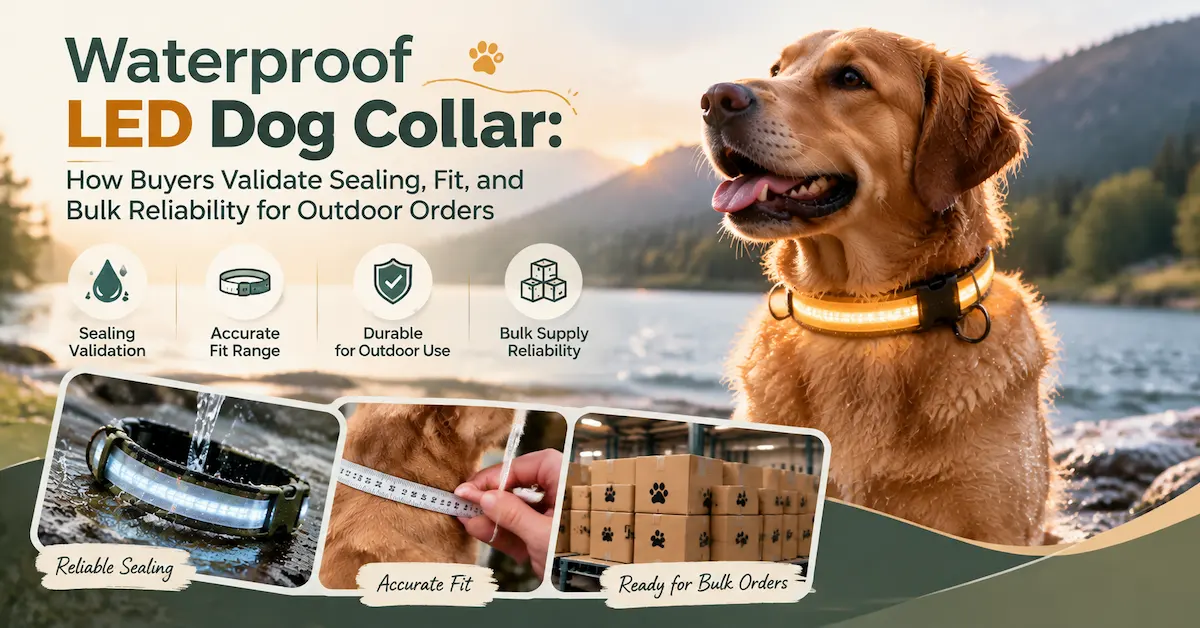
Waterproof LED Dog Collar: The Short Answer
A waterproof LED dog collar should be launched from a written product specification, not from the word “waterproof” on a supplier quotation. The specification must define the intended weather scenario, permitted exposure, light function, neck-size range, body and electronic components, cleaning limits, charging or storage instruction, packaging wording, and evidence required before release.
The central rule is alignment: the product claim, the physical construction, the test or inspection record, and the customer instruction must describe the same configuration. “For light rain” is not the same as “safe for immersion”; “wipe clean” is not the same as “machine washable.” A supplier should mark every field as confirmed, proposed, or still requiring a project-specific decision.
This article has one primary search intent: helping a retailer, importer, or pet brand write a usable specification for a waterproof LED dog collar before requesting a comparable OEM quotation. It is not another general guide to LED brightness, USB charging, flashing modes, or ordinary wholesale QC. Those decisions may appear in the specification, but the page focuses on claim control, customer expectations, and rainy-climate assortment planning.
Why Rainy-Climate Retailers Need a Different Product Brief
Wet-weather products create a communication problem before they create a factory problem. A buyer may think “waterproof” means the dog can wear the collar through any rain, rinse, or bath. The supplier may use the same word to describe a covered light module that tolerates occasional splashes. When the listing and the construction do not match, the result is predictable: water-related complaints, charging mistakes, unclear warranty decisions, and preventable returns.
A rainy-climate product brief should start with the customer journey. The dog leaves home in drizzle, walks past wet grass, returns with a damp collar, and is then dried and stored. A different customer may rinse mud from the collar, use it with a harness, or put it back on before the electronic section is fully dry. Each action affects the claim and the instruction. The buyer's job is to choose which of these behaviors the product is designed to support.
Define the weather scenario before choosing the word
Write the intended condition in plain language: occasional drizzle during urban walks, frequent rainfall in a coastal market, wet grass during outdoor recreation, or a product that may be wiped after a muddy outing. Include the expected duration and frequency. A product sold for short evening walks does not necessarily need the same construction as one positioned for long outdoor use.
Decide whether the collar is a visibility accessory
A lighted collar can help a dog stand out in low light, but that does not automatically make it the primary walking restraint. State whether the product is intended for visibility only, for normal collar use, or to be worn with a separate harness. This decision controls how the buckle, D-ring, stitching, fit, and packaging should be described. It also prevents a marketing team from turning a visibility feature into an unsupported safety guarantee.
Specify the user's next action after exposure
Every weather claim should lead to an instruction. Should the user wipe the collar, remove an electronic module, leave a port cover open while drying, or wait before charging? Should the collar be stored away from direct heat? These details are part of the product experience and should be agreed with the supplier before artwork is finalized.
Build a Claim Ladder Instead of One Broad Waterproof Promise
A claim ladder lets a buyer choose accurate wording for the product that is actually being supplied. It also gives the sales team, packaging designer, customer service team, and factory one shared vocabulary. The table below is a planning tool, not a statement that every level is available on every model.
| Claim level | Customer-facing meaning | Evidence and restriction to define |
|---|---|---|
| Light-rain suitable | Designed for short exposure to ordinary drizzle during walking. | Define duration, collar position, drying step, and prohibited immersion or washing. |
| Splash resistant | Can tolerate a stated splash or spray condition on the finished collar. | Record spray direction, distance, duration, sample state, and post-exposure function. |
| Rinse compatible | Can be cleaned using a specified rinse method after outdoor use. | Define water pressure, temperature, detergent rule, drying time, and electronics position. |
| Formal IP claim | Uses a named ingress-protection classification where applicable. | Obtain the exact test method, product revision, sample configuration, and report. |
| Immersion claim | Intended for a defined period and depth of immersion. | Requires a specific finished-product test and must not be inferred from a sealed component. |
Do not move up the ladder because a competitor uses a stronger word. Move up only when the finished product and the evidence support it. If testing is not complete, use “to be confirmed” internally and hold the final public claim. This is especially important when the charging port, battery housing, light strip, or textile body changes after the initial sample.
How to write a safe product sentence
A useful sentence contains four parts: the intended use, the permitted exposure, the care action, and the limitation. For example: “Designed for low-light dog walks and occasional light rain; wipe dry after use and do not immerse or charge while wet.” The exact sentence must match the approved model, but the structure prevents a vague adjective from doing all the work.
What not to put on the package
Avoid “works in all weather,” “fully waterproof,” “safe in water,” or “washable” unless the project has evidence for those exact statements. Avoid a universal visibility distance or a safety guarantee for traffic. Also avoid a care instruction that conflicts with the electronics, such as telling users to machine wash a collar whose light module cannot be removed.
What Should Be in the Waterproof LED Dog Collar Product Specification?
The product specification should be readable by purchasing, engineering, packaging, and customer support. It should identify the product, explain its intended use, list the components, define the customer promise, and show the open decisions. The following template can be copied into an RFQ or sample-approval file.
| Specification block | Required information | Release question |
|---|---|---|
| Product identity | Model name, revision, size family, color, intended market, and product role | Is the quoted item the same configuration that will be listed? |
| Weather use | Rain, splash, rinse, or other exposure; duration and frequency | What can the customer do, and what is prohibited? |
| Lighting system | Light source, modes, switch, light section, controller, and battery reference | Are all critical components identified and controlled? |
| Body construction | Webbing, illuminated section, housing, cover, buckle, adjuster, and D-ring | Does the body support the fit and the stated use? |
| Fit data | Usable neck range, width, finished weight, adjustment method, and size tolerance | Can a customer select a size without guessing? |
| Care and storage | Wipe, rinse, hand wash, drying, charging, storage, and temperature limits | Does the instruction match the physical product? |
| Branding | Logo position, artwork, color reference, label, and packaging revision | Can the same branded construction be repeated? |
| Commercial fields | MOQ by variant, sample cost, lead-time basis, packing, carton data, and inspection | Are suppliers quoting comparable scope? |
| Evidence status | Confirmed, proposed, or to be confirmed for each value | Which field still blocks public release? |
Separate product facts from project decisions
Some fields may be published by the manufacturer; others are created during the project. Company capability, production processes, and a standard collar reference are useful background. The water claim, finished weight, usable neck range, charging behavior, packaging text, and MOQ for a new waterproof LED dog collar are project-level decisions. Keep both types of information in the file, but label them differently.
Do not fill unknown fields with a competitor's number
Borrowed values are a common source of inaccurate listings. A runtime, IP rating, weight, neck range, or MOQ from another collar may use a different light module, body material, battery, or packaging format. Leave the field open and ask the supplier to confirm the exact configuration. A shorter but defensible specification is more valuable than a complete-looking document with mixed product data.
How Should the Retail Listing Explain Fit, Care, and Use?
A waterproof LED dog collar earns trust when the product page answers the questions customers ask after they have bought it. The listing should not force the buyer to interpret a photograph or a broad adjective. Use independent blocks for fit, weather use, lighting, care, and restrictions so each answer can be extracted by a search engine or an AI system without losing its conditions.
Fit block
Show the usable neck range for every size, the collar width, the adjustment method, and how to measure the dog's neck. If the product is a visibility accessory worn with another restraint, say so near the size guide. Do not use only “small, medium, and large” if the ranges have not been measured on the approved sample.
Weather block
State the approved claim in one sentence, followed by the allowed exposure and the main restriction. A customer should know whether light rain is acceptable, whether rinsing is allowed, and whether immersion is prohibited. Avoid putting the limitation in a distant FAQ while the product title says only “waterproof.”
Care block
Explain how to wipe or rinse the collar, whether the electronics are removable, how long it should dry, and when charging is allowed. If the product uses a covered port, tell the user to close it fully after charging. If the body cannot be machine washed, say so in the main care instruction.
Use block
Describe the low-light benefit without promising traffic safety, tracking, or universal visibility. Clarify whether the collar is intended to carry a leash. This is a small amount of copy, but it prevents the customer from using the product outside the approved role.
Which Factory Evidence Helps a Buyer Decide?
Original evidence is not limited to a laboratory report. A strong procurement page combines company facts, manufacturing process information, product documentation, sample records, and project-specific commercial answers. The public QQPETS About Us page identifies the company as a China-based dog harness, collar, and leash manufacturer and describes OEM, ODM, and wholesale services. It states that the factory covers 5,000 m2 and has heat-transfer printing, silk-screen printing, weaving, cutting, sewing, and packaging departments.
The same public page lists ISO 9001, BSCI, SGS, and OEKO standards and states that QQPETS serves customers in more than 100 countries. These facts support the entity questions a buyer needs answered: who the manufacturer is, where it operates, what product families it makes, and which production processes are available. They do not prove a universal waterproof claim for every LED collar.
For a specific waterproof LED dog collar, ask the supplier to add the missing product evidence: exact component list, water-use wording, care instruction, fit range, packaging text, sample revision, inspection result, MOQ, lead-time basis, and change-control rule. This is how company-level credibility becomes a useful project record rather than a generic paragraph.
Evidence boundary: The public company page supports QQPETS's manufacturing, customization, packaging, and export capability. It should be cited as company evidence. Product-level water performance and commercial terms still require confirmation for the selected collar configuration.
How Should a Buyer Choose Between a Standard Platform and a Custom Build?
Not every rainy-climate launch needs a new collar architecture. A standard platform can reduce development time and make the first order easier to control. A custom build may be justified when the target market needs a special size range, a different body material, a new light position, private-label packaging, or a specific care experience. The decision should be based on the product brief, not on the desire to add features.
| Route | Best fit | Buyer should confirm |
|---|---|---|
| Standard platform | First launch, limited assortment, fast seasonal test, or known collar architecture | Which materials, light module, size range, claim wording, packaging, and MOQ are already approved? |
| Private-label adaptation | Existing product with brand colors, logo, label, and retail packaging | Will branding change the surface, flexibility, care instruction, or water-related claim? |
| Custom development | Distinct market need, special fit, new weather use, or coordinated collection | What is the sample path, test requirement, development cost, lead time, and change-control process? |
When the specification is still uncertain, a standard platform is often a better learning vehicle than a heavily customized first order. The buyer can validate size demand, customer questions, packaging language, and weather-related returns before investing in a new architecture. If customization is required, lock the core construction before adding artwork and retail claims.
Use the OEM path after the product brief is clear
The OEM and private-label solutions category is a relevant next step when the buyer has defined the core construction and needs help with branding, assortment, packaging, or a coordinated pet walking line. The link should support a concrete project discussion, not replace the missing technical decisions.
MOQ, Lead Time, Packaging, and Seasonal Launch Control
Rainy-season products often have a narrow launch window. A buyer should ask commercial questions that connect directly to the specification. MOQ is not just a number; it may vary by size, color, logo, electronics, packaging, and material purchase. Lead time is not just a calendar promise; it depends on artwork approval, sampling, component availability, and the point at which production is released.
| Commercial field | Question for the supplier | Why the answer matters |
|---|---|---|
| MOQ | Is the minimum calculated by model, size, color, logo, electronics, packaging, or total order? | Shows whether the seasonal assortment creates excess inventory. |
| Sample timing | When does sampling start, and which materials and components are included? | Prevents a substitute-part prototype from becoming the approval sample. |
| Bulk lead time | Does the clock start after artwork, sample approval, deposit, or material arrival? | Creates a realistic launch calendar. |
| Packaging scope | Are care cards, charging parts, barcode labels, retail packs, and cartons included? | Connects the product claim to the item the customer actually receives. |
| Repeat order | How are materials, electronics, artwork, and packaging kept consistent? | Protects the rainy-season SKU from version drift. |
The public QQPETS dog collar reference describes a 30 to 40 piece MOQ for that particular product reference and presents custom logo, material, and packaging options. That is useful context for a conversation, but it is not a universal promise for a new waterproof LED dog collar. Ask for the exact MOQ and lead-time basis after the selected configuration is defined.
Pre-Launch Review: Can This Waterproof LED Dog Collar Go Live?
Use the following release review before the product page, packaging, or purchase order is finalized. It is deliberately written as a decision gate so the buyer can assign an owner to every open field.
- Intent: The product is assigned to one clear use case, such as low-light walking in occasional rain.
- Entity: The manufacturer, product role, material family, production location, and target market are identified.
- Claim: The public weather wording matches the approved exposure and the finished configuration.
- Fit: Usable neck ranges, width, weight, adjustment method, and measurement instructions are complete.
- Care: Wiping, rinsing, drying, charging, storage, and prohibited use are written in customer language.
- Components: The light system, body, housing, buckle, adjuster, port cover, and critical parts are controlled.
- Packaging: The insert, label, warnings, barcode, and carton data match the product revision.
- Commercials: MOQ, sample cost, lead-time start point, shipping assumptions, and inspection scope are quoted.
- Change control: A golden sample or approved reference and a revision number are in place.
- Trust: Company evidence and product-specific evidence are clearly separated, with an author, reviewer, update date, and contact path.
If any of these fields is still unknown, the article or product page should identify the limitation rather than fill it with a confident but unsupported number. That practice improves buyer trust and the quality of future supplier answers.
Frequently Asked Questions
What does waterproof LED dog collar mean?
It describes a dog collar with an active light system and a defined resistance to a stated water exposure. The phrase is incomplete without the allowed condition, duration, care instruction, product configuration, and limitation. A buyer should confirm those fields before using the phrase in a title or package.
Is a waterproof LED dog collar suitable for heavy rain?
Only when the selected product has been specified and checked for that exposure. A collar designed for occasional light rain should not be promoted for heavy rain or immersion. Ask the supplier to define the finished-product condition, the test or inspection method, and the care instruction before making a stronger claim.
Can I call the collar fully waterproof?
Use “fully waterproof” only when a documented finished-product test supports the wording and the market's claim requirements permit it. Otherwise, use narrower language such as “designed for occasional light rain” or “splash resistant under stated conditions.” A precise claim is easier for a customer and customer-service team to follow.
What should the product page say about cleaning?
State the approved cleaning method, whether electronics can be removed, how the collar should be dried, and when charging is allowed. Keep rinsing, hand washing, machine washing, and immersion separate. The care block should match the package insert and the supplier's approved product specification.
Does the LED collar replace a walking collar or harness?
Not automatically. The product brief must identify whether the collar is a visibility accessory or an approved walking restraint. If it is intended mainly for visibility, tell customers to use the appropriate collar or harness for leash control. Do not infer load-bearing performance from the light function.
What material information should an OEM supplier provide?
Request the finished body material, illuminated section, housing, cover, buckle, adjuster, D-ring if present, sealing material, battery, switch, cable, and packaging components. Also ask which parts are critical and how substitutions are approved. Material names alone are not enough; the buyer needs the configuration and tolerance that affect fit, care, and the public claim.
How can a brand reduce water-related returns?
Use a narrow weather claim, show the usable neck range, give a clear care instruction, explain charging and drying, and state what the collar is not designed for. Keep the same wording on the listing, package, and customer-service script. Record the approved revision so a repeat order does not silently change the product.
What MOQ should I ask for?
Ask for MOQ by actual model, size, color, logo method, electronic configuration, and packaging. A published MOQ for a standard dog collar may not apply to a custom waterproof LED dog collar. Request sample cost, bulk lead time, material assumptions, and carton information in the same quotation.
Can I launch with a standard collar and add branding later?
Sometimes, but confirm whether the branding method changes the surface, flexibility, heat exposure, care wording, or water-related claim. Approve a physical branded sample when the logo or label affects the collar construction. Keeping the core product stable can reduce development risk, but the final retail configuration still needs its own approval.
Where can I send a project brief?
Use the QQPETS Contact Us page and include the target climate, sales channel, neck-size range, intended weather exposure, product role, light system, materials, logo, packaging, quantity, and launch date. A complete brief gives the manufacturer enough context to answer with a project-specific quotation.
Conclusion
A waterproof LED dog collar becomes a reliable commercial product when the customer promise is designed together with the construction, fit, care instruction, packaging, and supplier controls. The key decision is not whether a sample can be described as waterproof. It is whether a rainy-climate buyer can understand exactly how the collar should be used, cleaned, stored, and replenished.
For a credible OEM launch, define one weather scenario, use a claim ladder, document the actual components, publish usable fit data, separate company evidence from product evidence, and keep MOQ and lead-time assumptions visible. QQPETS's public company information provides a starting point for discussing dog collar manufacturing, customization, packaging, and export capability. The selected waterproof LED dog collar still needs its own specification, sample approval, and commercial confirmation before release.