Heavy Duty Retractable Leash Manufacturer: The Short Answer
A reliable heavy duty retractable leash manufacturer should prove that the complete product system matches the target dog's size and use case. Buyers should evaluate the stated load limit, leash material, anchor point, spring and spool behavior, brake and lock response, hook, housing, handle, sample-test method, packaging, and repeat-order controls. A large-looking shell or a “heavy duty” name is not evidence of safe performance.
For a wholesale or OEM project, approve a model only after the manufacturer provides a controlled product specification and a test plan for the exact revision. The specification should state what is confirmed, what is tested, and what still requires confirmation. Do not transfer a pull-force value, weight range, material, MOQ, or delivery promise from one retractable leash to another model.
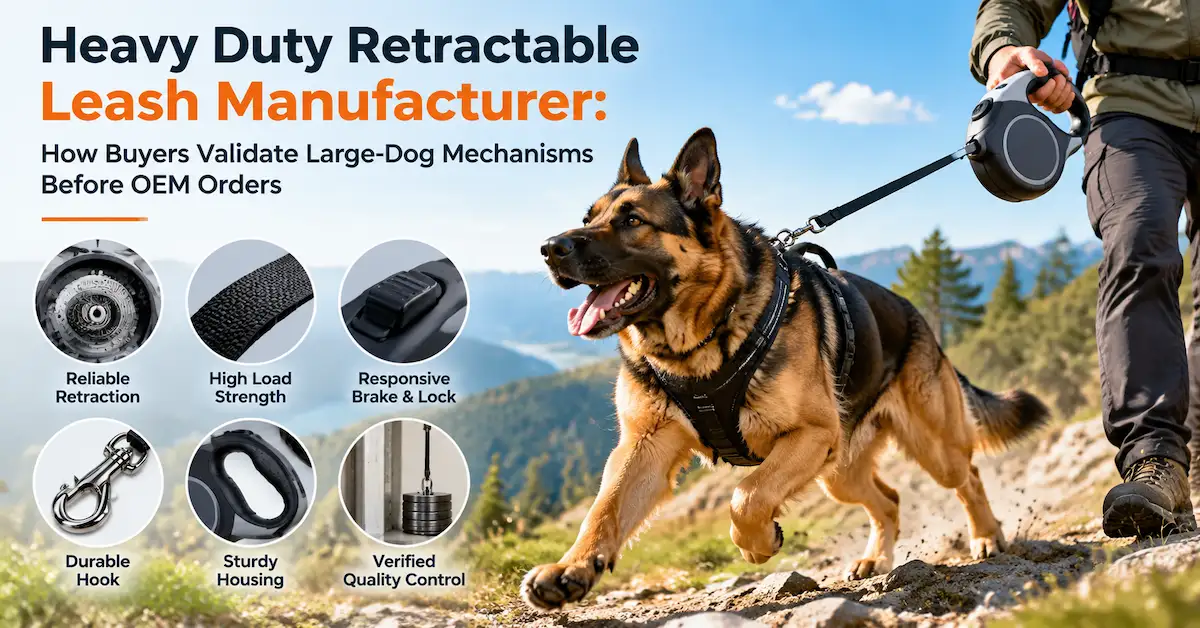
What Does “Heavy Duty” Mean in a Retractable Leash?
In a retractable leash, “heavy duty” should describe a controlled performance requirement, not a marketing adjective. The buyer must define the dog size, expected pulling behavior, walking environment, leash length, tape or rope construction, hardware, and acceptable operating behavior. Without those inputs, two suppliers can use the same label for products with very different mechanisms and limits.
Heavy duty is a system claim
The leash does not carry load through one part alone. Force travels through the hook, swivel, connection loop, tape or rope, guide opening, spool, spring, axle, housing, brake, and the user's hand. A stronger snap hook cannot compensate for a weak anchor loop. A wider tape cannot compensate for a brake that slips. A thick housing cannot compensate for a spring that loses retraction control.
For this reason, a buyer should request a system-level specification. It should connect the target dog range with the finished product and its intended use. The manufacturer should also explain whether the stated force is a proof load, a working load, a breaking result, or another measurement. These terms are not interchangeable, and a product listing should not present them as if they describe the same safety margin.
Heavy duty does not mean suitable for every dog
A retractable leash can be engineered for a defined range without being suitable for every large breed, every pulling pattern, or every environment. A dog that accelerates suddenly creates a different event from a dog that walks steadily. A wet or abrasive outdoor route creates different wear from a clean urban path. Buyers should define the intended application honestly and avoid universal language such as “for all large dogs” unless the exact evidence supports it.
Who Is the Buyer and What Must the Manufacturer Understand?
| Buyer role | Primary procurement question | Evidence to request |
|---|---|---|
| Pet brand | Can the product support a differentiated large-dog collection? | Approved mechanism, materials, user claims, color and logo control, packaging, and repeat-order record |
| Wholesaler or distributor | Can the product be replenished with stable quality across SKUs? | Model range, weight rating, carton details, MOQ by variant, lead-time basis, and batch inspection method |
| Retail buyer | Will customers understand the limit and operate it correctly? | Weight guidance, brake instructions, hook connection, care limits, warnings, and retail-ready package |
| E-commerce seller | Can the listing make accurate claims without increasing returns? | Dimensions, photos, mechanism behavior, actual test basis, materials, and approved product revision |
| Private-label buyer | Can the manufacturer control technical and branding changes together? | Engineering change record, sample approval, logo method, package artwork, barcode, and substitution process |
A useful RFQ starts with the target market, dog-size range, walking environment, preferred leash format, quantity by SKU, required packaging, branding, desired features, and launch date. It should not start with only a product photo and the words “make it stronger.”
Which Components Determine Heavy-Duty Retractable Performance?
The most important sourcing decision is to evaluate the retractable leash as a mechanism instead of as a shell. Each part has a defined function and a failure mode that should be included in the product review.
| Component | Function | Buyer should verify | Commercial risk if weak |
|---|---|---|---|
| Housing | Protects the internal mechanism and supports the handle | Material, wall consistency, impact behavior, assembly fit, surface quality | Cracks, loose parts, poor hand feel, or mechanism misalignment |
| Spool and axle | Stores and guides the tape or rope | Alignment, smooth rotation, guide clearance, and stability under load | Uneven winding, jams, noise, or inconsistent return |
| Spring system | Controls retraction force and return behavior | Initial response, repeated operation, and consistency across samples | Slow return, slack line, sudden pull, or early fatigue |
| Brake and lock | Stops or holds the leash at a chosen distance | Button travel, response, release, slip resistance, and repeat use | Unexpected movement or loss of user control |
| Tape or rope | Transfers force between the mechanism and the dog | Width, thickness, construction, edge finish, abrasion, and connection method | Fraying, cutting at the guide, tearing, or unstable winding |
| Hook and swivel | Connects the leash to a collar or harness | Gate closure, spring, rotation, surface finish, and model-specific strength | Opening, deformation, corrosion, or connection failure |
| Handle and grip | Transfers control to the person using the leash | Ergonomics, size, edge feel, balance, and impact resistance | Hand discomfort, drops, cracks, or poor premium perception |
Housing: protect the mechanism without making the product unusable
The housing should protect internal parts while remaining comfortable to carry. A heavier shell can increase perceived strength but may make the product tiring for daily use. Buyers should inspect the shell for flash, sharp edges, sink marks, cracks, joint gaps, and color inconsistency. Check the housing after the leash has been operated, not only when it is new and unused.
Impact behavior matters because retractable leashes are often dropped. A buyer should ask what product-specific drop or impact check is used, if one is required for the project, and whether the test applies to the complete assembled product. A material description alone is not evidence of finished-product durability.
Tape or rope: strength is only one part of the evaluation
Flat tape and rope create different user experiences and different interactions with the guide and spool. Buyers should compare the width, thickness, flexibility, edge treatment, color stability, abrasion behavior, and winding pattern of the selected material. A strong material that folds or twists at the guide can still produce an unstable product.
For a large-dog program, inspect the point where the tape or rope connects to the internal spool and the hook-side loop. Ask whether the connection uses stitching, a molded part, a crimp, or another construction. The purchase file should record the approved construction because a visual substitution can change the load path.
Brake and lock: test the user's control, not just button movement
A brake button can click correctly and still fail to hold the leash under the intended condition. The buyer should verify the difference between temporary stopping and continuous locking, the amount of button travel, whether the mechanism releases smoothly, and whether the held length slips after repeated operation.
Test the brake with the leash at several extension positions. A mechanism that holds near the handle may behave differently when more tape or rope is extended. The final acceptance criterion must be defined for the actual model, and any weight or force claim must state the test basis.
Hook and swivel: connection hardware needs its own inspection
The hook is often treated as a standard purchased component, but the hook shape, gate spring, swivel, plating, and connection loop all affect reliability. Inspect whether the gate closes fully, whether the swivel turns without binding, whether the hook rubs against the housing, and whether surface treatment remains intact after the agreed environmental exposure.
How Should Buyers Define the Load Envelope?
Load envelope is the most important difference between a general retractable leash and a heavy-duty sourcing project. It describes the conditions the product is intended to handle, such as dog weight range, normal pulling, sudden acceleration, leash extension, and walking environment. The manufacturer should help convert that application into a model-specific specification.
Record working load and test load separately
Ask the supplier to identify whether a stated number refers to a recommended dog weight, a continuous working condition, a proof test, a peak pull result, or a failure point. A failure point is not automatically a safe working limit. The product page for one current QQPETS retractable dog leash with LED light states that its robust design can withstand up to 120 kilograms of pull force. That statement belongs to that specific product page and configuration; it should not be copied to every retractable leash or interpreted without asking for the test method and acceptance basis.
The buyer's product listing should use the approved wording from the final specification. If the manufacturer has not confirmed a model-specific weight range or force statement, use “to be confirmed” internally rather than inventing a rating from a similar-looking product.
Consider dynamic loading
A steady pull and a sudden lunge are different mechanical events. The latter can create a peak load that travels through the hook, loop, spool, brake, spring, and housing in a short period. A heavy-duty qualification should therefore describe whether the project needs a static pull check, a dynamic or repeated load check, or another agreed method.
Ask the manufacturer to provide the controlled test method, equipment, sample quantity, force or weight basis, duration or cycle count, and pass criteria. This gives the buyer usable evidence without turning a marketing demonstration into a safety claim.
Match the load envelope to the application
A city walking product, an outdoor trail product, and a large-dog training product may need different balances of leash length, tape or rope, handle, hook, brake, and housing. Define whether the product is for neighborhood walking, parks, travel, open outdoor areas, or a collection that includes matching harnesses and collars. The right heavy duty retractable leash manufacturer should ask these questions before quoting a mechanism.
What Mechanical Tests Should a Heavy Duty Retractable Leash Manufacturer Provide?
Testing should be planned before a sample is approved. The exact method and acceptance values depend on the model and destination market, but a buyer can use the following framework to compare suppliers consistently.
| Test area | What the buyer wants to learn | Evidence to record |
|---|---|---|
| Extension and return | Whether the tape or rope extends and retracts smoothly across the intended range | Sample revision, extension position, operating observation, and pass criteria |
| Brake and lock | Whether temporary stop and continuous lock respond and hold as intended | Button sequence, extension position, force or condition, slip result, and repeat observations |
| Load verification | Whether the complete force path meets the agreed working or proof requirement | Test method, equipment, load basis, duration or cycles, sample count, and result |
| Connection hardware | Whether hook, gate, swivel, and loop remain functional and aligned | Gate closure, rotation, deformation, surface condition, and connection result |
| Repeated operation | Whether spring, spool, guide, brake, and lock behavior stays consistent | Defined cycle method, before-and-after operation, and visible wear |
| Abrasion and edge behavior | Whether tape or rope remains usable at the guide and contact points | Material revision, exposure method, fraying or damage, and acceptance limits |
| Drop or impact | Whether the assembled housing and mechanism remain usable after the agreed event | Drop condition, impact surface, sample orientation, function after test, and damage record |
| Environmental exposure | Whether the product meets the actual outdoor or care claim | Complete-product condition, exposure method, drying or cleaning instruction, and result |
Do not confuse a factory inspection with a certification
A finished-product inspection record, a material document, a company management-system certificate, and a third-party test report answer different questions. Buyers should request the document that matches the commercial claim. A company-level certification does not automatically prove the load performance of a customized retractable leash.
When a report matters, check the product name or model, applicant or manufacturer, test date, applicable method, sample description, and scope.
How Can Buyers Control Batch Quality?
The first approved sample proves that one configuration can work. It does not prove that every unit in a wholesale order will behave the same way. A heavy duty retractable leash manufacturer should be able to explain incoming checks, assembly controls, functional inspection, and packaging verification for the exact SKU.
Incoming component checks
Incoming inspection may cover housing parts, tape or rope, spring and spool components, brake and lock parts, hook and swivel, screws or fasteners, logo pieces, and packaging. The buyer should identify which components are critical and require notification before substitution. This is particularly important when the supplier uses a standard mechanism platform with several tape widths, colors, hook sizes, or feature versions.
In-process assembly checks
Assembly checks should confirm the position and fit of the spool, spring, guide, brake, lock, housing, handle, hook connection, and any lighting or accessory component. A finished leash can look attractive while a misaligned internal part produces noise, drag, or uneven return. The factory should identify where such issues are caught before final packing.
Finished-product inspection
Finished inspection should compare the unit with the approved sample and specification. Check appearance, dimensions, extension, return, brake, lock, hook, handle, tape or rope, logo, labels, accessories, and packaging. For a heavy-duty project, add the agreed mechanical checks rather than relying on a visual inspection alone.
Product Evidence From the Current Sixpet Website
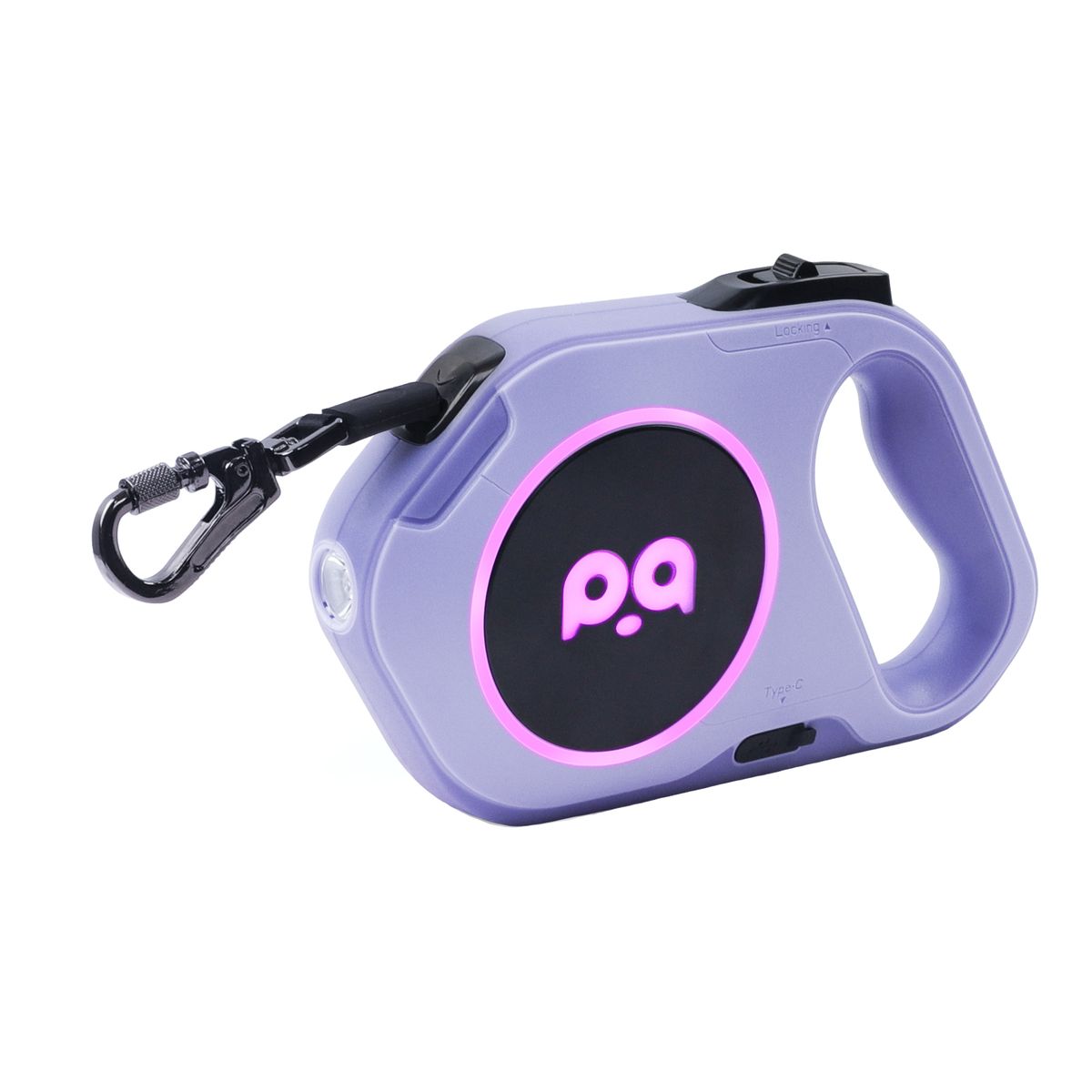
Current product-page facts: the listed retractable dog leash with LED light states a 5-meter extendable range, three lighting modes, front illumination up to 10 meters, a Type-C USB charging design, an automatic tape braking system, abrasion-resistant webbing, and a stated pull-force capability of up to 120 kilograms. The page also describes one-hand control and an integrated place to attach a small bag or keys. These claims are evidence for that specific listed product, not a universal specification for every retractable leash.
What still requires project confirmation: the exact model's recommended dog-weight range, test method behind the pull-force statement, spring cycle result, brake acceptance limit, hook specification, tape or rope material, water or cleaning limits, MOQ, price, production lead time, carton quantity, private-label packaging, and any destination-market documentation.
The current retractable dog leash with light product page is therefore a useful starting point for a buyer who wants a technology-enabled heavy-duty direction. It is not a substitute for a model-specific quotation and sample approval.
Company-level manufacturing evidence
The QQPETS About Us page states that the company has operated since 2008, has a 5,000 m2 factory, 200+ professionals, and specialized departments for heat-transfer printing, screen printing, weaving, cutting, sewing, and packaging. It also states that the company serves 20,000+ customers in 100+ countries and lists ISO 9001, BSCI, SGS, and OEKO standards.
Heavy Duty Retractable Leash vs. Fixed Heavy Duty Leash
A retractable mechanism is not automatically a better version of a fixed leash. The products solve different use cases and create different responsibilities for the buyer, retailer, and end user.
| Decision factor | Heavy duty retractable leash | Fixed heavy duty leash |
|---|---|---|
| Distance control | Adjustable distance through a spring, spool, brake, and lock system | Fixed length with simpler operation |
| Mechanical complexity | Higher: housing, spool, spring, guide, brake, lock, and connection system | Usually concentrated in webbing, stitching, handle, and hardware |
| Key buyer risk | Inconsistent return, lock slip, internal wear, or mechanism mismatch | Material, stitching, hardware, and handle failure |
| User training | Requires clear brake and lock instructions | Usually simpler to explain |
| Retail differentiation | Can support distance flexibility, compact storage, lighting, or accessory features | Can support strength, simplicity, control, or training positioning |
| Best sourcing evidence | System test plan, load basis, cycle checks, and approved mechanism revision | Material and hardware evidence, stitching inspection, and agreed strength checks |
A brand should select the product format from the application rather than assuming “heavy duty” means retractable. If adjustable distance is the customer value, a retractable system may be appropriate. If direct close control and simple operation are the priority, a fixed leash may be a better product direction.
OEM and Private Label Requirements
OEM work on a retractable leash should separate cosmetic customization from mechanical change. A logo, color, label, or retail box may be a controlled branding task. A new tape width, spring, brake, hook, housing, handle, light module, or connection point can change performance and should be treated as an engineering change.
Lock the technical brief before the artwork
Before designing packaging, confirm the product format, dog-weight range, leash length, tape or rope, housing, hook, brake and lock behavior, lighting if present, intended application, care wording, and approved claims. Otherwise, the brand may print a package around a specification that changes during sampling.
Keep one version-controlled SKU file
- Model name, revision, sample date, and approval status
- Target dog size or weight range and the meaning of any load number
- Leash length, tape or rope material, width, thickness, and connection construction
- Housing, handle, spring, spool, brake, lock, hook, swivel, and critical fasteners
- Logo method, color codes, label position, barcode, package artwork, and instructions
- Test plan, sample quantity, acceptance criteria, and defect handling
- Change-notification rule for any critical component or supplier substitution
- MOQ by model, color, leash material, hook, package, and other actual SKU splits
This file protects repeat orders. Without it, a second production run may be called the same product while using a different spring, hook, tape, brake, or housing. A product name is not a substitute for a controlled specification.
Packaging must explain the mechanism
Retail packaging should tell the customer the intended dog-size or weight range, how to attach the hook, how to use the brake and lock, how to inspect the product, and what conditions are outside the product's intended use. If the product includes lights, a charging cable, or an accessory attachment point, those functions need their own accurate instructions.
MOQ, Lead Time, Cost, and Supply Continuity
A heavy-duty retractable leash quote should be based on the actual mechanism and SKU structure. Unit price alone does not show whether two offers are comparable. One offer may include a standard housing and basic package; another may include a custom color, hook, tape, mechanism change, logo, retail box, inspection, and additional samples.
Ask MOQ by variant
Confirm whether MOQ applies to the whole order, each model, size, color, tape or rope type, hook, electronic option, logo file, or packaging version. A project with multiple colors and packages can be highly fragmented even when the total quantity sounds large. Record the MOQ assumption in the quote because it affects inventory, unit cost, and launch risk.
Separate sample time from bulk production time
The schedule may include product selection, engineering review, color and artwork approval, sample production, mechanical testing, revisions, final approval, component purchasing, assembly, inspection, packing, and shipment preparation. Ask when the quoted production lead time starts. It may begin after deposit, sample approval, artwork approval, or material readiness.
For repeat orders, ask whether critical parts remain available. A spring or brake substitution can require a new sample even when the outside housing looks unchanged. A stable manufacturer should explain the change-notification process instead of treating every replacement as invisible.
Compare total project content
When comparing a heavy duty retractable leash manufacturer with another supplier, place the same requirements in every RFQ: dog-size range, load terminology, leash length, material, hook, brake, lock, housing, color, logo, packaging, inspection, MOQ, lead time, and documentation. Then compare the products on an equivalent basis. The lowest unit quotation is not necessarily the lowest project cost if it creates more sampling, returns, rework, or packaging corrections.
RFQ Template for a Heavy Duty Retractable Leash Manufacturer
Use this brief when requesting a quotation. It is intentionally specific enough to trigger a technical response without pretending that unconfirmed values are already fixed.
| RFQ field | What to provide or ask | Why it matters |
|---|---|---|
| Target market | Country, channel, buyer type, and intended dog use | Sets packaging, claims, and product positioning |
| Dog range | Target size or weight range and expected pulling behavior | Defines the load envelope and model suitability |
| Leash format | Tape or rope, length, width, thickness, and visibility features | Changes winding, guide, housing, and user feel |
| Mechanism | Brake, lock, spring, spool, guide, handle, and hook requirements | Defines the actual mechanical product |
| Performance | Working load, proof load, test method, cycle requirement, and pass criteria | Prevents ambiguous strength claims |
| Branding | Logo, colors, label, barcode, and package artwork | Controls private-label presentation |
| Packaging | Box, hanging card, instruction card, language, carton quantity, and accessories | Supports retail and logistics planning |
| Commercials | Quantity by SKU, MOQ, sample cost, price basis, and payment terms | Allows a real cost comparison |
| Delivery | Sample timing, bulk lead time starting point, and repeat-order plan | Prevents a misleading production promise |
| Quality | Incoming, assembly, functional, mechanical, packaging, and substitution checks | Connects the quotation to batch control |
Buyer Checklist Before Approving the Sample
- Identify the model, revision, sample date, and intended dog-size or weight range.
- Ask what every load or force number means and request the test basis.
- Inspect housing fit, surface, edges, joints, handle balance, and visible fasteners.
- Extend and retract the tape or rope at several positions and observe noise, drag, twist, and return consistency.
- Operate the brake and lock repeatedly and check whether the held length slips.
- Inspect the hook gate, spring, swivel, connection loop, and surface finish.
- Confirm tape or rope width, thickness, edge finish, abrasion behavior, and winding path.
- Review the manufacturer's load, cycle, impact, and environmental test plan for the complete product.
- Confirm whether the product is for ordinary walking, outdoor use, training, or another defined application.
- Check all packaging, instructions, warnings, logos, labels, barcodes, and accessories.
- Record the exact configuration in a controlled SKU file before approving bulk production.
- Ask how the supplier will notify you before changing a spring, brake, hook, tape, rope, housing, or package.
- Confirm MOQ, sample revision rules, lead-time starting point, and batch inspection responsibility.
Frequently Asked Questions
What should a heavy duty retractable leash manufacturer prove first?
The manufacturer should first define the exact model and intended dog-use range, then explain the load terminology, tape or rope construction, hook and connection path, spring and spool behavior, brake and lock, and test method. The evidence should relate to the complete assembled product rather than to one isolated component.
Is a larger retractable leash automatically heavy duty?
No. A larger housing may contain more material without improving the spring, brake, hook, guide, or connection loop. Heavy duty should be supported by a model-specific specification and test plan that matches the intended application.
What is the difference between working load and breaking force?
Working load describes an intended operating condition, while breaking force describes a failure result or another defined limit. The exact meaning depends on the manufacturer's test method. Buyers should request the definition, equipment, sample, duration or cycles, and pass criteria before using a number in packaging or marketing.
Are retractable leashes suitable for large dogs?
Some models are designed for larger dogs, but suitability depends on the exact product, load basis, connection hardware, mechanism, and intended use. Buyers should select the model-specific range and should not generalize from a different retractable leash or from a product that only looks similar.
How should a buyer test the brake and lock?
Test both temporary stopping and continuous locking at more than one leash extension position. Record button travel, response, release, slip, and repeated operation. The factory and buyer should agree on the force or condition and the pass criterion. A visual click is not enough evidence that the lock performs under load.
What causes repeat-order failures?
Common causes include unrecorded component substitutions, a new spring or brake, different tape or rope, changed hook dimensions, inconsistent housing assembly, unclear weight claims, and package artwork that does not match the physical product. A controlled SKU file and a change-notification process reduce these risks.
Can QQPETS support a custom heavy duty retractable leash?
QQPETS presents retractable dog leashes, custom pet accessories, OEM and ODM support, sampling, bulk production, quality inspection, and private-label packaging through its website. The available customization scope, MOQ, lead time, mechanism options, and model-specific testing still need to be confirmed for the buyer's actual project. Use the contact page to submit the RFQ details.
Conclusion
Choosing a heavy duty retractable leash manufacturer requires more than comparing housing size, unit price, or a single strength number. The buyer must qualify the complete load path: hook, connection loop, tape or rope, guide, spool, spring, brake, lock, housing, handle, and packaging instructions. The product should be tested against the intended dog range and application, and the result should be tied to a controlled model revision.
For wholesale and OEM projects, the strongest sourcing process is direct and measurable. Send the target market, dog range, leash format, performance requirement, packaging, SKU quantity, and launch date. Request the model specification, test plan, sample record, MOQ, lead-time assumptions, and change-control process. Use company-level evidence to understand the manufacturing partner, and use product-level evidence to support the final claim.
QQPETS provides a starting point for buyers looking for retractable dog leash manufacturing, custom pet accessory development, and private-label supply. The next step is to confirm whether the current product direction matches your market and to request a project-specific quotation before publishing a heavy-duty performance claim.