What Should Buyers Check Before Ordering LED Dog Collars Wholesale?
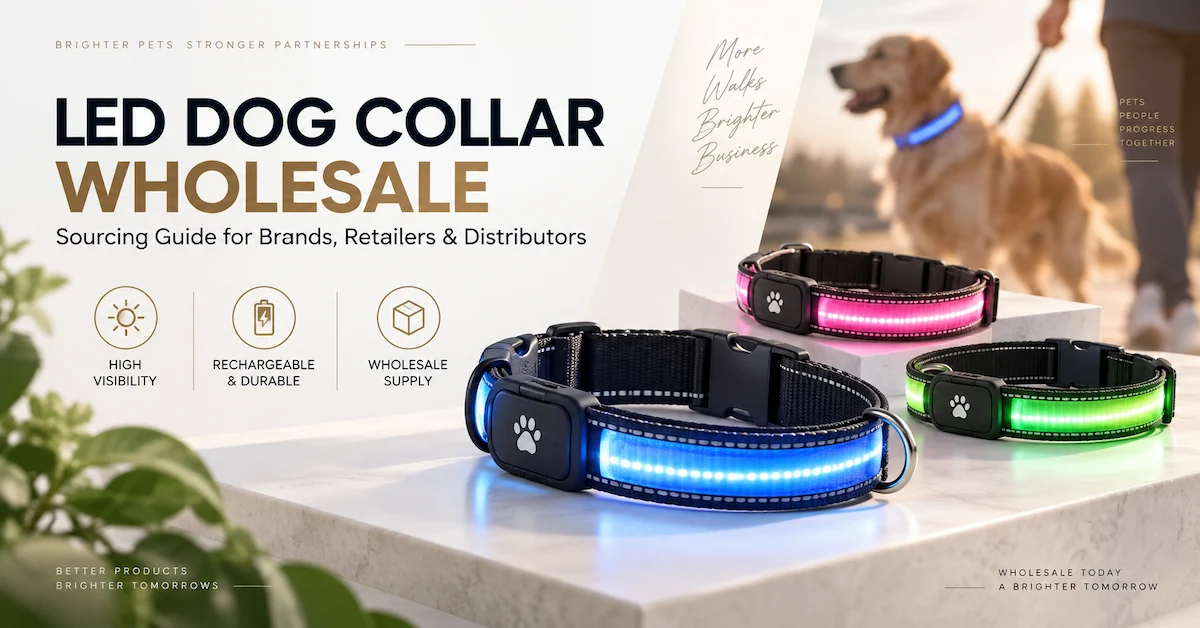
For an LED dog collar wholesale project, buyers should evaluate the complete product rather than treating illumination as the only purchasing criterion. A commercially workable collar needs a clearly defined lighting system, charging method, adjustment range, materials, closure or buckle arrangement, electronic-component placement, care instructions, packaging, and repeatable production specification. Pet brands and distributors should also distinguish between features that are visually attractive in a sample video and features that can be consistently manufactured, explained to end users, and supported across repeat orders. QQPETS currently includes an LED Dog Collar category within its broader pet accessories product range, but buyers should confirm the exact available configuration, dimensions, lighting options, and commercial terms for the model under discussion instead of assuming that one specification applies to an entire category.
Which Buyers Benefit Most From LED Dog Collar Wholesale Programs?
Wholesale LED dog collars are particularly relevant to pet brands developing night-walking collections, distributors adding visibility-oriented products, retailers building seasonal outdoor assortments, and e-commerce sellers looking for differentiated dog-walking accessories. A private-label brand may prioritize custom colors, packaging, logo placement, and coordinated collars, harnesses, or leashes; a distributor may care more about stable replenishment, SKU control, operating instructions, and component consistency; a retailer may focus on clear size information, charging instructions, shelf-ready packaging, and minimizing avoidable returns. An LED collar wholesale program is less suitable when the buyer has not yet defined whether the product is intended primarily as an illuminated visibility accessory or as a leash-attachment collar. That distinction affects how the structure, hardware, mechanical requirements, and product instructions should be evaluated.
Start With the Night-Walking Application Before Selecting Light Modes
A practical sourcing brief starts with where and how the product is expected to be used. An urban evening-walking product may prioritize easy operation, visible illumination, compact electronics, and convenient charging. A product positioned for parks or outdoor walks may require more attention to operating duration, environmental exposure, and cleaning instructions. A promotional or fashion-focused collection may prioritize color options, flashing patterns, appearance, and retail packaging. These use cases should not automatically share one technical specification. The QQPETS outdoor pet safety guide also distinguishes active illumination from passive reflective products, an important purchasing distinction because LEDs require electrical components and power while reflective materials depend on external light.
LED, Flashing, and Reflective Collars Serve Different Functions
Buyers comparing dog collars should first separate the underlying visibility technologies. A powered LED product actively generates light, while a reflective collar returns light from an external source such as vehicle headlights or a flashlight. Within LED products, continuous and flashing modes can create different visual effects and may also affect power consumption differently. A product offering several modes is not automatically superior; buyers need to decide which functions customers actually need and whether those functions can be clearly explained and consistently reproduced.
| Product Direction | Visibility Method | Purchasing Focus | Key Questions |
|---|---|---|---|
| Steady LED collar | Continuous active light | Simple, consistent illumination | Runtime, light coverage, charging |
| Flashing LED collar | Intermittent active light | Attention-grabbing visibility | Flash sequence, mode control, runtime |
| Multi-mode LED collar | Multiple powered modes | Flexible user choice | Mode order, operation, runtime by mode |
| Reflective collar | Passive reflection | No charging requirement | Reflective coverage and conditions |
| LED + reflective design | Active and passive elements | Broader visibility concept | Added weight, construction, care requirements |
This comparison is a sourcing framework rather than a list of confirmed QQPETS LED collar models. Buyers should request the current product specification before quoting or marketing any particular configuration.
Build an LED Dog Collar Specification Before Comparing Prices
A meaningful LED dog collar wholesale quotation should refer to a defined product. Terms such as “rechargeable,” “waterproof,” “adjustable,” or “high visibility” are too broad by themselves because different suppliers may interpret them differently. Buyers should create a specification sheet and separate mandatory requirements from preferred features and items still awaiting confirmation.
| Specification Area | What Buyers Should Confirm | Why It Matters |
|---|---|---|
| Product format | Complete collar or supplementary visibility collar | Defines intended use |
| Neck range | Minimum and maximum adjustment | Supports size selection |
| Collar width | Finished width by size | Influences fit and appearance |
| Product weight | Finished weight including electronics | Important for smaller dogs |
| Lighting area | Full, partial, or segmented illumination | Affects visible coverage |
| Lighting modes | Steady, fast flash, slow flash, other | Defines operation |
| Light colors | Fixed or selectable | Influences SKU complexity |
| Battery | Type and rated specification | Affects charging and runtime |
| Charging method | Interface, cable, indicator | Affects user experience |
| Runtime | Defined by mode and test condition | Prevents vague claims |
| Materials | Collar body, housing, buckle, electronics | Defines construction |
| Cleaning | Approved cleaning procedure | Reduces misuse |
| Packaging | Instructions, cable, labels, barcode | Supports retail readiness |
If a supplier has not yet confirmed a value, it is better to mark the item “to be confirmed” than to borrow data from another product.
Evaluate Light Coverage, Not Just Maximum Brightness
Brightness alone does not tell a buyer how effectively an LED collar presents around the dog's neck. Evaluate where the illuminated sections are located, whether electronics or buckles create visible gaps, whether adjustment changes the light position, and whether the output looks reasonably consistent around the intended illuminated area. During sample review, compare collars under similar ambient light, viewing distance, battery condition, and operating mode. Front, side, and rear observations are more useful than one close-up photograph. Buyers should also be cautious with numerical visibility-distance claims. If a particular distance will appear on retail packaging or product pages, request evidence tied to the exact product and the conditions under which the observation or test was performed rather than turning a promotional demonstration into a universal performance statement.
Battery Runtime Should Be Compared by Operating Mode
Runtime is one of the most important commercial specifications for rechargeable LED collars, but it is also easy to oversimplify. A steady mode and an intermittent flashing mode may consume energy differently, so one generic “working time” number may not describe the full product. Ask the supplier to state runtime by applicable mode and identify the starting charge condition and end point used for measurement. For buyer-side sample validation, record the sample number, charging process, selected mode, start time, noticeable changes, and end condition. This type of simple record is more useful for supplier comparison than accepting phrases such as “long-lasting battery.” It also helps purchasing and marketing teams use the same approved information when preparing product listings.
Charging Design Can Affect Customer Experience and Return Rates
Charging should be reviewed as part of the finished collar design rather than as an isolated electronic feature. Buyers should check where the port is located, how easily it can be accessed, whether the connector remains secure, whether a charging indicator is provided, whether a cable is included, and how the product should be handled during cleaning. The package should clearly tell the customer what charging equipment is included and how the product operates. If the manufacturer changes the charging interface in a repeat order, packaging graphics and instructions may also need to change. For this reason, a private-label LED collar specification should identify the approved charging arrangement as a controlled component rather than leaving it to general descriptions such as “USB rechargeable.”
Fit Still Matters When Light Is the Main Selling Point
LED functions do not replace basic collar-fit requirements. Buyers should confirm the usable neck range, width, closure system, adjustment mechanism, edge finish, and distribution of electronic components. A battery or control housing can add bulk in one area, which becomes more important for small-size products. During sampling, evaluate the collar at both ends of its adjustment range and confirm that tightening or loosening the collar does not excessively fold, obstruct, or reposition illuminated sections. If a D-ring is present, do not automatically assume the product is intended to function as the dog's primary leash collar. The supplier should clarify whether that particular finished construction is designed for leash attachment or whether the illuminated collar is intended as an additional visibility accessory used alongside ordinary walking equipment.
Materials and Electronics Must Work as One Product System
An LED collar combines several types of components that would not appear in a basic textile collar. Depending on the design, these may include webbing or another collar body material, a buckle or closure, adjuster, light-transmitting components, LEDs, wiring, switches, battery, charging parts, control electronics, and protective housings. A good supplier discussion identifies which parts are critical to appearance, operation, and repeat production. QQPETS describes weaving, printing, cutting, sewing, and packaging operations through its About Us page; for an LED collar wholesale project, buyers should additionally confirm how electronic parts for the selected product are sourced, assembled, inspected, and controlled. A similar-looking replacement electronic component should not automatically be accepted because it can change illumination, charging behavior, dimensions, or runtime.
Water Resistance, Rain Exposure, and Washing Are Not the Same Claim
Pet products may be used in changing outdoor conditions, but environmental descriptions should be precise. Light rain, splashes, temporary immersion, swimming, hand washing, and machine washing represent different exposure conditions. Buyers should ask what the finished collar is actually designed to tolerate and whether electronics must be removed before cleaning. Charging areas, switches, housing joints, and electrical connections can create limitations that are not obvious from photographs. If a specific water-protection claim will be published, request applicable evidence for the complete product configuration. Avoid assuming that a protected component makes the entire assembled collar suitable for immersion or machine washing.
Quality Control Should Cover Mechanical and Electronic Functions
An LED collar requires a broader inspection plan than a standard collar because both physical construction and electronic behavior matter. Incoming checks can cover collar materials, closures, housings, LEDs, batteries, charging parts, switches, and packaging materials. During assembly, factories may need to verify correct component positioning, connection, product size, and lighting operation. Finished inspection should compare the product with the approved sample and specification, including dimensions, appearance, adjustment, illumination modes, switch operation, charging response, included accessories, labeling, and packaging. QQPETS discusses material, production, finished-product, and packaging checks in its pet accessories supplier guide, which provides a useful general framework for creating an LED-product-specific inspection plan.
Documentation Should Match the Exact Product Being Purchased
Buyers sometimes request “certificates” without first determining what document is needed, what requirement it addresses, and whether it applies to the exact configuration. Company management-system certificates, material documentation, battery-related records, and finished-product test reports are different types of evidence. When a document matters for a destination market, retailer, or product claim, identify the requirement early in the project. Review the company name or applicant, applicable product or material, issue and validity information where relevant, and scope. Do not assume that one report shown at company level applies automatically to every customized LED dog collar. A change in battery, electronic module, housing, material, or construction may also require the buyer to review whether existing documentation remains applicable.
MOQ Should Be Calculated Around the Real SKU Structure
A wholesale order can appear large while still being highly fragmented. Suppose a brand requests three collar sizes, three body colors, four LED colors, and two packaging versions. That combination could create many SKUs even before different logos or regional labels are considered. This example illustrates SKU complexity rather than a recommended assortment. Ask whether MOQ applies by overall order, collar size, textile color, LED color, electronics configuration, artwork, or packaging. The bulk pet accessories ordering guide emphasizes defining quantities by actual product requirements rather than focusing only on one headline number. New brands may reduce purchasing risk by launching fewer variants and expanding the assortment after collecting real sales information.
Lead Time Should Include Sampling and Approval, Not Only Production
LED dog collar wholesale projects may require more steps than buying an existing non-electronic collar. A realistic project schedule can include requirement review, available-platform selection, artwork preparation, electronic configuration confirmation, sample production, buyer evaluation, revisions, final sample approval, component purchasing, bulk assembly, inspection, packaging, and shipment preparation. Buyers should ask exactly when the quoted production period begins. A factory may calculate it from deposit, sample approval, artwork approval, or material readiness. Repeat orders can also be affected if a previously approved electronic component is no longer available. Therefore, the delivery plan should identify both buyer-dependent approvals and factory-dependent production steps.
Compare Wholesale Configurations on an Equivalent Basis
Different offers can appear to describe the same LED collar while actually containing different functions and costs. One quotation might include several light modes, charging cable, printed retail packaging, and private labeling, while another includes only the collar in basic packing. Buyers should normalize the specification before comparing unit price.
| Comparison Item | Basic Wholesale Program | Private-Label Program | Buyer Should Confirm |
|---|---|---|---|
| Base collar | Existing configuration | Existing or modified configuration | Current model |
| Light modes | Standard factory option | Agreed modes | Actual available modes |
| Colors | Standard selection | Brand-specific selection where feasible | MOQ by variant |
| Logo | Standard/no logo | Custom branding | Method and position |
| Packaging | Standard packing | Custom retail packaging | Included materials |
| Instructions | Existing | Brand or market-specific | Charging/care wording |
| Sample approval | Recommended | Essential | Approved version |
| QC | Standard factory process | Agreed project requirements | Inspection scope |
| Repeat order | Standard configuration | Controlled private-label SKU | Change notification |
The table describes purchasing routes rather than confirmed QQPETS product packages. Exact commercial options should be discussed against the selected model.
What Adds Cost to an LED Dog Collar Wholesale Order?
Unit cost can be influenced by more than collar material. Electronics, battery specification, LED configuration, charging components, closures, custom colors, logo application, packaging, instructions, quantity per SKU, inspection requirements, and new development work can all affect the commercial offer. Buyers should therefore compare total project content rather than automatically selecting the lowest unit quotation. The lowest-cost option may be suitable when it meets the agreed requirements; a higher price is not inherently proof of better quality either. The useful comparison is whether each quotation describes the same product and services. Clearly documenting the approved configuration also helps reduce hidden costs caused by sample revisions, packaging changes, component substitutions, or disagreements after production.
Private Label and OEM Projects Require Different Levels of Control
A private-label project may start from an existing LED collar and focus on logo, color, packaging, or labels. A deeper OEM project may modify dimensions, components, light configuration, closure design, or other technical elements. Buyers should separate cosmetic changes from changes that can affect function. Changing packaging artwork usually does not carry the same development risk as changing battery capacity, lighting layout, housing, or electronic controls. When technical changes are requested, confirm whether a new prototype, testing, documentation review, or different MOQ is required. QQPETS provides broader customization and manufacturing information through its company page, but the available LED collar customization scope should be established for the actual product instead of inferred from general OEM/ODM terminology.
Repeat Orders Need Component and Revision Control
Repeat production is one of the strongest tests of a wholesale supplier. Buyers should keep an approved SKU file linking the product to its physical sample, neck range, dimensions, material, buckle or closure, light module, battery, charging interface, operating modes, colors, logo, labels, instructions, packaging, and agreed inspection requirements. If the supplier later proposes changing a component, the buyer can review exactly what is affected. This is especially important for electronics because a component can look similar while producing different charging behavior, illumination, runtime, or packaging requirements. An LED dog collar wholesale program should therefore be managed as a controlled product rather than as a generic item reordered only by product name.
What Should You Send an LED Dog Collar Supplier for a Wholesale Quote?
A useful inquiry should identify the target sales market, preferred collar format, neck-size range, quantity by size and color, required lighting modes, preferred light colors, charging expectations, branding requirements, retail packaging, required instructions, expected outdoor-use description, destination market, and launch schedule. If you already sell a similar collar, provide photographs, measurements, existing packaging, or a physical sample and explain what you want to improve. Problems such as inconsistent sizing, difficult charging, unclear operating modes, bulky electronics, uneven lighting, or component changes give the supplier important context. Buyers can use the QQPETS contact page to provide project information after reviewing the current product categories.
Frequently Asked Questions
1. What should I check first when sourcing LED dog collars wholesale?
Start with intended use, collar construction, neck-size range, lighting system, battery and charging method, operating modes, materials, packaging, and quantity by SKU. Once the product is defined, evaluate sampling, QC, customization, MOQ, and delivery planning.
2. Are LED dog collars and reflective dog collars the same?
No. LED collars actively produce light and require power, while reflective collars depend on an external light source. They should be sourced and marketed according to their actual operating principle.
3. How many LED modes should a wholesale dog collar have?
There is no universal number. The useful configuration depends on the target market and user experience. If multiple modes are offered, buyers should confirm mode order, operation, and runtime for the specific product.
4. How should buyers compare LED collar battery runtime?
Use the same operating mode, starting charge condition, product configuration, and end criterion. Avoid comparing figures produced under different conditions as if they were directly equivalent.
5. Can an LED collar be used for leash attachment?
Only if the specific finished collar is designed and appropriately evaluated for that use. Some illuminated collars may primarily be visibility accessories, so buyers should confirm the intended function rather than assume it from appearance.
6. Are rechargeable LED dog collars waterproof?
Water protection depends on the actual product construction and evidence. Rain exposure, splashing, immersion, and washing are different conditions, so buyers should request model-specific information and care instructions.
7. Can LED dog collars be customized for private-label brands?
Branding, colors, labels, and packaging may be available depending on the product. Changes to electronics, battery, lighting layout, housing, or structural components should be separately evaluated because they may require additional development.
8. What affects LED dog collar wholesale MOQ?
MOQ may depend on the base product, collar sizes, textile colors, LED colors, electronic configuration, logo, packaging, and component purchasing requirements. Ask for quantity requirements at SKU level.
9. What should be checked during bulk LED collar inspection?
Inspection can include approved dimensions, adjustment, appearance, lighting modes, controls, charging response, components, labels, included accessories, packaging, and any additional requirements agreed for the specific product.
10. How can buyers reduce repeat-order risk?
Maintain an approved sample and controlled product specification covering textile and electronic components, dimensions, lighting modes, charging, artwork, packaging, and inspection requirements. Review relevant substitutions before they enter production.
Conclusion
A successful LED dog collar wholesale program depends on defining and controlling the complete product rather than purchasing on brightness, color, or price alone. Pet brands, wholesalers, distributors, and retailers should evaluate how the collar fits, where and how it illuminates, how each lighting mode operates, how charging and runtime are defined, how textile and electronic components are integrated, what environmental and cleaning limits apply, and how the supplier controls bulk and repeat production. Buyers can review the QQPETS LED Dog Collar category, explore the broader pet accessories range, and learn more about the company's manufacturing background through About Us. For a project-specific quotation, contact QQPETS with your required size range, lighting configuration, quantity breakdown, branding files, packaging requirements, destination market, and expected application so the available product configuration, sample requirements, MOQ, and production plan can be confirmed.