Reflective Dog Collar Wholesale: The Short Answer
A dependable reflective dog collar wholesale program should prove more than the presence of a shiny strip. The buyer should approve a defined collar construction, reflective material and placement, webbing specification, size range, buckle and D-ring configuration, stitching pattern, logo method, packaging, inspection standard, and repeat-order process. The supplier should also separate confirmed product facts from fields that still require quotation or testing. This is the minimum evidence a reflective dog collar wholesale buyer needs before treating a sample as a scalable SKU.
For a bulk order, compare suppliers using the same sample size and the same checklist. Inspect visibility under a consistent light source, measure the collar at its usable adjustment range, check the hardware and stress points, and record how the reflective element is attached. Then lock the approved revision before production. A "reflective" label by itself does not prove angle coverage, wash durability, abrasion resistance, or suitability for every dog. The practical job of a reflective dog collar wholesale supplier is to turn that label into a repeatable product specification.
This article serves a commercial investigation and supplier comparison intent. It is written for pet brands, importers, wholesalers, retail buyers, and e-commerce teams that need a repeatable way to qualify reflective collars for night-walking collections. It does not treat reflective collars as a substitute for supervision, identification, or other safety equipment. Its purpose is to help a buyer decide what to ask a manufacturer before approving a reflective dog collar wholesale or private-label program.
What Should "Reflective" Mean in a Wholesale Specification?
In procurement, "reflective" should identify a measurable design feature rather than a general visual impression. A collar may use reflective yarn, a laminated strip, a printed reflective area, a reflective label, or a combination of elements. Each option creates a different surface area, attachment method, hand feel, cost, and durability risk. The buyer should decide which function the collar must perform in the target market before comparing prices.
Visibility is directional
Reflective material returns light toward a source, so the result depends on the angle between the dog, the light, and the observer. A narrow strip facing sideways may be effective in one position and less noticeable when the dog turns. A collar with separated reflective zones can provide a different visual pattern from a collar with continuous coverage. The product brief should therefore describe the intended viewing directions: front, side, rear, or a defined combination.
For retail communication, use precise wording such as "reflective detail for low-light visibility" unless the manufacturer has approved a stronger, test-supported claim. Avoid writing that a collar makes a dog visible from every direction or at a specific distance when no controlled test supports that statement.
Visibility is not the same as illumination
A reflective collar uses incident light; it does not generate light. That distinction matters when a brand sells both reflective and LED products. A reflective collar does not need charging, but its visibility depends on a light source and line of sight. An LED collar can emit light but introduces a battery, charging, electronics, sealing, and operating-time specification. Buyers should keep these product promises separate in their catalog and packaging.
Define the reflective element before requesting a quote
Include the following in the RFQ: material type, visible width, usable length, placement, attachment method, color, expected wash or cleaning method, abrasion exposure, and any required test or performance statement. If the buyer wants reflective stitching, specify whether it is a continuous line, a pattern, or a woven section. If the buyer wants a reflective strip, specify how it should be bonded or sewn and which bend zones it must tolerate.
Procurement conclusion: A wholesale collar is ready for comparison only when "reflective" has been converted into a material, placement, condition, and acceptance requirement. The visual effect in a product photograph is useful for design approval, but it is not a batch-quality specification.
Who Buys Reflective Dog Collars and What Does Each Buyer Need?
Different channels use the same collar for different commercial reasons. A supplier that understands the buyer's channel can recommend a more useful construction and packaging plan. The product should be specified around the sales environment rather than around a generic "one size fits all" description. That is especially important when a reflective dog collar wholesale line will be sold through several markets with different size, labeling, and packaging expectations.
| Buyer type | Main business question | Evidence to request before bulk approval |
|---|---|---|
| Pet brand | Can the collar carry a consistent safety and design story across a collection? | Approved material, size architecture, logo method, color standards, matching products, and packaging artwork |
| Wholesaler or distributor | Can the SKU be replenished with stable appearance and dimensions? | Variant matrix, tolerance, carton data, inspection plan, MOQ by color and size, and change-control process |
| Retail buyer | Will shoppers understand the benefit and fit without staff explanation? | Size guide, care instructions, visibility wording, hang tag, barcode, and retail-ready packaging |
| E-commerce seller | Can the listing make accurate claims and reduce size-related returns? | Measurement diagram, product photos, reflective close-up, material description, packaging images, and approved claims |
| Private-label buyer | Can branding changes be made without changing the collar's load path or fit? | Logo location, print or label process, sample sign-off, artwork version, approved component list, and substitution rules |
These buyers may share a supplier but not a specification. A distributor may prioritize carton efficiency and replenishment. A premium brand may prioritize a soft hand feel, a controlled color palette, and matching harnesses. A marketplace seller may need compact packaging, barcode placement, and clear size photography. The RFQ should state the channel so the supplier can price the complete solution rather than only the collar body.
Which Collar Components Control Wholesale Quality?
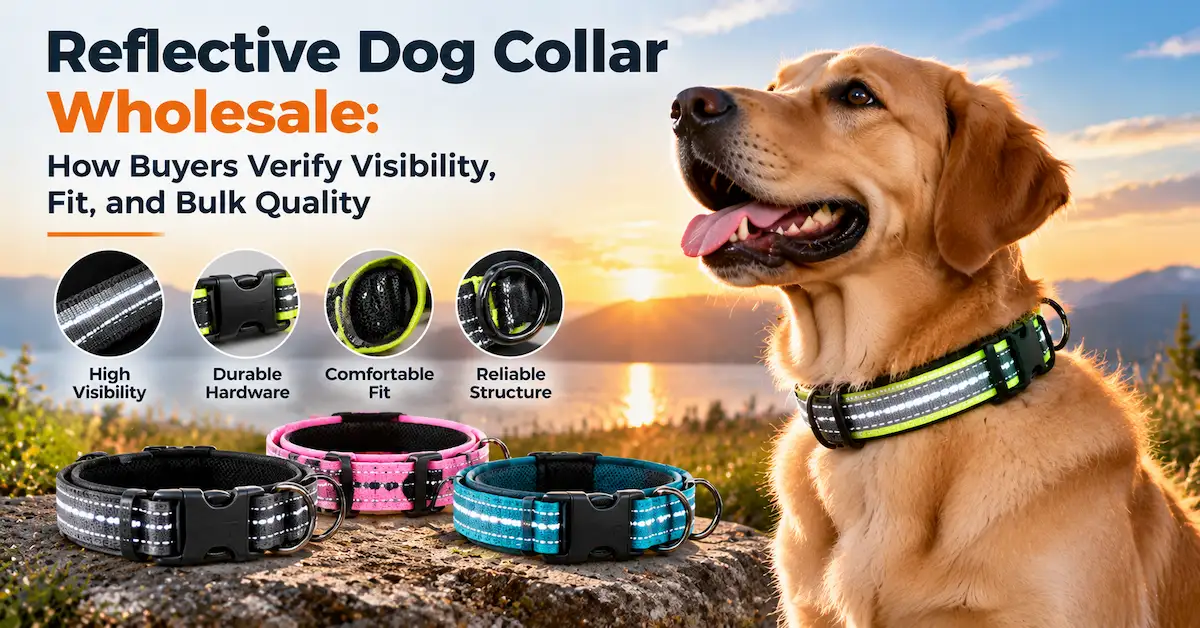
A reflective collar is a small product with several connected failure points. The webbing, reflective element, buckle, D-ring, adjustment hardware, stitching, edge finish, and logo application all affect the customer's experience. Inspecting only the reflective stripe leaves the main commercial risks unresolved. A capable reflective dog collar wholesale supplier should explain how these parts are controlled as one finished assembly.
| Component | Function | Buyer should verify | Typical bulk-order risk |
|---|---|---|---|
| Webbing | Forms the collar body and carries everyday tension | Material, width, thickness, edge feel, color, flexibility, and dimensional tolerance | Uneven width, rough edges, color variation, or uncomfortable stiffness |
| Reflective element | Returns incident light in low-light conditions | Coverage, position, attachment, surface consistency, and retention after agreed exposure | Peeling, cracking, weak visual effect, or inconsistent placement |
| Buckle | Allows the user to put on and remove the collar | Closure, release pressure, fit with the webbing, surface finish, and size compatibility | Accidental release, difficult use, deformation, or poor fit |
| D-ring | Provides the leash or tag connection point | Material, weld or joint, position, finish, and attachment reinforcement | Rotation, deformation, corrosion, or stitching failure |
| Adjuster | Controls the usable neck-size range | Adjustment travel, grip on the webbing, movement under use, and size consistency | Slipping fit, limited range, or inconsistent sizing across batches |
| Stitching | Secures the buckle, D-ring, adjuster, and reflective detail | Pattern, density, back-tack, thread, edge distance, and loose ends | Fraying, missed stitches, weak stress points, or visible defects |
| Logo and label | Supports brand identity and product information | Method, placement, color, wash behavior, artwork version, and alignment | Wrong artwork, poor adhesion, unreadable care information, or rework |
Webbing: compare comfort and stability together
Webbing should be evaluated by its finished behavior, not by the name of the fiber alone. A buyer should feel the edge, bend the collar through its intended adjustment range, inspect the weave, and compare width across samples. A collar that feels strong but has a sharp edge can create complaints. A soft collar with an unstable adjuster can create fit problems. The final choice is a balance between hand feel, dimensional stability, visual quality, and the intended dog-size range.
Reflective attachment: keep visibility from becoming a wear point
Reflective material may be placed on a surface that bends, rubs, or passes through an adjuster. Those movements can create different stresses from a static display sample. The buyer should inspect where the reflective element enters a buckle area, crosses a seam, or contacts the dog's environment. Ask whether the reflective detail is woven into the webbing, sewn on, bonded, printed, or applied by another method. The approved method should be recorded in the production specification.
Hardware: the visible metal or plastic is not the whole connection
A buckle or D-ring is only reliable as part of its surrounding assembly. Check the hardware size against the webbing width, the way the webbing folds, the stitch pattern, and the amount of material around the stress point. The D-ring should sit in a position that works with the intended leash connection and does not distort the collar when the dog moves. If a buyer changes hardware after sample approval, the collar should be rechecked because the new component can change the load path and fit.
How Should Buyers Check Fit and Size for a Wholesale Collar Line?
Fit is a commercial issue as much as a comfort issue. A collar that is difficult to size creates returns, negative reviews, and poor repeat sales even when the reflective feature works. A wholesale program should define the actual neck-size range for each SKU, the adjustment method, and the measurement instructions shown to customers. Every reflective dog collar wholesale quotation should include this usable range rather than only a nominal strap length.
Use usable neck range, not only total strap length
Total strap length includes overlap, buckle area, adjustment allowance, and unused material. It is not the same as the dog's usable neck range. Ask the supplier to provide the minimum and maximum recommended neck measurements for every size. Confirm how the measurement is taken and whether the range assumes a specific buckle, adjuster, or D-ring layout.
Check fit at the smallest and largest approved positions
Measure at both ends of the approved range and at a middle position. Look for exposed webbing, an adjuster that twists, a buckle that sits off-center, and a reflective strip that becomes hidden or distorted. The product photograph should show a useful fit, but the inspection must include the less attractive boundary conditions because those are where size complaints often appear.
Build the size guide from the approved sample
Do not create the online size chart from an old drawing or a similar SKU. Measure the approved sample, record tolerances, and provide clear customer instructions. A useful chart can include recommended neck range, collar width, dog-size guidance, buckle type, and a reminder to leave a comfortable fit. The chart should not promise suitability for every breed or behavior without evidence.
What Quality Checks Should Be Included in Reflective Dog Collar Wholesale Orders?
Quality control should connect the approved sample with the shipped batch. Buyers should define the inspection points before production, not after the first complaint. The exact sampling level and test values depend on the order, market, and product construction, but the following structure provides a practical starting point for a reflective dog collar wholesale order.
| QC stage | What to check | Record for the buyer |
|---|---|---|
| Material approval | Webbing, reflective material, thread, hardware, and label components | Supplier, revision, color, material description, and approved sample reference |
| First-piece inspection | Size, construction, reflective placement, buckle, D-ring, and logo | Measurements, photos, defects, and approval before line continuation |
| In-process inspection | Stitching, edge finishing, component placement, and color consistency | Inspection time, production lot, defect categories, and corrective action |
| Functional checks | Buckle operation, adjuster grip, D-ring attachment, and usable fit range | Test method, sample count, result, and any exclusion or limitation |
| Reflective check | Appearance and visibility under an agreed light and viewing condition | Light source, angle or setup, sample identity, photos, and pass criteria |
| Final inspection | Dimensions, defects, logo, packaging, carton marks, and quantity | Inspection report, accepted revision, carton details, and release decision |
Test the finished collar, not just the raw reflective material
Raw-material documentation is useful, but it cannot show whether the final collar has the correct placement, seam, bend behavior, or surface condition. The buyer should request finished-product checks using the production sample. If reflective performance matters to the claim, define the light source, observation position, sample orientation, and pass criterion. A phone photograph can support visual comparison, but it should not be presented as a laboratory measurement.
Inspect high-risk points with a defect list
Use a defect list that separates critical, major, and minor issues where appropriate. High-risk examples include a buckle that does not close, a D-ring with an incomplete joint, a stitch miss at a load point, an exposed sharp edge, a reflective section that is detached, an incorrect size label, and a wrong logo version. A loose thread or small cosmetic mark may be categorized differently, but the buyer should define the rule before the inspection.
Control substitutions between orders
Repeat orders can drift when a component is unavailable or a production team assumes that a similar material is acceptable. Require written approval for changes to webbing, reflective film, thread, buckle, D-ring, adjuster, packaging, or artwork. The supplier should identify which changes require a new sample or functional check. This is one of the most important controls for long-term wholesale supply.
What Factory Evidence Can Sixpet Provide for This Sourcing Decision?
A buyer should separate company capability from product-specific evidence. Sixpet's public About Us page identifies QQPETS as a dog harness, collar, and leash manufacturer in China and describes OEM, ODM, and wholesale services. It also states that the company has operated since 2008, works from a 5,000 m2 factory, and has dedicated heat-transfer printing, silk-screen printing, weaving, cutting, sewing, and packaging departments. The same page lists ISO 9001, BSCI, SGS, and OEKO standards and says the company serves customers in more than 100 countries.
Those are company-level signals. They do not automatically confirm the reflective performance, exact material, MOQ, lead time, or inspection result of a specific collar. The current published QQPETS dog collar product page describes a collar with a printed design, black buckle, selected materials, custom logo and packaging options, and a published MOQ of 30 to 40 pieces for that product reference. It also presents product-level factory and capacity information. Buyers should treat that page as a reference for the published collar program and ask the team to confirm whether the same conditions apply to a new reflective collar design.
Evidence boundary: The public pages support QQPETS's collar manufacturing, printing, sewing, packaging, OEM/ODM, and wholesale capability. They do not establish a universal reflective-material specification or a universal MOQ and lead time for every collar. Those fields belong in the project quotation and sample approval record.
This distinction improves trust. A procurement page should say exactly what the factory has published and exactly what the buyer still needs to verify. It is more useful than transferring an impressive number from an unrelated model into a new product brief.
How Do OEM and Private-Label Buyers Build a Reflective Collar?
OEM and private-label work is easiest to control when the buyer separates product architecture from visual branding. Start with the collar's intended dog-size range, webbing, reflective placement, hardware, fit, and care requirements. Then add the brand color, logo, label, packaging, barcode, and retail message. This order prevents a visual concept from hiding a construction problem.
Recommended customization layers
- Core construction: neck range, collar width, webbing, reflective element, buckle, D-ring, adjuster, stitching, and edge finish.
- Visual identity: webbing color, reflective pattern, print, woven label, rubber patch, logo position, and approved color references.
- Retail presentation: hang tag, barcode, care instructions, size chart, inner packing, carton marks, and product photography requirements.
- Collection architecture: matching leash or harness, coordinated colors, size naming, seasonal packaging, and replenishment logic.
Sixpet's published product and company pages describe custom collars, logo integration, material and packaging selection, and manufacturing processes that include heat transfer, weaving, cutting, sewing, and packaging. For a new reflective design, request a development sample that shows the actual reflective material and the final branding method. Do not approve a printed mockup alone if the reflective element changes the collar's hand feel or construction.
Lock artwork and components in one approval file
The final approval file should include the product drawing or photos, measurements, size table, material list, hardware, reflective placement, logo artwork, color references, packaging, warnings, and inspection requirements. Assign a revision number and date. When the buyer later asks for a color or packaging change, the supplier can identify whether the product specification remains unchanged or whether a new sample is needed.
How Should Buyers Compare Wholesale Price, MOQ, and Lead Time?
Price comparison is meaningful only when suppliers quote the same specification. A collar with a wider reflective area, reinforced stitching, custom hardware, retail packaging, and several sizes should not be compared with a basic collar using a single visible strip and generic packing. Ask for a line-item quotation or at least a written scope so the commercial difference is understandable. In a reflective dog collar wholesale comparison, the cheapest unit price can hide a weaker reflective attachment, incomplete packaging, or a higher inspection burden.
| Commercial field | What to ask | Why it affects the decision |
|---|---|---|
| MOQ | Is the minimum by design, color, size, or total order? | Determines inventory risk and whether a collection can launch in small quantities |
| Sample cost | What is included, and can the sample cost be credited to a bulk order? | Shows the real cost of validating fit, reflective material, and branding |
| Lead time | Does the quoted time start after artwork approval, deposit, material arrival, or sample sign-off? | Prevents a calendar promise from being misunderstood |
| Packaging | Is the quote for bulk packing, retail packing, barcode labels, and cartons? | Packaging changes unit cost, labor, storage, and shipping volume |
| Inspection | Is final inspection included, optional, or buyer-arranged? | Defines who owns the release decision and evidence record |
| Repeat orders | Will the same materials and components be reserved or re-approved? | Controls product drift and protects customer experience over time |
The public QQPETS collar reference includes a 30 to 40 piece MOQ statement, but that number should not be copied to every reflective SKU. Ask for MOQ by color, size, logo method, packaging format, and total quantity. Lead time should likewise be confirmed after the material, artwork, sample, and destination requirements are known. A transparent supplier will define the starting point and the events that can change the schedule.
What Should a Buyer Put in the RFQ?
A useful RFQ lets the supplier evaluate the same product that the buyer plans to sell. Include enough information to prevent an attractive but unusable quote. The request should make clear whether the buyer needs a basic reflective dog collar wholesale range, a premium private-label collection, or a matching night-walking set.
- Target market, sales channel, and intended use, such as urban evening walking or outdoor retail.
- Dog-size range and required usable neck measurements for each SKU.
- Collar width, webbing preference, reflective material or design reference, and reflective coverage.
- Buckle, D-ring, adjuster, stitch, edge, and care requirements.
- Logo method, artwork file, color references, label, barcode, and packaging format.
- Quantity by size and color, target launch date, sampling requirement, and inspection expectation.
- Required documents, approved product claims, destination-market labeling, and shipping assumptions.
Ask the supplier to return a specification table that clearly marks confirmed values, proposed values, and values requiring testing. This format makes supplier comparison faster and creates a useful record for the sample and bulk order.
How Can Buyers Approve the Pre-Production Sample?
Sample approval should be a decision gate, not a formality. The sample should represent the final materials, component configuration, branding, and packaging as closely as possible. A prototype made with substitute reflective material or a temporary buckle may be useful for early discussion, but it should not be the only sample used to release production.
Use a three-part approval review
First, review appearance. Check color, reflective placement, logo alignment, label information, edge finish, stitching cleanliness, and packaging. Photograph the front, side, rear, buckle, D-ring, adjustment area, and reflective close-up.
Second, review function. Measure the usable neck range, operate the buckle, slide the adjuster, inspect the D-ring attachment, and fit the collar at the minimum, middle, and maximum approved positions. Verify that the reflective element remains in the intended position.
Third, review claims and documents. Match the sample against the specification, approved artwork, size chart, packing list, and product copy. Remove any claim that the sample or test record does not support. Record open questions, responsible person, and due date before approval.
Keep a golden sample and revision record
Keep one signed or otherwise identified reference sample with the specification. Record the revision number, date, materials, hardware, logo, packaging, and accepted changes. When a repeat order is placed, compare production samples with the same reference. This protects both the buyer and the manufacturer from vague memory-based approvals.
FAQ: Reflective Dog Collar Wholesale Buying Questions
What is a reflective dog collar?
A reflective dog collar is a collar that uses reflective yarn, a reflective strip, a reflective print, or another light-returning element to improve recognition under suitable low-light conditions. It is not the same as an illuminated LED collar, and it should not be marketed as a guarantee of visibility in every environment.
What should I compare when choosing a wholesale supplier?
Compare the complete specification: reflective material and placement, webbing, usable neck range, buckle, D-ring, adjuster, stitching, logo method, packaging, inspection evidence, MOQ, lead-time basis, and repeat-order controls. A supplier's ability to answer these questions is more useful than a general "high quality" statement. Use the same checklist for every reflective dog collar wholesale candidate so the comparison remains fair.
Can reflective dog collars be customized with a logo?
Many collar programs can support logo printing, woven labels, patches, or other branding methods, but the method depends on the construction and the buyer's artwork. The current QQPETS collar reference describes custom logo integration and packaging options. Confirm the exact logo method, position, color, care behavior, and sample requirement for the reflective design.
What materials are used for reflective collars?
Possible constructions include woven webbing with reflective yarn, a sewn reflective strip, a bonded reflective surface, or another layered design. The correct material depends on the required hand feel, coverage, flexibility, price, cleaning method, and target market. Request the exact finished-product material description rather than assuming that every reflective collar uses the same substrate.
What MOQ should I expect?
MOQ varies by product design, color, size, logo method, packaging, and material sourcing. The published QQPETS dog collar reference states a 30 to 40 piece MOQ for that product reference, but that is not a universal promise for every reflective collar. Request a project-specific MOQ by SKU and variant before planning a reflective dog collar wholesale launch.
How should reflective performance be tested?
Agree on a finished-product inspection method that identifies the light source, viewing position, sample orientation, and acceptance criterion. Visual comparison can support sample approval, while a formal measurement may be required for a specific market claim. The test should be tied to the exact reflective material and collar revision.
Can I order a matching collar, leash, and harness collection?
A coordinated collection can help a brand create a clearer night-walking story, but each product still needs its own specification and inspection. Sixpet's public product and company pages list dog collars, dog leashes, dog harnesses, LED collars, and LED harnesses within its product and OEM capability. Ask the team to confirm color matching, reflective placement, component compatibility, and packaging across the proposed collection.
How do I reduce returns from wholesale collar orders?
Start with an accurate size chart, usable neck range, clear fit instructions, and photos of the collar on a representative size. Before production, inspect the smallest and largest positions, the adjuster grip, buckle operation, reflective placement, and label information. After production, check size, hardware, stitching, packaging, and sample conformity before release.
Where can I discuss a custom project?
For a project-specific specification, sample, MOQ, packaging, or production discussion, use the QQPETS Contact Us page. Include the target market, quantities, size range, reflective concept, branding, packaging, and desired schedule so the team can respond with a usable quotation.
Conclusion
Reflective dog collar wholesale is a commercial opportunity when the product solves a clear low-light walking need and the supplier can reproduce the design consistently. The buying decision should be based on a finished collar specification, not only on a reflective photograph or a generic product title. Confirm the webbing, reflective element, coverage, hardware, fit, stitching, logo, packaging, inspection method, MOQ, lead-time basis, and change-control process.
Sixpet's public company information supports its identity as a China-based dog accessory manufacturer with collar, leash, harness, printing, sewing, packaging, OEM, ODM, and wholesale capabilities. Its published collar reference provides a starting point for discussing materials, branding, packaging, and small-batch MOQ. A new reflective collar still requires its own sample, quotation, testing, and approval record. That separation between published evidence and project-specific confirmation gives buyers a stronger basis for a reliable wholesale program.