What Should Buyers Look for in a Soft Padded Dog Harness Supplier?
Choosing a soft padded dog harness supplier is not simply about finding a factory that can add foam, mesh, or another soft material to a standard harness.
For pet brands, wholesalers, distributors, retail chains, Amazon sellers, and private-label businesses, the real sourcing challenge is whether a supplier can turn comfort requirements into a repeatable product specification.
A padded harness affects more than surface feel. Padding can influence fit, breathability, product weight, sewing difficulty, edge comfort, drying performance, size grading, hardware positioning, packaging volume, and retail positioning.
A harness may look comfortable in a product photograph but perform poorly if the chest panel is oversized, padding is placed in the wrong area, binding rubs against the dog's body, webbing twists during movement, or adjustment points do not provide enough fitting range.
For this reason, professional buyers should evaluate a supplier through five connected questions:
-
Is the harness structure suitable for the intended application?
-
Are the padding, lining, webbing, and hardware compatible?
-
Can sizing and adjustment ranges be controlled consistently?
-
Can the supplier reproduce the approved sample in bulk production?
-
Can future repeat orders match the original specification?
The best sourcing decision therefore comes from evaluating the complete product system rather than comparing only price, padding thickness, or appearance.
Buyers researching different walking products can first review the current QQPETS product range to understand available harness and pet walking product directions.
What Is a Soft Padded Dog Harness?
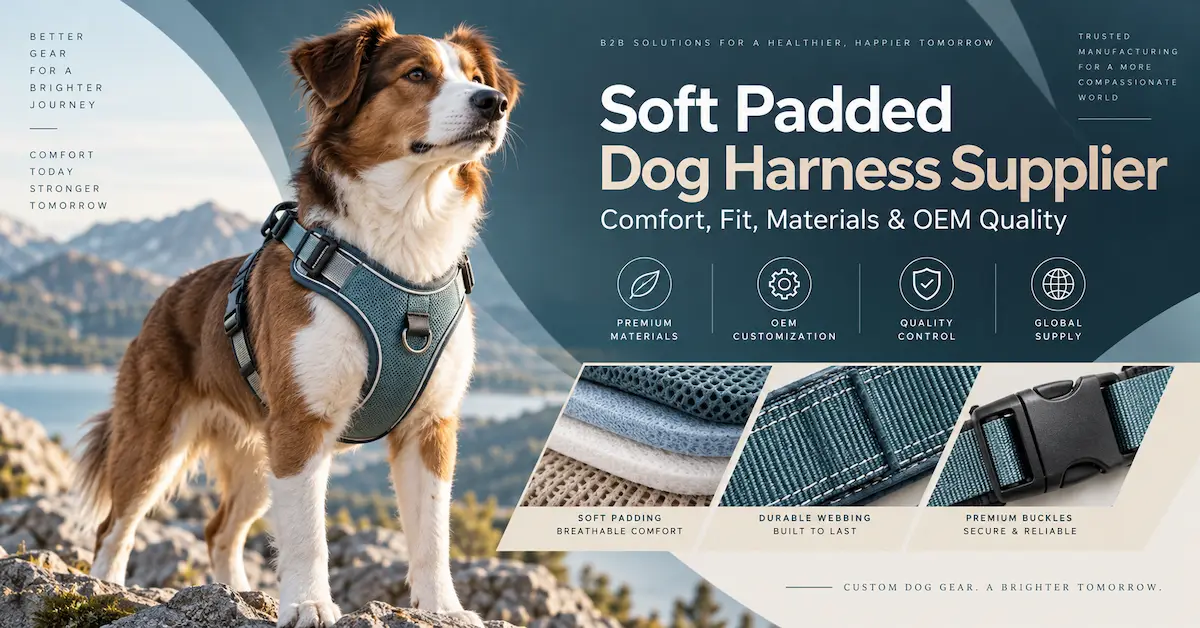
A soft padded dog harness is a walking harness designed with additional cushioning, soft lining, or padded contact areas between the load-bearing structure and the dog's body.
Depending on the product design, padding may appear around:
-
the chest panel;
-
shoulder areas;
-
neck opening;
-
back panel;
-
belly straps;
-
strap edges;
-
other high-contact areas.
The purpose is generally to improve the body-contact experience while maintaining enough structure for walking and leash control.
However, the term “soft padded” does not describe one standardized construction.
Two harnesses can both be marketed as padded while using completely different:
-
outer fabrics;
-
lining structures;
-
cushioning layers;
-
webbing systems;
-
panel shapes;
-
binding methods;
-
hardware configurations.
This is why B2B buyers should not source a harness using only visual references.
A useful specification should define what “soft” means in the intended product.
Softness Should Be Defined Through Product Function
A private-label buyer may be looking for:
-
a lightweight daily-walking harness;
-
a breathable summer harness;
-
a soft vest-style harness;
-
an adjustable padded harness;
-
a padded Y-shaped harness;
-
a reflective outdoor harness;
-
a premium fashion harness.
Each application requires a different balance of materials, coverage, structure, weight, and breathability.
The supplier should therefore understand the intended use before recommending materials.
Which Buyers Need a Soft Padded Dog Harness Supplier?
A soft padded harness is particularly relevant for businesses where comfort, fit, premium positioning, or product differentiation matters.
Private-Label Pet Brands
Private-label pet brands often want more than a stock product with a logo.
They may need control over:
-
harness shape;
-
padding;
-
lining;
-
exterior fabric;
-
webbing;
-
buckle color;
-
D-ring finish;
-
custom artwork;
-
woven or printed labels;
-
size systems;
-
retail packaging.
For these brands, padding becomes part of the complete product identity.
A premium daily-walking harness should feel, fit, and look different from a basic low-cost webbing harness.
Amazon and E-Commerce Sellers
Online buyers cannot physically touch a harness before ordering.
That means e-commerce brands need product specifications that can be communicated visually and clearly.
Important selling points may include:
-
breathable mesh;
-
padded contact areas;
-
adjustable straps;
-
buckle positioning;
-
size range;
-
leash attachment points;
-
edge finishing.
But these features also create return risks if actual sizing or construction does not match the product listing.
For online sellers, size consistency is therefore not only a production issue. It is also a customer acquisition and return-management issue.
Wholesalers and Distributors
Wholesale buyers usually need a broader commercial balance.
They may evaluate:
-
product cost;
-
size assortment;
-
number of colors;
-
packaging;
-
replenishment reliability;
-
market suitability;
-
product consistency.
A distributor may need several harness constructions for different customer groups rather than one design for the entire market.
Retail Chains
Retail buyers typically require consistent specifications across larger quantities and future replenishment orders.
Their concern is not only whether the first sample is attractive.
They also need confidence that:
-
dimensions remain stable;
-
colors remain consistent;
-
hardware is not silently substituted;
-
labels stay accurate;
-
packaging remains unchanged;
-
repeat orders match previous batches.
This makes specification control an important part of supplier evaluation.
Small or Early-Stage Brands
A smaller brand may also benefit from an experienced OEM supplier, but should avoid unnecessary product complexity.
Launching too many sizes, colors, hardware combinations, and custom materials at once can increase:
-
development costs;
-
inventory complexity;
-
packaging requirements;
-
SKU management;
-
sourcing risk.
Starting with a controlled product range can make the first private-label program easier to manage.
Which Applications Should Define the Harness Design?
A common sourcing mistake is choosing materials first.
Buyers sometimes begin with statements such as:
“We need a neoprene harness.”
or:
“We need very thick padding.”
A better development process begins with the application.
Daily Urban Walking
A daily walking harness usually needs a balanced design rather than an extreme design.
Priorities may include:
-
comfort;
-
moderate weight;
-
easy adjustment;
-
simple buckle operation;
-
breathable construction;
-
easy cleaning;
-
stable leash attachment.
Excessive padding can make a daily harness unnecessarily bulky.
Warm-Climate Walking
For markets with warmer weather, buyers may place more emphasis on ventilation.
A padded harness with poor airflow may become less comfortable during longer periods of wear.
Important factors can include:
-
mesh structure;
-
total panel coverage;
-
lining;
-
padding density;
-
drying behavior;
-
edge construction.
The current QQPETS Adjustable Dog Harness describes breathable mesh lining and adjustable construction, making this type of product a useful reference when developing comfort-oriented harnesses.
Outdoor and Hiking Applications
Outdoor products may require additional consideration of:
-
abrasion;
-
dirt exposure;
-
moisture;
-
visibility;
-
stronger hardware;
-
secure adjustment;
-
reinforced attachment areas.
Padding should support comfort without compromising the load-bearing structure.
For outdoor-oriented product planning, buyers can also review the QQPETS outdoor pet safety gear guide.
Small Dogs and Puppies
Small-dog harnesses require careful component selection.
Heavy or oversized hardware can represent a significant percentage of the total product weight.
Buyers should review:
-
webbing width;
-
buckle size;
-
D-ring size;
-
adjuster dimensions;
-
padding thickness;
-
panel dimensions.
A large-dog harness should not simply be scaled down without considering how component proportions change.
Stronger or More Active Dogs
For stronger dogs, comfort remains important, but structural requirements become more critical.
Buyers may need to discuss:
-
webbing construction;
-
reinforced stitching;
-
buckle selection;
-
leash connection points;
-
strap routing;
-
adjustment stability.
Padding should never be used to hide weaknesses in the underlying structure.
Fashion and Lifestyle Collections
For fashion-oriented pet brands, padded panels create useful branding surfaces.
A collection may differentiate through:
-
custom patterns;
-
seasonal colors;
-
contrast binding;
-
matching webbing;
-
custom labels;
-
matching collar and leash sets.
In this market, color consistency and artwork execution become significant sourcing considerations.
How Should Buyers Evaluate Soft Padding Materials?
The word “soft” is subjective.
A supplier may consider a harness soft because it contains cushioning, while a buyer may expect a completely different hand feel.
A professional RFQ should separate the padded harness into functional layers.
| Area | What Buyers Should Define | Why It Matters |
|---|---|---|
| Outer layer | Fabric type, color, surface texture, print | Controls appearance and initial feel |
| Padding | Material direction, thickness, softness | Influences cushioning and bulk |
| Inner lining | Mesh or other body-contact textile | Affects ventilation and comfort |
| Webbing | Material, width, thickness | Provides structural support |
| Edge finish | Binding construction and softness | Influences friction around contact areas |
| Reinforcement | Stitching and load-bearing sections | Supports structural reliability |
Breathable Mesh
Breathable mesh is frequently used in comfort-oriented harness construction because it can support airflow while keeping the product relatively lightweight.
Buyers should evaluate:
-
mesh softness;
-
openness;
-
thickness;
-
edge behavior;
-
abrasion resistance;
-
lamination quality where applicable.
A mesh can look similar in photos while performing differently in the finished harness.
Spacer Mesh
Spacer mesh has a three-dimensional textile structure.
It may offer:
-
airflow;
-
cushioning;
-
dimensional body.
However, buyers should also evaluate:
-
thickness;
-
sewing behavior;
-
compression;
-
finished weight;
-
panel stiffness.
Neoprene-Type Materials
Neoprene-type materials can provide a smooth and cushioned feel.
They may work well in products where:
-
a more substantial feel is desired;
-
clean surface appearance is important;
-
padding and structure need to be integrated.
However, buyers should consider ventilation, weight, thickness, and drying requirements.
Foam-Laminated Fabrics
Foam combined with outer and inner textile layers can offer flexibility in softness and structure.
Important sourcing questions include:
-
foam density;
-
thickness;
-
compression behavior;
-
lamination quality;
-
edge finishing.
Soft Textile Linings
Some products may use soft textile surfaces rather than heavy cushioning.
This can be useful when the objective is improved body contact without significantly increasing product bulk.
The supplier should confirm how the lining interacts with:
-
stitching;
-
moisture;
-
abrasion;
-
washing or cleaning.
Why Breathability Matters as Much as Padding
A padded harness covers more of the dog's body than a simple strap harness.
As coverage increases, the interaction between the body and the lining becomes more important.
A material can feel soft when held in the hand but perform differently when incorporated into a multilayer harness.
The final comfort experience depends on:
outer fabric + padding + lining + webbing + binding + panel geometry
rather than any one material.
Questions to Ask About Breathability
Buyers can ask:
-
How much body area does the padded panel cover?
-
Does the internal material have an open mesh structure?
-
Does the binding reduce airflow?
-
Does the padding retain moisture?
-
How does the finished harness dry after cleaning?
-
Does the structure remain flexible after assembly?
Evaluating the completed sample is more useful than evaluating a single material swatch.
Why Harness Structure May Matter More Than Padding Thickness
More padding does not automatically produce better comfort.
If the harness shape places pressure or friction in the wrong location, increasing the padding may not solve the problem.
Y-Shaped Harness
A Y-shaped harness typically creates a defined front chest structure.
Buyers should examine:
-
chest geometry;
-
shoulder clearance;
-
neck opening;
-
strap angle;
-
side positioning;
-
adjustment range.
The QQPETS Y-shaped harness provides one example of this structural direction.
H-Shaped Harness
H-shaped designs rely strongly on strap positioning and adjustment.
Important evaluation points include:
-
strap width;
-
number of adjustment points;
-
hardware placement;
-
connection-point location;
-
product stability during movement.
The current QQPETS H-shaped harness provides another design reference.
Vest-Style Padded Harness
Vest-style products generally use larger body panels.
Advantages may include:
-
larger soft-contact area;
-
stronger visual differentiation;
-
greater branding surface.
Potential trade-offs include:
-
higher material consumption;
-
increased heat retention;
-
increased weight;
-
greater fit sensitivity;
-
more sewing complexity.
No-Pull Harness Design
If a product is positioned as a no-pull harness, the sourcing specification should identify the structural feature behind that claim.
Possible elements may include:
-
front leash attachment;
-
dual leash attachment;
-
chest strap arrangement;
-
additional control handle;
-
specific strap geometry.
The buyer should evaluate the actual design rather than relying only on the term “no pull.”
What Components Should Buyers Inspect Beyond the Padding?
A professional soft padded dog harness supplier should be able to discuss the complete bill of materials.
Webbing
Webbing can affect both structure and appearance.
Buyers should specify or review:
-
material;
-
width;
-
thickness;
-
flexibility;
-
edge quality;
-
color;
-
print compatibility;
-
hardware compatibility.
If webbing passes through adjusters, the relationship between thickness and hardware dimensions is especially important.
Buckles
A buckle should match the product in both size and function.
Review:
-
opening and closing action;
-
molding quality;
-
dimensions;
-
color;
-
surface finish;
-
compatibility with webbing width;
-
position on the dog's body.
For smaller harnesses, an unnecessarily large buckle can add weight and bulk.
Adjusters
Adjustment hardware should allow fitting but should not move unintentionally.
During sample testing, check:
-
how easily the strap moves;
-
whether the webbing slips;
-
whether the webbing folds;
-
whether the adjuster is correctly sized.
D-Rings
The D-ring should be evaluated as part of a connection system.
Consider:
-
size;
-
shape;
-
surface finish;
-
connection webbing;
-
surrounding stitching;
-
attachment position.
The strength of the metal alone does not determine the strength of the complete attachment point.
Binding
Binding has an important role in padded products because it sits directly around panel edges.
Inspect:
-
softness;
-
thickness;
-
stitch position;
-
edge coverage;
-
consistency;
-
areas near the front legs and neck.
Poor binding can undermine the comfort benefit of the padded center panel.
How Should Buyers Evaluate Harness Fit and Sizing?
Sizing is one of the most important parts of an OEM harness program.
Terms such as S, M, L, and XL are not technical measurements.
A buyer should define physical ranges.
Critical Size Information
Depending on the harness structure, specifications may include:
-
neck circumference or opening;
-
chest/girth range;
-
strap lengths;
-
chest-panel width;
-
chest-panel length;
-
back-panel dimensions;
-
webbing width;
-
hardware dimensions.
The exact measurement system should match the product structure.
Size Grading Matters
Scaling a harness from one size to another requires more than increasing every measurement by the same percentage.
Component proportions may also need adjustment.
For example:
-
a buckle suitable for L may be too heavy for XS;
-
webbing may need a different width;
-
chest-panel proportions may change;
-
padding coverage may need adjustment.
This is why buyers should evaluate the complete size set rather than approving only one medium-sized sample.
Fit Should Be Verified Before Bulk Production
A sample fitting review should check:
-
whether the harness sits in the intended position;
-
whether straps have sufficient adjustment;
-
whether edges contact sensitive areas;
-
whether hardware creates unwanted pressure;
-
whether the product remains stable during normal movement.
The QQPETS dog harness manufacturer guide provides additional information for buyers evaluating harness sourcing and production.
How Is a Custom Soft Padded Dog Harness Developed?
The exact manufacturing process depends on the design, but a professional OEM program generally moves through several connected stages.
Requirement Definition
The buyer should provide enough information to establish the project direction.
This may include:
-
target market;
-
target retail price level;
-
intended application;
-
target dog sizes;
-
reference product;
-
preferred structure;
-
desired materials;
-
color direction;
-
branding;
-
packaging;
-
estimated quantity.
The objective is to remove major uncertainties before sampling begins.
Material and Hardware Selection
The next step is to define the system of materials.
Possible items include:
-
exterior fabric;
-
lining;
-
padding;
-
webbing;
-
buckles;
-
adjusters;
-
D-rings;
-
thread;
-
binding;
-
labels;
-
packaging.
These decisions are interconnected.
Changing one component can affect other parts of the design.
Example
If webbing width changes, the project may also need different:
-
buckles;
-
sliders;
-
D-rings;
-
sewing patterns.
This is why component decisions should be controlled through a specification rather than made independently.
Pattern Development
Padded harnesses often require shaped textile panels.
Pattern accuracy affects:
-
fit;
-
symmetry;
-
sewing;
-
alignment;
-
size consistency.
Once the shape is approved, the pattern becomes an important production reference.
Printing and Branding
Customization can include:
-
printed artwork;
-
heat-transfer designs;
-
labels;
-
logo patches;
-
branded webbing;
-
custom colors;
-
custom packaging.
The appropriate branding method depends on the chosen material and design.
Cutting
Consistent cutting helps control:
-
finished dimensions;
-
left/right symmetry;
-
panel alignment;
-
size grading.
Laminated or multilayer materials may require more careful handling than simple webbing structures.
Sewing
Sewing quality is particularly important for padded harness construction.
Buyers should inspect:
-
seam alignment;
-
reinforcement;
-
thread tension;
-
binding;
-
skipped stitches;
-
loose threads;
-
symmetry;
-
transitions between webbing and padded panels.
Assembly
After textile components are prepared, hardware and straps are assembled according to the approved design.
The order of assembly can influence production efficiency and consistency.
Packaging
Packaging should be included in development rather than added at the final stage.
A padded harness may require different packaging dimensions than a basic webbing harness.
Buyers should confirm:
-
folding method;
-
retail bag or box;
-
hang tag;
-
barcode;
-
size marking;
-
carton configuration.
QQPETS' current company information lists manufacturing processes including heat-transfer printing, silk-screen printing, weaving, cutting, sewing, and packaging. Buyers can review the broader manufacturing background on the QQPETS About Us page.
What Quality Control Should a Soft Padded Dog Harness Supplier Provide?
Quality control should not begin only after production is completed.
It should follow the product through different manufacturing stages.
Incoming Material Checks
The factory should verify that production materials match approved references.
Important items may include:
-
exterior fabric;
-
lining;
-
padding;
-
webbing;
-
buckles;
-
adjusters;
-
D-rings;
-
thread;
-
labels;
-
packaging.
Cutting Checks
Cutting inspection can help identify:
-
incorrect patterns;
-
wrong sizes;
-
poor symmetry;
-
material-direction errors;
-
inaccurate panel dimensions.
Printing and Branding Checks
For custom artwork, inspect:
-
color;
-
placement;
-
orientation;
-
sharpness;
-
logo dimensions;
-
label positioning.
Sewing Checks
Sewing inspection should consider both appearance and structure.
Look for:
-
missed stitches;
-
uneven seams;
-
weak reinforcement;
-
exposed padding;
-
uneven binding;
-
incorrect strap assembly.
Hardware Checks
Operate buckles and adjusters.
Check:
-
correct component model;
-
smooth operation;
-
secure closing;
-
correct placement.
Dimension Checks
Finished products should be compared with the approved size specification.
This is especially important across multiple sizes.
Appearance Checks
Inspect:
-
symmetry;
-
stains;
-
scratches;
-
wrinkles;
-
color matching;
-
hardware finish;
-
exposed foam or lining;
-
thread trimming.
Packaging Checks
Final packaging inspection may include:
-
correct SKU;
-
correct size;
-
correct color;
-
barcode;
-
labels;
-
inserts;
-
carton marks.
For retail and e-commerce brands, packaging errors can be commercially significant even when the harness itself is correctly manufactured.
What Testing Should Buyers Discuss?
The appropriate testing plan depends on the product design, intended market, use case, and buyer requirements.
Possible areas for discussion include:
-
seam performance;
-
attachment-point performance;
-
buckle operation;
-
adjustment stability;
-
abrasion;
-
colorfastness;
-
dimensional consistency;
-
cleaning performance;
-
logo durability;
-
reflective performance where applicable.
The objective should not be to request every possible test.
A better method is to identify likely failure points and decide how those risks should be checked.
Example: Outdoor Harness
A buyer developing an outdoor product may focus more strongly on:
-
attachment areas;
-
abrasion;
-
hardware;
-
dirt exposure;
-
visibility features.
Example: Fashion Harness
A fashion-focused product may place greater emphasis on:
-
artwork;
-
color;
-
logo quality;
-
stitching appearance;
-
matching accessories.
Testing priorities should reflect actual product risk.
How Should Buyers Approach Certifications and Compliance?
Buyers frequently ask suppliers:
“What certifications do you have?”
That question is useful, but incomplete.
A better B2B approach is to determine whether a document applies to the specific:
-
company;
-
factory;
-
material;
-
finished product;
-
target market.
QQPETS currently lists ISO 9001, BSCI, SGS, and OEKO-related standards on its About Us page.
However, buyers should verify the scope of any certificate or report relevant to their project.
Information to Request
Where relevant, ask for:
-
document name;
-
issuing organization;
-
certificate or report number;
-
scope;
-
validity period;
-
applicable materials;
-
applicable product category.
Do not assume that a factory-level document automatically certifies every finished harness.
Compliance requirements should be confirmed according to the target market and actual product specification.
Soft Padded vs Breathable Mesh vs Basic Webbing Harness
Different harness types serve different product strategies.
| Harness Type | Key Advantage | Main Trade-Off | Suitable Positioning |
|---|---|---|---|
| Basic webbing harness | Lightweight and simple | Less body cushioning | Entry-level walking |
| Soft padded harness | Softer contact and premium feel | Higher material complexity | Premium daily walking |
| Breathable mesh harness | Airflow and lightweight comfort | Mesh quality matters | Warm-weather walking |
| Padded Y-shaped harness | Structured fit and comfort | Requires careful sizing | Premium walking range |
| Vest-style padded harness | Large soft area and branding surface | More coverage and bulk | Fashion/lifestyle |
| Reflective padded harness | Comfort plus visibility | Additional components | Outdoor/night use |
There is no universally “best” structure.
The buyer should define:
target customer + application + retail level + material requirements + fit strategy
before selecting the product.
How Does OEM Customization Work for Padded Harnesses?
OEM development can take different levels of complexity.
Level 1: Branding an Existing Harness
The buyer may retain an existing structure while modifying:
-
color;
-
logo;
-
artwork;
-
labels;
-
packaging.
This is often easier to manage than a complete structural redesign.
Level 2: Material and Component Customization
The general harness geometry remains similar, but the buyer may change:
-
exterior material;
-
mesh;
-
padding;
-
webbing;
-
buckles;
-
hardware finishes;
-
binding.
This can create stronger differentiation while keeping development under control.
Level 3: Structural Development
A more advanced project may change:
-
panel shape;
-
neck geometry;
-
strap routing;
-
adjustment points;
-
leash attachment;
-
back handle;
-
size grading.
Structural changes normally require more sample evaluation.
Level 4: Complete Walking Collection
Private-label brands may develop matching:
-
harnesses;
-
dog collars;
-
dog leashes;
-
related walking accessories.
A coordinated range can share:
-
artwork;
-
webbing;
-
colors;
-
hardware finish;
-
brand labels;
-
packaging design.
Buyers planning a private-label harness program can also review the QQPETS dog harness private-label supplier guide.
What Determines Soft Padded Dog Harness Cost?
A serious OEM quotation should be based on the actual specification.
There is no meaningful universal price for a custom soft padded harness.
Major Cost Variables
Cost can be influenced by:
-
exterior fabric;
-
lining;
-
padding;
-
webbing;
-
buckle type;
-
adjusters;
-
metal hardware;
-
printing;
-
reflective components;
-
custom labels;
-
number of sizes;
-
number of colors;
-
sewing complexity;
-
packaging;
-
order volume.
A cheaper quotation may not represent the same product.
Example
Supplier A may quote a lower unit price because it uses:
-
simpler hardware;
-
different padding;
-
lighter webbing;
-
basic packaging;
-
fewer customized components.
Supplier B may be quoting against a higher specification.
Comparing the prices directly would therefore be misleading.
Build a Common RFQ Before Comparing Prices
Send each potential supplier the same:
-
product drawing;
-
material requirements;
-
sizes;
-
color requirements;
-
hardware direction;
-
packaging;
-
quantity.
This makes supplier quotations easier to compare.
What Determines MOQ for Custom Padded Harnesses?
MOQ can be affected by more than the final assembly process.
Upstream materials may create their own minimum requirements.
Possible MOQ drivers include:
-
custom fabric;
-
custom print;
-
custom webbing;
-
custom color;
-
special hardware;
-
labels;
-
packaging.
SKU quantity also matters.
Example of SKU Complexity
A range containing:
-
5 sizes;
-
4 colors
already creates 20 size/color combinations.
The total order may appear large, but individual SKU quantities may still be small.
Therefore, ask:
“What MOQ applies to this material, color, size breakdown, logo method, and packaging specification?”
rather than:
“What is your MOQ?”
The second question is too broad to support an accurate sourcing decision.
Why Is Sampling Essential?
A digital rendering can help confirm appearance, but it cannot confirm many physical characteristics.
A production-intent sample allows the buyer to evaluate the complete product.
Material Review
Check:
-
softness;
-
texture;
-
weight;
-
lining;
-
padding;
-
binding.
Fit Review
Check:
-
chest position;
-
neck opening;
-
strap location;
-
adjustment;
-
movement;
-
edge contact.
Hardware Review
Check:
-
buckle operation;
-
adjuster operation;
-
D-ring position;
-
hardware size;
-
finish.
Workmanship Review
Check:
-
stitching;
-
reinforcement;
-
symmetry;
-
binding;
-
thread;
-
panel alignment.
Branding Review
Check:
-
logo position;
-
print quality;
-
color;
-
labels;
-
artwork orientation.
Packaging Review
Check:
-
folding;
-
barcode;
-
SKU information;
-
size marking;
-
package dimensions.
Sample approval should not be based on appearance alone.
Why Should the Approved Sample Be Combined With a Specification Sheet?
A sample shows what the product should look and feel like.
A specification explains what must be reproduced.
Using both creates a stronger production reference.
Recommended Specification Fields
| Specification Area | Details to Record |
|---|---|
| Product | Model or structural reference |
| Application | Daily, outdoor, fashion, etc. |
| Size | Neck, chest and critical dimensions |
| Outer fabric | Approved material |
| Padding | Approved construction |
| Lining | Approved lining |
| Webbing | Material, width and color |
| Buckles | Type and size |
| Adjusters | Type and dimensions |
| D-rings | Size, position and finish |
| Binding | Material and color |
| Thread | Color |
| Logo | Method, size and location |
| Artwork | Approved version |
| Labels | Brand, size, care |
| Packaging | Retail and shipping details |
| QC | Critical inspection requirements |
| Sample | Approved sample version |
A controlled specification becomes especially important for repeat orders.
Why Is Repeat-Order Consistency Important?
Many sourcing problems appear not during the first production run but during later replenishment.
Possible changes include:
-
different mesh feel;
-
different foam density;
-
webbing color variation;
-
changed buckle finish;
-
altered logo dimensions;
-
size variation;
-
new packaging materials.
These changes may seem small at factory level but can be visible to consumers.
Questions to Ask the Supplier
Ask how the supplier manages:
-
approved material references;
-
size specifications;
-
artwork files;
-
sample versions;
-
component changes;
-
product revisions.
If a component becomes unavailable, there should be a clear approval process before substitution.
For a growing brand, this type of specification control can be more valuable than a small unit-price difference.
What Are the Most Common Sourcing Risks?
Choosing Padding Only by Thickness
Thicker padding can increase:
-
bulk;
-
heat;
-
weight;
-
packaging volume.
Comfort should be evaluated in the finished harness.
Selecting Materials Before Defining Use
Material should follow application.
A daily urban harness and an outdoor harness may need different priorities.
Approving Products Only From Photos
Photos do not accurately communicate:
-
softness;
-
weight;
-
edge feel;
-
hardware operation;
-
actual fit.
Physical sampling remains important.
Comparing Different Specifications
If suppliers quote different materials and hardware, the lowest number is not necessarily the lowest price for the same product.
Developing Too Many SKUs Too Early
A broad size and color range increases:
-
inventory;
-
material allocation;
-
packaging complexity;
-
forecasting risk.
A controlled launch can be easier to scale.
Ignoring Repeat Production
A first sample is not enough.
Buyers should consider how the supplier will reproduce the same product later.
Treating Compliance as a Checkbox
Certificate names alone do not explain whether a document applies to the specific product.
Verify scope.
Treating Padding as Purely Cosmetic
Padding affects:
-
pattern design;
-
sewing;
-
fit;
-
heat;
-
weight;
-
packaging.
It should be treated as a technical component.
How Should Buyers Compare Soft Padded Dog Harness Suppliers?
A supplier scorecard can make the decision more objective.
| Evaluation Area | Buyer Question |
|---|---|
| Application knowledge | Does the supplier ask how the harness will be used? |
| Materials | Can padding and lining be clearly specified? |
| Structure | Can the supplier explain harness geometry? |
| Sizing | Can adjustment and measurement ranges be documented? |
| Hardware | Are webbing, buckles and D-rings compatible? |
| Sampling | Is there a structured sample approval process? |
| Customization | Can branding, pattern and packaging be controlled? |
| Sewing | Can padded construction be produced consistently? |
| QC | Are material, dimension and hardware checks defined? |
| Documentation | Can specifications and artwork versions be controlled? |
| Repeat orders | Is there a process for managing component changes? |
| Product range | Can related walking products be developed? |
| Communication | Are requirements confirmed before production? |
The supplier should be able to reduce ambiguity.
A factory that responds to every question with “yes, no problem” without discussing specifications may not yet have enough information to quote responsibly.
What Should Be Included in a Dog Harness RFQ?
A detailed RFQ improves both quotation accuracy and supplier comparison.
Include as many of the following as possible:
-
Product reference
-
Photos or drawings
-
Harness structure
-
Target market
-
Target dog sizes
-
Size chart
-
Outer material
-
Padding requirement
-
Lining requirement
-
Webbing
-
Buckles
-
Adjusters
-
D-rings
-
Colors
-
Logo artwork
-
Custom pattern
-
Labels
-
Packaging
-
Quantity
-
SKU breakdown
-
Testing requirements
-
Target launch schedule
If you already have product drawings, artwork, reference photos, packaging files, or technical information, they can help the supplier understand the project more quickly.
Buyers can submit sourcing requirements through the QQPETS inquiry page.
Why Consider QQPETS for a Soft Padded Dog Harness Project?
For an OEM project, supplier evaluation should focus on relevant manufacturing and customization capabilities rather than marketing claims.
QQPETS currently presents dog harnesses and other walking accessories through its product range, including adjustable, Y-shaped, H-shaped, and reflective harness directions.
Its company information also identifies manufacturing processes including:
-
heat-transfer printing;
-
silk-screen printing;
-
weaving;
-
cutting;
-
sewing;
-
packaging.
The current Adjustable Dog Harness product information references breathable mesh lining, adjustable construction, and OEM/ODM customization options.
Buyers evaluating a project can use the following site resources:
A useful first inquiry should describe the intended application, size range, preferred structure, materials, estimated order volume, branding requirements, and packaging direction.
FAQ About Soft Padded Dog Harness Suppliers
What should I look for in a soft padded dog harness supplier?
Evaluate the supplier's ability to control materials, padding, harness structure, sizing, webbing, hardware, sewing, sampling, branding, packaging, quality control, and repeat production.
The strongest supplier is not simply the one that offers the lowest unit price. It is the supplier that can translate your product concept into a controlled specification.
What materials are commonly considered for padded harnesses?
Common market approaches can include breathable mesh, spacer mesh, neoprene-type materials, soft textile layers, foam-laminated fabrics, and multilayer combinations.
The correct option depends on your intended application, target weight, climate, comfort requirement, retail positioning, and cleaning expectations.
Actual material availability should be confirmed with the supplier.
Is a soft padded harness always better than a basic harness?
No.
Padding can improve body contact and support premium positioning, but a poorly designed padded harness can still create fit or heat issues.
A basic webbing harness may be more suitable for some lightweight or entry-level applications.
Product selection should be based on use case rather than one feature.
Should I choose a mesh or neoprene padded harness?
The correct choice depends on the desired product characteristics.
Mesh may be attractive where ventilation and lower weight are priorities.
Neoprene-type materials may offer a different cushioning feel and surface appearance.
Evaluate complete physical samples rather than choosing only by material name.
Can a padded dog harness be customized with a private-label logo?
Yes, depending on the product structure and selected material.
Possible customization can include:
-
logos;
-
labels;
-
printed patterns;
-
colors;
-
packaging.
The appropriate branding method should be confirmed during product development.
Can I develop matching collars and leashes?
If the supplier supports related walking-accessory categories, it may be possible to create coordinated product sets.
A collection can share:
-
colors;
-
artwork;
-
webbing;
-
hardware finishes;
-
labels;
-
packaging.
This can help private-label brands create a more consistent retail assortment.
What is the MOQ for a custom padded dog harness?
MOQ depends on the exact project.
Factors may include:
-
materials;
-
custom colors;
-
printing;
-
hardware;
-
size count;
-
color count;
-
packaging;
-
total SKU structure.
Request an MOQ based on your complete specification rather than asking for one universal number.
Do I need a physical sample?
For customized products, a physical sample is strongly recommended before bulk approval.
It allows buyers to evaluate:
-
softness;
-
fit;
-
sizing;
-
hardware;
-
workmanship;
-
branding;
-
packaging.
The sample should ideally be supported by a written specification.
How should bulk quality be checked?
A useful quality-control plan may include:
-
incoming materials;
-
cutting;
-
printing;
-
sewing;
-
hardware;
-
finished dimensions;
-
appearance;
-
labels;
-
packaging.
Inspection requirements should be defined before production where possible.
What should I send a supplier for an accurate quotation?
Provide:
-
reference product;
-
application;
-
sizes;
-
materials;
-
padding;
-
lining;
-
hardware;
-
colors;
-
branding;
-
packaging;
-
quantity;
-
SKU breakdown;
-
target market.
The more complete the RFQ, the easier it is to compare suppliers accurately.
Conclusion
Choosing the right soft padded dog harness supplier requires evaluating more than softness or unit price. Focus on fit, breathable materials, padding structure, webbing, hardware, sewing, sizing, sampling, QC, customization, and repeat-order consistency.
A clear specification and approved sample reduce sourcing risk and make quotations easier to compare. For an OEM or private-label padded harness project, buyers can contact QQPETS with product references, sizes, materials, branding, packaging, and estimated quantities for further project evaluation.