Padded Dog Collar Supplier: The Short Answer
A suitable padded dog collar supplier is not simply a source of collars with foam or soft fabric added to a strap. For a B2B buyer, the supplier must control the wearable system: webbing, padding, skin-facing layer, edge finish, buckle, adjuster, D-ring, stitching, size range, branding, packaging, inspection, and repeat-order specifications. The question is whether the supplier can reproduce the same comfort and appearance across a defined SKU.
This guide addresses one search intent: how should pet brands, wholesalers, distributors, retailers, and e-commerce teams compare padded-collar suppliers before a bulk order? It focuses on supplier comparison and commercial investigation. It does not make medical claims or treat every padded design as suitable for leash restraint.
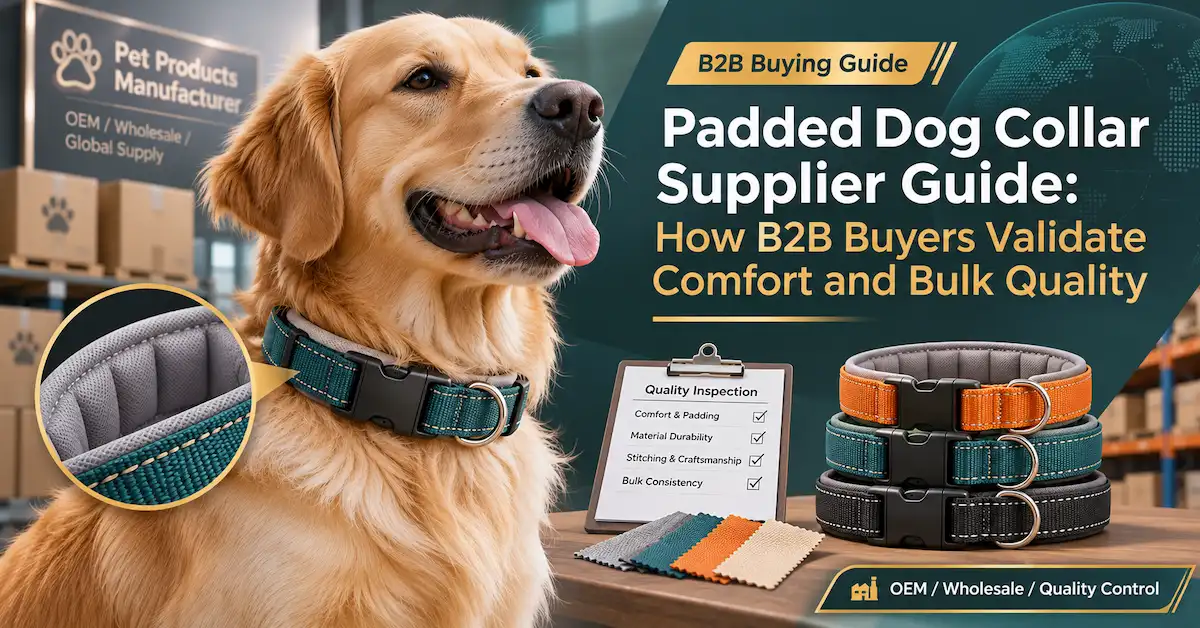
What Buyers Mean by a Padded Dog Collar
“Padded” is a construction description, not a complete specification. A collar may use foam laminated to webbing, neoprene-like backing, spacer mesh, brushed fabric, quilted layers, or a soft sleeve around a structural strap. Two products can both be called padded while differing substantially in thickness, moisture behavior, drying time, weight, flexibility, and sewing complexity.
Define the commercial use case first
A fashion-oriented everyday collar may prioritize a soft hand feel, print quality, and retail presentation. A walking collection may prioritize stable adjustment, a reliable D-ring, and a backing that remains comfortable under a leash. A premium travel line may need a washable surface, controlled color, and packaging that explains cleaning limits. These are different briefs, so the supplier should not quote “padded collar” without asking what the product must do.
| Buyer decision | Questions to define | Commercial consequence |
|---|---|---|
| Target user | Small, medium, large, short-haired, long-haired, or sensitive-skin positioning? | Changes width, weight, edge treatment, adjustment range, and comfort expectations. |
| Wearing scenario | Short daily walks, all-day wear, travel, training, or accessory styling? | Sets the priority between softness, low weight, durability, and hardware strength. |
| Climate | Dry indoor market, humid region, frequent rain, or cold-weather use? | Influences backing, drying instructions, odor risk, and care communication. |
| Sales channel | Pet stores, distributors, marketplaces, or direct-to-consumer? | Determines package format, barcode needs, claims, and return-risk controls. |
| Brand position | Value, mid-market, premium comfort, or coordinated collection? | Guides padding finish, hardware appearance, logo method, and packaging investment. |
Give the supplier a measurable brief: collar width, neck range, padding materials, color references, buckle, D-ring, logo location, package contents, quantity by size and color, destination market, and inspection expectations. Judge the physical sample against that brief.
Padding Construction: Comfort Depends on More Than Thickness
Padding changes the contact surface between the collar and the dog’s neck, but thicker is not automatically better. Excess material can add weight, trap moisture, reduce flexibility, and make the collar rotate. A thin, well-finished backing may be more comfortable than a thick layer with rough seams or exposed edges. The right construction depends on the target dog, wearing time, climate, and product position.
Layer one: the structural webbing
The webbing carries the main load and gives the collar its shape. Buyers should record fiber type, width, thickness, weave, color, and edge condition. Nylon may be selected for a flexible hand feel and everyday strength; polyester may suit stable color presentation and printed collections. These are sourcing options, not automatic performance claims. The supplier should provide the actual material specification for the proposed SKU and explain whether the padding is laminated, sewn, or enclosed.
Layer two: the cushioning material
Ask what the cushioning layer is designed to do. A foam layer can soften contact but may compress over time. A spacer mesh can improve airflow but introduces additional seams and cleaning considerations. A brushed textile can feel soft against fur but may collect lint. Neoprene-like materials can offer a smooth, flexible backing yet require clear guidance about heat, moisture, and odor. The buyer should evaluate recovery after compression, surface pilling, color transfer, and the way the layer behaves around the buckle and adjuster.
Layer three: the skin-facing finish and edge
Most comfort complaints start at the edge or at a hard transition between layers. Run a finger along the inside perimeter, around folded webbing, beside the buckle, and across the D-ring attachment. Look for exposed foam, sharp cut edges, bulky overlaps, skipped stitches, or a stiff label. Ask how the supplier controls edge binding and seam placement when the collar is produced in multiple sizes.
Evidence boundary: “Soft,” “comfort,” and “padded” are product-positioning terms. They should be supported by a sample review, measurable dimensions, material information, and wear instructions. They are not proof of medical safety or suitability for every dog.
Hardware, Stitching, and Load Paths
A padded collar still depends on ordinary collar components. The soft layer cannot compensate for a buckle that releases unintentionally, an adjuster that slips, a D-ring that is poorly attached, or stitches that stop short of the load path. A buyer should inspect hardware and sewing as a system, especially when padding makes the assembly thicker.
| Component | What to inspect on the sample | Why it affects bulk orders |
|---|---|---|
| Webbing and backing | Width, thickness, alignment, hand feel, color, and layer movement. | Controls fit, comfort, appearance, and repeatable dimensions. |
| Buckle | Locking feel, release action, molding quality, and clearance around padding. | Affects daily use, returns, and the perceived quality of the line. |
| Adjuster | Threading path, movement, holding behavior, and ease of adjustment. | Determines whether the size chart remains usable after wear. |
| D-ring | Material, finish, position, weld or connection, and surrounding reinforcement. | Influences tag or leash attachment and local stress concentration. |
| Stitching | Straightness, density, back-tacks, thread tension, and loose-thread control. | Connects the hardware to the strap and reveals process discipline. |
| Label and logo | Placement, abrasion, color, and contact with the dog’s neck. | Protects brand identity without creating a comfort defect. |
Ask the supplier to identify the load path: where force enters the D-ring, how it travels through the webbing, and which stitches reinforce the connection. State clearly whether the collar is for identification, fashion, or leash attachment; do not infer restraint suitability from a decorative sample.
Fit and Size Development for Padded Collars
Padding changes the effective inside circumference. A collar that fits a display form may feel tight when the backing compresses against fur, or loose when a thick layer prevents the adjuster from holding its position. Size should therefore be developed with the padding installed, not calculated from the unpadded webbing alone.
Build a measurable size chart
For each size, define minimum and maximum finished neck circumference, collar width, padding thickness, buckle dimensions, adjuster position, and tolerance. Add a fitting instruction that explains how the end customer should check the collar. The familiar “two-finger” rule can be a general consumer instruction, but a B2B specification still needs actual measurements so the factory and buyer are discussing the same product.
Test both ends of the adjustment range
Fit every sample at the smallest and largest stated settings. Check whether the padding folds, whether the buckle sits under the throat, whether the D-ring rotates to an awkward position, and whether the collar stays centered after movement. Repeat the check on more than one size because a seam or hardware location that feels acceptable on a medium sample may create pressure on a small or large version.
Account for coat, moisture, and movement
Long fur can change how a collar settles, while short fur exposes edge pressure more directly. Humidity and rain can change the hand feel of a backing and increase drying time. Ask for cleaning instructions that match the actual materials and hardware. If the collar is not designed for soaking or machine washing, the packaging should say so rather than implying universal washability.
Sampling: Approve the Construction, Not Just the Artwork
A padded collar needs a more deliberate sample process than a flat printed strap because the relationship between layers is part of the product. Use staged approval so design, fit, comfort, and packaging are not mixed into one last-minute decision.
- Requirement sample: confirm the proposed padding, webbing, hardware, edge finish, and general dimensions before investing in final artwork.
- Size-set sample: review all planned sizes, because padding thickness, adjuster position, and seam length can vary by size.
- Branding sample: approve color, print, woven label, logo placement, hangtag, barcode, and package copy.
- Pre-production sample: confirm that the components and construction match the bill of materials that will enter bulk production.
Record the sample revision, material names, component codes, dimensions, tolerance, logo file, color reference, package proof, and open questions. Keep the approved sample physically. “Same as last time” is not a sufficient reorder specification when a supplier may change foam, backing fabric, buckle, thread, or packaging.
Use a practical hand-check list
- Measure minimum and maximum neck circumference with padding installed.
- Run a finger across every inside edge and seam transition.
- Cycle the buckle and adjuster repeatedly; note friction, slip, or snagging.
- Inspect D-ring attachment and reinforcement from both sides.
- Compress the padding and check recovery, uneven thickness, and permanent creasing.
- Check color, print registration, logo position, label comfort, and loose threads.
- Compare package contents and cleaning instructions with the physical product.
Quality Control for Padded Dog Collars
Quality control should cover incoming materials, construction, function, appearance, and packing. A final visual check can miss a backing that delaminates, an adjuster that slips, or a size label that does not match the actual circumference. Agree on checkpoints before production and define how defects are classified and corrected.
| Control stage | Checks to discuss | Evidence a buyer can retain |
|---|---|---|
| Incoming materials | Webbing, padding, backing, buckles, rings, thread, labels, and packaging. | Approved swatches, component list, and substitution rule. |
| Cutting and layering | Length, width, layer alignment, padding placement, and edge preparation. | Cutting tolerance and in-process checklist. |
| Sewing and assembly | Seam position, reinforcement, thread tension, hardware installation, and loose threads. | Reference sample and workmanship standard. |
| Fit and function | Adjustment, buckle operation, D-ring position, weight distribution, and edge comfort. | Size chart, functional check, and sample record. |
| Appearance and branding | Color, print, logo, label, stains, pilling, and surface damage. | Approved artwork, color reference, and acceptance photos. |
| Packing | Size, quantity, barcode, insert, warning, carton mark, and protection. | Final packing list and package proof. |
Separate factory evidence from SKU evidence
Sixpet’s public company information references standards and certifications including ISO 9001, BSCI, SGS, and OEKO. Those references help establish a manufacturing context, but a buyer should verify the current document, issuing body, validity period, and scope. A company-level quality system does not automatically certify every padding material, buckle, finished collar, or destination market. Request product- or component-specific evidence whenever the product page makes a technical or compliance claim.
Define defects that matter to customers
A broken buckle, exposed hard edge, missing reinforcement, wrong size label, or delaminated padding can create a safety complaint or return. A small print variation may be cosmetic, but a logo that touches the skin-facing surface may become a comfort problem. Classify defects by customer impact and agree on corrective action, rather than accepting a generic statement that every item was “checked.”
MOQ, Lead Time, Cost, and Packaging Questions
There is no responsible universal price for a padded collar. The quotation changes with webbing, cushioning, backing, width, color, buckle, metal hardware, logo method, number of sizes, packaging, inspection, and quantity. A supplier comparison should use the same written brief so that a lower price is not simply a thinner or less complete specification.
| Commercial item | Questions to ask a padded dog collar supplier | Risk controlled |
|---|---|---|
| MOQ | Is the minimum per color, size, material, logo, or total order? | Prevents hidden inventory exposure across many small SKUs. |
| Sample cost | Does sampling include padding, hardware, logo, and package proof? | Shows whether the sample represents the sellable product. |
| Lead time | When does timing start: brief, sample approval, deposit, or material confirmation? | Separates development, material preparation, production, inspection, and dispatch. |
| Packaging | Are hangtags, barcode labels, inserts, size marks, and carton details included? | Prevents a “finished” order that still needs relabeling. |
| Reorders | How are approved padding, fabric, hardware, artwork, and tolerances controlled? | Protects comfort and brand consistency in later batches. |
A current QQPETS dog collar listing references a 30–40 piece minimum for that specific design. Treat this as a product-level reference, not a universal padded-collar MOQ. Padding type, custom color, size assortment, private-label packaging, and the number of SKUs can change the minimum. Ask for the MOQ of the exact material, dimensions, hardware, branding, and package you intend to sell.
Separate lead time into development, sample revision, component preparation, production, inspection, and dispatch. For repeat orders, retain the bill of materials, approved sample, size chart, artwork, package proof, and inspection criteria; require approval before substitutions.
Private Label and Collection-Level Customization
Private-label buyers often want a padded collar to look like part of a larger walking collection. That means the supplier must control more than a logo. Coordinate the collar’s color, print scale, label, hardware finish, packaging, and size language with the matching leash or harness. A supplier that can produce multiple pet accessory categories may reduce coordination work, but each SKU still needs its own sample and quality specification.
Customization options to define
- Construction: webbing width, padding type, backing fabric, edge binding, buckle, adjuster, and D-ring.
- Appearance: Pantone or physical color, print pattern, contrast binding, hardware finish, and label format.
- Branding: heat-transfer print, screen print, woven label, sewn label, rubber patch, hangtag, or package branding.
- Packaging: retail card, box, polybag, barcode, insert, care text, warning copy, and carton marks.
- Assortment: sizes, colors, matching products, seasonal variants, and reorder priorities.
Start with a controlled assortment instead of every color and size. Five colors across five sizes already create 25 SKU combinations before packaging. A smaller launch makes comfort, returns, sell-through, and replenishment easier to validate.
Supplier Comparison Scorecard
Use a common brief with every candidate and score evidence, not adjectives. A supplier that asks about wearing time, climate, coat type, leash attachment, and package claims may be reducing risk. A supplier that sends a fast price for an undefined “padded collar” is quoting an assumption.
| Evaluation area | Evidence to request | Pass signal |
|---|---|---|
| Product definition | Layer construction, dimensions, intended use, and care limits. | The supplier distinguishes comfort, identification, and restraint functions. |
| Material control | Webbing, padding, backing, hardware, color, and component codes. | Specifications are written and substitutions require approval. |
| Fit development | Size chart, adjustment range, tolerances, and size-set sample. | Padding is included in the measured finished dimensions. |
| Construction quality | Edge finish, seam reinforcement, hardware attachment, and workmanship checks. | Comfort and load paths are reviewed together. |
| Sampling | Revision history, physical approval, branding proof, and pre-production sample. | Bulk production has one controlled reference. |
| QC evidence | Incoming, in-process, functional, appearance, and packing checks. | Defects are defined by customer impact, not only by appearance. |
| Commercial clarity | SKU MOQ, sample cost, lead-time start, packaging, and reorder terms. | Finance can model the real launch and replenishment risk. |
| Entity and trust | Factory address, processes, company profile, certificates, and contact route. | Company-level claims are separated from SKU-level proof. |
Mark missing documents as “open” rather than awarding an assumption a passing score. A factory photograph is not evidence of a padded collar’s seam quality, and a certificate logo is not proof that every material in the proposed order is covered. The strongest supplier file links each claim to a sample, specification, test record, or current document.
FAQ: Padded Dog Collar Supplier Sourcing
1. What should a padded dog collar supplier provide before a bulk order?
The supplier should provide a defined collar specification, material and component details, a physical sample, a measurable size chart, quality checkpoints, packaging proof, MOQ, lead-time assumptions, and evidence for any performance or compliance claim. The buyer should retain the approved sample and written revision record.
2. Is padding automatically safer or more comfortable?
No. Comfort depends on padding material, thickness, edge treatment, moisture behavior, fit, weight, and how the collar is worn. Padding can improve the contact feel, but it cannot replace correct sizing, suitable hardware, or a product-specific safety review.
3. Which materials are common in padded dog collars?
Common constructions combine nylon or polyester webbing with foam, mesh, brushed textile, neoprene-like backing, or another soft layer. The right choice depends on the target market and use case. Ask for the exact material name, thickness, color method, cleaning limits, and sample behavior.
4. How should I test a padded collar sample?
Measure both ends of the adjustment range, inspect every inside edge, cycle the buckle and adjuster, check D-ring reinforcement, compress the padding, review color and logo placement, and compare the package contents with the specification. Test every intended size and not only the middle size.
5. Is a padded collar suitable for leash attachment?
Only when the design and intended use support it. Some padded collars are primarily identification or fashion accessories. Do not infer restraint suitability from a decorative sample; ask the supplier to confirm the load path, hardware, reinforcement, and any applicable product-specific testing.
6. How is MOQ set for a custom padded collar?
MOQ can change with webbing, padding, color, hardware, logo method, number of sizes, packaging, and total SKU count. Request the MOQ for the exact configuration. A minimum quoted for a standard collar or another reference design should not be treated as a universal padded-collar minimum.
7. What documents should I request from the supplier?
Request a product specification, bill of materials, size chart, approved artwork, care and warning copy, inspection method, relevant test reports, certificate scope, MOQ, lead-time assumptions, and change-control process. The destination market and published claims determine which documents are necessary.
8. Can I create a matching collar, leash, and harness collection?
Yes, a multi-category manufacturer can coordinate colors, patterns, labels, hardware finishes, and packaging. Each product still needs its own sample because padding, load paths, fit, and sewing details differ.
9. How do I reduce differences on repeat orders?
Keep an approved physical sample, bill of materials, component codes, color references, artwork, size tolerances, package proof, and inspection criteria. Require written approval before a supplier changes padding, backing, buckle, D-ring, thread, label, or packaging.
10. What information should I send when requesting a quotation?
Send the target dog profile, wearing scenario, neck range, width, padding and backing preference, hardware, colors, logo, packaging, quantity by SKU, destination market, launch timing, and testing or documentation needs. Clearly mark decisions that are still open.
Conclusion
A padded dog collar supplier should be evaluated as a product-development and repeat-order partner, not only as a source of soft-looking samples. The buyer must verify layer construction, edge comfort, hardware, load paths, measurable fit, sampling discipline, QC evidence, SKU-level MOQ, lead time, packaging, and change control. Company credentials provide context, but only the approved padded-collar configuration can support product claims.
Use the scorecard in this guide to compare suppliers, approve a size-set and pre-production sample, and keep every material and packaging decision traceable. For a private-label padded collar or coordinated walking collection, send Sixpet your specification so the team can review construction options and sampling requirements for your market.