A buckle dog collar wholesale order succeeds or fails on the fastener specification, not on the strap colour. The buckle decides how the collar closes, how much load the closure survives, which dog weights the size range can honestly claim, and how often the product comes back as a return. Buyers who describe the buckle in the purchase order — type, material, inner width, plating, break strength and test method — get comparable quotes and repeatable bulk lots. Buyers who write "black buckle" get whatever the factory had on the shelf that week.
What a buckle collar is — and what the term hides
A buckle collar is a collar closed by a fastener rather than slipped over the head or clipped with a snap hook. In retail language that usually means a pin-and-hole buckle working like a belt: the strap passes through the frame and a prong drops into one of several punched holes.
In hardware and factory language, "buckle" covers a much wider family, including side-release buckles that clip together and are often called quick-release clips by dog owners. This single naming gap causes a large share of bulk-order disputes. A purchase order that says "buckle" without a drawing can be quoted as a tongue buckle by one supplier and a plastic clip by another, and both quotes will look legitimate.
For a buckle dog collar wholesale programme, fix the language first: name the fastening method, attach a 2D drawing, and state the webbing width the buckle must accept. Everything else in this guide builds on that one document.
The four dog collar buckle types in wholesale programmes
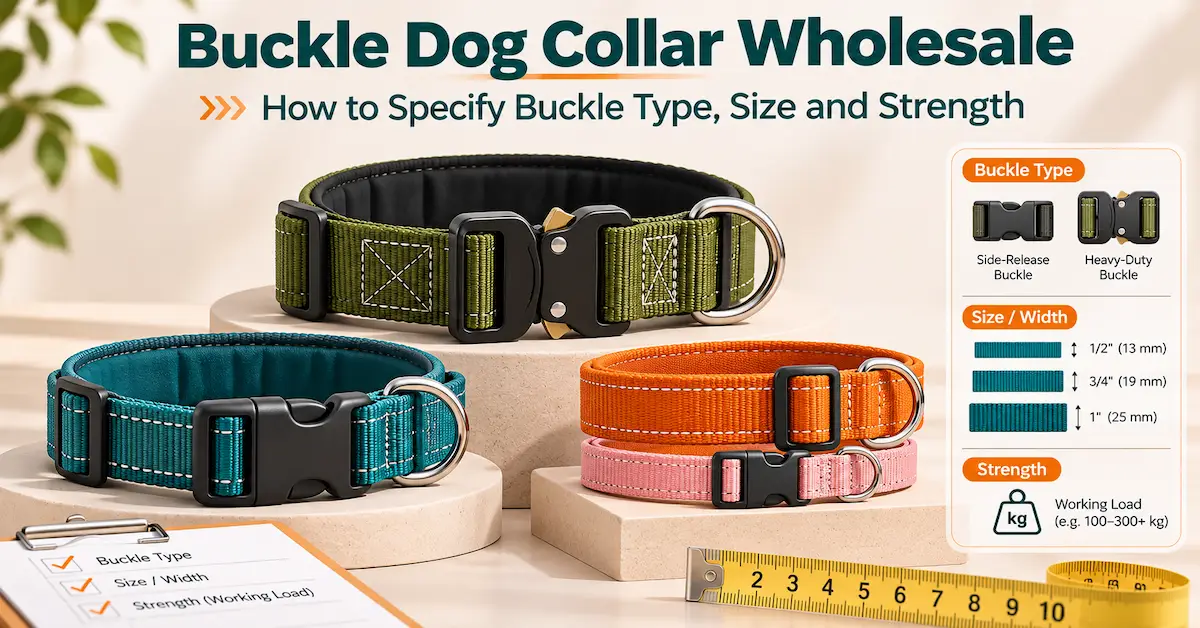
Most buckle dog collar wholesale ranges are built from four dog collar buckle types. Each has a different failure profile, which matters more than the catalogue photo.
| Buckle type | How it fastens | Common materials | Best suited to | Buyer watch-outs |
|---|---|---|---|---|
| Pin-and-hole (tongue) buckle | Prong passes through a punched hole, like a belt | Stainless steel, zinc alloy, brass, some acetal | Everyday collars worn all day, ID tags, wide adjustment range | Hole stretch and prong wear; slower to fasten one-handed |
| Plastic side-release | Two moulded halves snap together; squeeze both tabs to open | Acetal (POM), nylon | Lightweight everyday and puppy collars, entry price points | Cold-weather brittleness, UV fade, tab wear after repeated opening |
| Metal side-release | Metal body with a spring latch, released by squeezing | Aluminium, zinc alloy, stainless steel | Strong pullers, premium lines, working and duty collars | Weight on small dogs, noise, plating wear at contact points |
| Metal-shell hybrid | Metal-look cover over a moulded latch core | Zinc shell plus acetal core | Mid-market lines that want a metal look at plastic weight | Core quality varies between factories; inspect the latch, not the cover |
Pin-and-hole buckles remain the default for collars that stay on the dog permanently because they cannot be released by a snag on a branch or a fence. Side-release buckles are faster for owners who take the collar on and off several times a day, and they are easier for people with limited hand strength. That difference in daily use, not the price difference, should decide which family leads your range.
Metal versus plastic: where the trade-off shows up after 90 days
New samples rarely reveal the difference between a good buckle and a cheap one. The gap appears in the first season of real use, and it appears differently depending on climate and dog behaviour.
| Dimension | Metal buckle | Plastic buckle |
|---|---|---|
| Strength for a given size | Higher, especially in stainless and die-cast zinc | Adequate when the grade and wall thickness are specified |
| Weight | Noticeably heavier on small collars | Light enough for toy breeds and puppies |
| Cold weather | No embrittlement | Low-grade mouldings can crack below freezing |
| Water, salt and chlorine | Depends entirely on alloy and plating | Unaffected by water, but UV exposure fades colour |
| Noise | Can rattle against the D-ring | Quiet in the house |
| Branding | Laser, engraving or debossing on cast parts | Debossing or in-mould marking; small areas limit detail |
| Repairability | Usually replaced, not repaired | Usually replaced, not repaired |
A metal buckle dog collar is not automatically the stronger product, and a plastic side release buckle dog collar is not automatically the cheap option. The difference sits in the grade: a die-cast zinc part with thin plating and a blackened stainless part can look identical in a sample bag and behave very differently after a winter of wet walks.
The practical conclusion for wholesale ranges is rarely "metal is better". It is that the material claim must match the market: a coastal market with daily swimming needs a corrosion specification, while a cold-climate market needs a low-temperature impact note on any plastic buckle. Both are specification lines in the RFQ, not marketing lines on the box.
Buckle-to-webbing sizing: a dog collar buckle size chart that protects your fit claims
Buckle size is quoted as an inner width that matches the webbing, not as an overall length. A 25 mm buckle is made for 25 mm webbing, and a 1 mm mismatch shows up as a buckle that will not slide, a strap that bunches at the frame, or an adjuster that slips under load. The dog collar buckle size chart below is a starting point for a size range, not a substitute for the supplier's measurement drawing.
| Webbing width | Typical buckle inner width | Typical dog weight band | Common programme use |
|---|---|---|---|
| 5/8 in (15 mm) | About 16 mm | Up to roughly 10 lb | Puppies, toy breeds, cat collars, tag collars |
| 3/4 in (20 mm) | About 20-21 mm | Roughly 10-25 lb | Small to medium breeds |
| 1 in (25 mm) | About 25-26 mm | Roughly 20-60 lb | Medium to large breeds; the most common wholesale width |
| 1.5 in (38 mm) | About 38-40 mm | Roughly 50-90 lb | Large dogs and strong pullers |
| 2 in (50 mm) | About 50-52 mm | From about 80 lb | Heavy-duty and working collars |
Three details turn a size chart into a working specification. First, state the tolerance: 25.0 mm plus or minus 0.3 mm is a measurable requirement, while "1 inch" is not. Second, confirm the webbing's actual thickness and shrinkage after finishing, because printed or coated webbing can finish thicker than the raw roll. Third, check the adjuster as a system with the buckle — a buckle that accepts the strap but a slider that does not hold it under load is still a fit failure.
Dog collar belt buckle wholesale buyers have one extra check: the prong spacing and hole pitch have to suit the adjustment range you advertise. If the holes are punched 20 mm apart, a collar sold as "adjustable from 30 to 40 cm" delivers only five usable positions, and customers notice that in the first week.
Putting a number on strength
"Strong buckle" is not a specification. Tensile strength is, provided the purchase order states four things together: the target load, the direction of pull, the test method, and the sample size.
Ask for the failure load and the failure location, not a pass stamp. A collar assembly usually fails at its weakest point — a prong that bends, a moulded tab that shears, a stitch line that runs, or a D-ring that opens — and knowing which one fails first tells you where to spend the next dollar. Buckle collar safety depends on that weakest-link view: a supplier who reports only "tested and passed" has told you nothing you can put in front of a retailer's quality team.
Strength should also be tied to the weight class you print on the packaging. Common industry practice applies a safety multiplier between the dog's body weight and the required break strength, so the sensible RFQ line is: "state your target break strength for each size and the multiplier behind it." That forces the supplier to show its reasoning instead of guessing, and it gives you a defensible answer if a retailer asks why the 1-inch collar is rated for a 60 lb dog.
Test the closure with the webbing installed, not as a bare component. A buckle that holds 300 lb on a test fixture can still fail at 120 lb in an assembly where the strap is stitched too close to the frame.
Dog collar hardware: corrosion, plating and finish specifications
Metal dog collar hardware fails in the field in a predictable order: plating wears at the prong and frame contact points, the base alloy shows through, and the part discolours before it weakens. In wet or coastal markets this happens within a season, and the complaint arrives as "the buckle rusted" even though the alloy never structurally failed.
Write the finish as a specification rather than a colour. State the base alloy, the plating or coating type, the plating thickness where the supplier can measure it, and a salt-spray hour target agreed with your market's expectations. For collars sold into the EU, note that nickel release from articles in prolonged skin contact is restricted under REACH Annex XVII, entry 27, as listed by the European Chemicals Agency, so any nickel-plated hardware should come with the supplier's statement on release testing. If your range targets households with children, add the restricted-substance declarations your retailer requires to the same document.
Plastic buckles have their own finish issues. Colour matching across lots drifts, and UV exposure fades dark colours first. Ask for the colour reference under a named light source and a master batch record, then keep a retained sample from each lot.
Matching the buckle to dog weight and use case
A single buckle across a full size range is the fastest way to create returns. Match the closure to how the collar will actually be used:
- Toy and small breeds: weight matters more than absolute strength. A light plastic side-release or a small stainless tongue buckle keeps the collar from feeling heavy on a 6 lb dog.
- Medium breeds, everyday wear: 1-inch webbing with a pin-and-hole buckle or a quality side-release covers most of the market, and it is the size band where colour and print variety sells.
- Large dogs and strong pullers: metal side-release or a heavy tongue buckle on 1.5-inch webbing, with the D-ring welded or forged rather than bent wire.
- Senior owners and handlers with limited grip: one-handed operation is a feature worth specifying. A buckle that needs two hands to close is a daily friction point, whatever its break strength.
- Working and duty collars: specify the release under load. A latch that opens unintentionally under a strong pull is a safety defect, not a styling choice.
Common mistakes in buckle dog collar wholesale orders
- Ordering "buckle" without a drawing. The word covers both a belt-style prong and a plastic clip, and quotes are not comparable until the drawing is fixed.
- Sizing by overall buckle length. Only the inner width matters for webbing fit; the rest is cosmetic.
- Omitting tolerances. Without a number, a 0.8 mm difference is "within specification" and your adjuster still slips.
- Testing the buckle alone. Assembly strength is what the customer experiences.
- Specifying colour but not plating. Two black buckles can be a painted zinc casting and a blackened stainless part with very different field life.
- Using one buckle across all sizes. It forces either an overweight small collar or an under-strength large one.
- Ignoring the D-ring and stitching. Both are part of the load path and both are cheaper places to fail than the buckle.
- Approving a sample without a retained golden sample. Repeat orders then get judged against memory instead of a physical reference.
Sample and approval workflow
A buckle change is a tooling and inventory decision, so the sample stage deserves its own sequence rather than a single photo approval:
- Send the buckle drawing, webbing specification and target market to the supplier, and ask for a measurement drawing back before quoting.
- Request samples in the full size range, not one middle size, with the intended webbing installed.
- Test each size to failure and record the failure location, then compare against your stated target.
- Run a wear trial of at least two weeks on a dog in the target weight class, including wet conditions if your market needs it.
- Sign off a golden sample with the measurement report, colour reference and packaging attached.
- Keep the golden sample and the test report for the life of the SKU, and reference both in every repeat purchase order.
How we build buckle collars at QQPETS
We have manufactured pet accessories since 2008, and collars are one of our core custom categories alongside harnesses and leashes. Our collars use eco-friendly materials and heat transfer printing for the pattern work, a process we run in-house so colours stay bright through rain and machine washing rather than fading at the first wash. The buckle on our featured collar is a jet-black part engineered for quick one-handed fastening and release without giving up strength on the strap.
Because we produce in our own 5,000 m² facility with more than 100 machines and a team of over 200 people, buckle, webbing, printing and stitching are controlled in one production line rather than assembled from several traders. That is what makes a documented buckle specification practical: the same team that cuts the webbing signs off the hardware. Capacity runs to 300,000 pieces a month, and we hold ISO 9001, BSCI, SGS, OEKO and CE documentation for buyers who need supplier files.
For custom dog collar wholesale programmes, our OEM and ODM service covers private-label branding, custom logos, pattern development, and material and packaging selection. Minimum order quantity starts at 30 to 40 pieces, which lets a brand test a buckle and colour combination in a real market before committing to a full production run. You can see the current collar line on our custom pet accessories range, and our factory and certification details set out the production and quality systems behind it. Buyers who want to see how the wider range is sourced can also read our dog collar supplier guide and the reflective dog collar wholesale guide for visibility-led styles.
FAQ
What is a buckle dog collar?
A buckle dog collar closes with a metal or plastic fastener instead of clipping onto a ring. In most retail ranges that means a pin-and-hole buckle that works like a belt, though some suppliers also use "buckle" for a side-release clip, so confirm the drawing before ordering.
Are buckle collars safe for dogs?
Yes, when the buckle is sized to the dog's weight and the assembly is tested as a unit. A pin-and-hole buckle is the safer choice for a collar worn continuously because it cannot pop open on a snag; a side-release buckle is easier to remove quickly in an emergency.
Is metal or plastic better for a large dog?
Metal is the usual choice for large dogs and strong pullers because it gives more strength in the same footprint. A well-specified acetal side-release can work for medium dogs, but for a 70 lb puller the closure, D-ring and stitching all need to be rated together.
What size buckle fits 1-inch webbing?
A buckle with an inner width of about 25-26 mm, specified with a tolerance such as 25.0 mm plus or minus 0.3 mm. Confirm against the finished webbing thickness, because printed or coated webbing can measure thicker than the raw roll.
What break strength should I require in a bulk order?
Set a target per size, tied to the dog weight class on your packaging, and require the supplier to state the multiplier behind it. Ask for the failure load and the failure location, not a pass stamp, and test the closure with the webbing installed.
Will a metal buckle rust?
It depends on the alloy and the plating, not on the word "metal". Specify the base alloy, plating type and a salt-spray hour target for your market, and ask for the supplier's nickel release statement if you sell into the EU.
Can the buckle carry our logo?
Often yes, through laser marking, engraving or debossing, but the usable marking area on a small buckle is limited. Send the artwork early so the supplier can confirm the minimum legible size before tooling is cut.
What is the difference between a buckle collar and a quick-release collar?
A buckle collar uses a pin-and-hole frame with several adjustment holes. A quick-release collar uses a side-release clip, which is faster to put on and take off but can be opened by a snag or a determined dog pawing at it.
What MOQ should I expect for a custom buckle collar?
It varies with the buckle tooling and the number of sizes. At QQPETS, custom collar orders start at 30 to 40 pieces, which makes it practical to validate a hardware and colour combination before scaling.
How do I compare quotes from two suppliers?
Send both the same drawing, webbing specification, tolerance, break strength target, finish requirement and inspection level, then compare the returned measurement drawings and test reports. Quotes built on different specifications are not prices for the same product.
Conclusion
Buckle dog collar wholesale is a hardware decision before it is a design decision. Nail the fastening type with a drawing, tie the inner width and tolerance to your webbing, put a number and a test method behind strength, and specify the finish for the climate you sell into. Do that, and quotes become comparable, bulk lots become repeatable, and returns stop being a surprise.
If you are planning a buckle dog collar wholesale range and want the hardware specified properly before sampling, send us your drawing and size range and our team will come back with the measurement details and options for your market.