Quick Answer: What Should Buyers Expect From a Multi-SKU Pet Accessories Supplier?
A pet accessories supplier supporting a multi-SKU program should be able to manage more than individual product quotations.
The supplier should help buyers keep multiple products, colors, sizes, materials, hardware options, branding details, and packaging requirements organized under one controlled sourcing program.
For pet brands, wholesalers, distributors, retailers, and e-commerce businesses, the challenge is rarely finding one acceptable dog harness or leash.
The harder challenge is making sure that:
-
related products look like one collection
-
sizes remain consistent
-
colors match across products
-
hardware does not change unexpectedly
-
MOQ remains commercially workable
-
approved samples are reproduced correctly
-
packaging matches each SKU
-
repeat orders follow the same specification
A buyer evaluating only unit price can easily miss these operational risks.
Buyer takeaway: A multi-product sourcing program should be evaluated as a system, not as a collection of unrelated quotations.
For a broader introduction to supplier qualification, buyers can also review the existing pet accessories supplier guide. This article focuses specifically on managing assortment complexity and repeat purchasing.
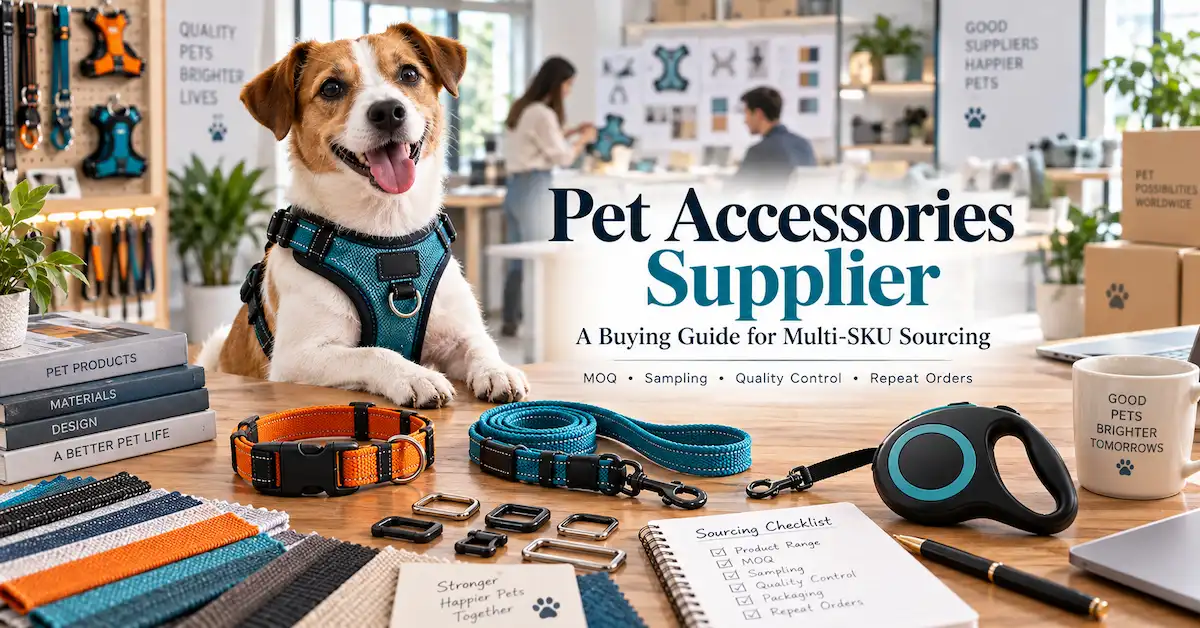
Why Multi-SKU Sourcing Changes the Supplier Evaluation Process
Buying one product is relatively straightforward.
A buyer may need to confirm:
-
one design
-
one material
-
one size range
-
several colors
-
one package
A collection is different.
Imagine a brand sourcing:
-
dog harnesses
-
dog collars
-
dog leashes
-
retractable leashes
Each product may then have:
-
four sizes
-
five colors
-
different logo positions
-
different hardware
-
different packaging
The number of purchasing combinations grows quickly.
More SKUs create more opportunities for:
-
specification mistakes
-
color mismatch
-
incorrect labels
-
packaging errors
-
inventory imbalance
-
delayed replenishment
-
inconsistent repeat orders
This is why a pet accessories supplier that performs well on a single SKU may not automatically be the right partner for a broader product program.
Start With an Assortment Map Before Asking for Prices
One of the most useful steps buyers can take is to define the assortment before requesting final quotations.
Do not begin with:
“Please quote all your harnesses, collars, and leashes.”
Instead, define what role each product will play.
A simple assortment map might look like this:
| Product Role | Example | Business Purpose |
|---|---|---|
| Core Product | Adjustable dog harness | Main year-round SKU |
| Matching Product | Dog leash | Increases collection consistency |
| Add-On Product | Dog collar | Supports bundle sales |
| Premium Product | Retractable leash | Higher-value category |
| Safety Variant | Reflective walking gear | Low-light use |
| Seasonal Variant | Printed color collection | Seasonal marketing |
This approach keeps sourcing tied to a commercial objective.
It also helps prevent a common problem: developing too many products before the buyer knows which SKUs deserve inventory investment.
Buyers can review the current SIXPET product range when planning which categories may fit into a coordinated walking collection.
Understand How SKU Count Multiplies
SKU complexity is easy to underestimate.
Consider a harness program with:
-
4 sizes
-
5 colors
That already creates 20 harness SKUs.
If matching collars and leashes are added, the number of individual purchasing lines increases again.
Then consider:
-
different packaging languages
-
retail versus e-commerce packs
-
different barcodes
-
different labels
-
regional compliance information
The operational workload can become much larger than the visible product range suggests.
Why This Matters to Buyers
Every SKU may require control over:
-
quantity
-
dimensions
-
color
-
logo
-
label
-
barcode
-
packaging
-
carton information
-
production status
A reliable pet accessories supplier should therefore have a practical way to identify and manage each SKU.
The buyer should also maintain a clear SKU list instead of relying only on product photos or chat messages.
Evaluate MOQ at SKU Level, Not Only Order Level
MOQ is often discussed as a single number.
In practice, a multi-SKU project can involve several different constraints.
For example, MOQ may be affected by:
-
webbing color
-
custom printing
-
buckle color
-
metal finish
-
fabric
-
size
-
packaging
-
custom label
-
total production setup
This means the question:
“What is your MOQ?”
may be too broad.
A better set of questions is:
-
Is MOQ calculated by product?
-
By color?
-
By size?
-
By printed pattern?
-
By custom component?
-
Can sizes share one production quantity?
-
Can matching products share the same material order?
-
Does custom packaging have a separate MOQ?
Understanding this early helps brands avoid building an assortment that looks attractive in a spreadsheet but becomes impractical when production minimums are applied.
Reduce Complexity Through Component Standardization
Customization does not mean every component must be different.
In fact, brands can sometimes improve purchasing efficiency by standardizing selected components across a collection.
Possible shared elements include:
-
webbing colors
-
buckle colors
-
D-ring finishes
-
logo labels
-
print patterns
-
packaging style
-
hangtags
-
brand color references
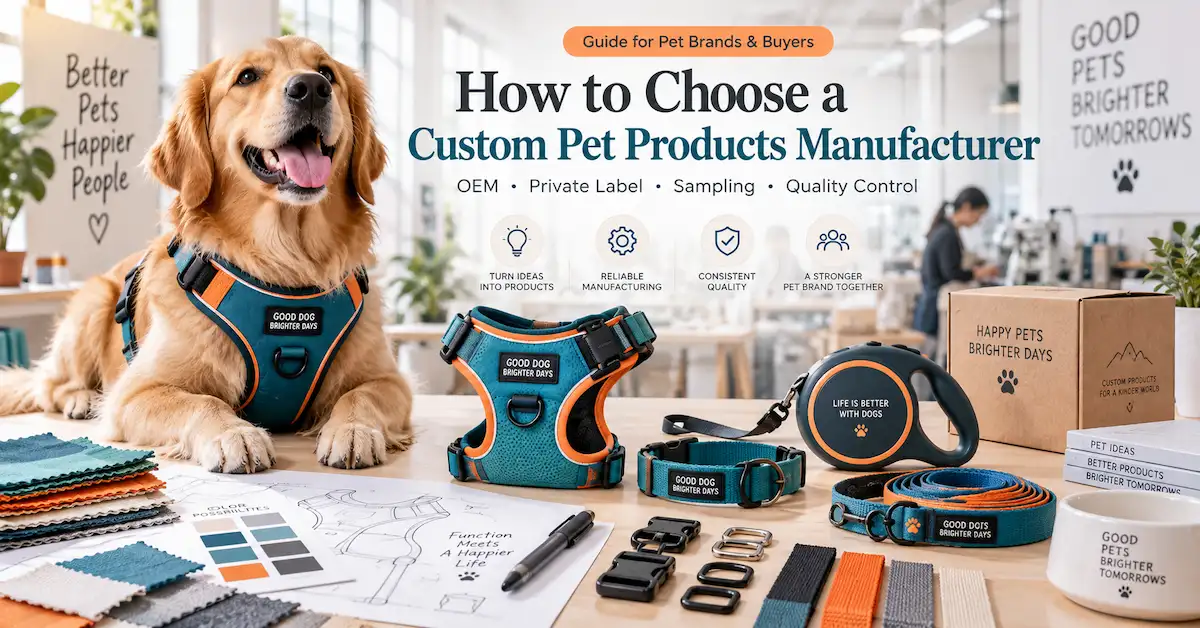
Example: Matching Walking Collection
A brand may develop:
Harness + Collar + Leash
with the same:
-
teal webbing
-
black hardware
-
woven logo label
-
packaging language
-
visual design
The three products remain structurally different, but the shared design system makes the collection easier to recognize.
It may also reduce unnecessary sourcing complexity.
However, standardization should never override product function.
A leash hook, harness D-ring, collar buckle, and adjustment slider perform different jobs and should be selected according to the product's actual requirements.
Color Consistency Becomes More Important Across Collections
A single product can tolerate minor visual differences more easily than a matching set.
If a buyer markets a harness, collar, and leash as one collection, customers may compare them side by side.
Differences in:
-
webbing shade
-
printed pattern
-
hardware finish
-
stitching thread
-
binding
-
logo color
become easier to notice.
For this reason, color approval should not depend only on a product name such as:
“navy blue”
or
“orange.”
The approved production reference should identify the exact color direction used for the collection.
When multiple materials are involved, buyers should also understand that the same color reference may appear differently on:
-
woven webbing
-
mesh
-
plastic buckles
-
coated metal
-
printed fabric
The commercial goal is usually visual coordination, not the unrealistic expectation that every material reflects light identically.
Sampling Should Reflect the Assortment Strategy
A common mistake is treating sampling as a simple yes-or-no stage.
For multi-SKU sourcing, buyers should decide what needs to be physically approved.
Core Samples
Priority products should normally receive detailed review.
Examples include:
-
main harness structure
-
primary leash construction
-
collar sizing
-
retractable mechanism
-
custom packaging
Color or Material Samples
If several products share the same material, buyers may use controlled material references to verify:
-
webbing
-
mesh
-
pattern
-
hardware finish
-
label
-
packaging
Size Samples
Not every size should automatically be assumed to scale perfectly from one sample.
This is especially relevant for dog harnesses.
Changing the size may affect:
-
strap proportions
-
chest panel dimensions
-
adjustment range
-
hardware position
-
overall fit
Buyers should identify which sizes are commercially or technically critical and include those in the approval plan.
Use a Sample Matrix Instead of Informal Approval
A simple sample matrix makes approval easier to manage.
| Item | Structure Approved | Color Approved | Branding Approved | Packaging Approved |
|---|---|---|---|---|
| Harness | Yes | Yes | Yes | Yes |
| Collar | Yes | Yes | Yes | Yes |
| Leash | Yes | Yes | Yes | Yes |
| Retractable Leash | Yes | Yes | Yes | Yes |
The purpose is not bureaucracy.
The purpose is clarity.
When production begins, both buyer and supplier should know which version is the final approved reference.
This becomes even more important when revisions have been made during sampling.
Separate Product Approval From Collection Approval
There are two different questions:
Is each product acceptable?
and
Do all products work together as a collection?
A leash may pass its individual inspection but still use a hardware finish that visually conflicts with the matching collar.
A harness may fit correctly but use a logo size that does not visually match the rest of the range.
Collection review should therefore check:
-
color coordination
-
branding consistency
-
packaging style
-
product naming
-
hardware appearance
-
collection hierarchy
This step is particularly important for private-label and DTC brands where visual consistency is part of the perceived product value.
Quality Control Must Work Across Different Product Types
A multi-category order should not use one generic inspection checklist for every item.
Different products have different risk points.
Dog Harness
Typical control points may include:
-
dimensions
-
adjustment range
-
strap routing
-
buckle operation
-
D-ring position
-
stitching
-
symmetry
-
branding
Dog Collar
Important checks may include:
-
collar length
-
adjustment
-
buckle
-
D-ring
-
webbing
-
printing
-
label position
Dog Leash
Common control areas include:
-
leash length
-
handle
-
hook
-
swivel function
-
webbing
-
stitching
-
logo
Retractable Dog Leash
Additional functional checks may include:
-
extension
-
retraction
-
locking
-
tape or cord movement
-
assembly
-
applicable lighting functions
The buyer should focus inspection attention on the features most likely to affect customer experience, returns, brand consistency, or product function.
For a more detailed supplier-production review, see the pet accessories factory audit guide.
Packaging Can Become a Major Source of SKU Errors
Packaging is often treated as the final cosmetic step.
For a multi-SKU program, it is also a data-management task.
Each product may have a different:
-
product name
-
size
-
color
-
barcode
-
SKU number
-
quantity
-
instruction
-
carton mark
A correctly manufactured product placed in the wrong package can still become a commercial problem.
Build a Packaging Control Sheet
For each SKU, confirm:
| Field | Example Control |
|---|---|
| SKU Code | Unique product identifier |
| Product Name | Approved retail name |
| Color | Approved color name/code |
| Size | S / M / L / XL |
| Barcode | Correct SKU barcode |
| Packaging | Approved box/card/bag |
| Quantity | Units per inner/master carton |
| Label | Required product label |
| Carton Mark | Correct shipping information |
This becomes especially useful when several visually similar products are produced at the same time.
Unit Price Is Only One Part of Multi-SKU Cost
The lowest quoted price per piece does not automatically create the best purchasing result.
Multi-SKU programs can create hidden commercial costs through:
-
unused packaging
-
excessive color variants
-
fragmented MOQ
-
slow-moving sizes
-
sample redevelopment
-
incorrect labels
-
mismatched components
-
overstock
-
delayed replenishment
A better sourcing question is:
“What assortment structure gives us the best balance between differentiation, inventory efficiency, and reliable production?”
This is different from simply negotiating the lowest individual SKU price.
For buyers preparing a larger purchase, the bulk pet accessories order guide provides additional planning considerations.
Plan Reorders Before the First Order Ships
Repeat orders are often treated as a future issue.
They should be considered during initial development.
Before the first production run is closed, the buyer should know how the approved SKU will be identified later.
Useful records include:
-
final product specification
-
approved sample
-
material reference
-
color reference
-
hardware reference
-
artwork version
-
packaging version
-
size chart
-
inspection requirements
Why Change Control Matters
Components may change over time.
A material may become unavailable.
A buckle supplier may update a mold.
Packaging requirements may change.
The correct response is not to assume that no changes will ever happen.
The more realistic goal is:
Changes should be identified, communicated, reviewed, and approved before they affect production.
This is one of the most important differences between transactional sourcing and a stable long-term supplier relationship.
One Pet Accessories Supplier or Several Specialized Suppliers?
There is no universal answer.
Both models have advantages.
| Sourcing Model | Advantages | Risks |
|---|---|---|
| One multi-category supplier | Easier coordination, matching colors, fewer contacts, simplified purchasing | Buyer must verify capability in every category |
| Multiple specialized suppliers | Deep specialization by product type | More coordination, harder collection consistency |
| Hybrid sourcing | Combines core supplier with specialists | Requires stronger internal sourcing management |
One Supplier May Be Better When
You need:
-
coordinated harness, collar, and leash sets
-
consistent branding
-
shared packaging
-
simplified communication
-
consolidated purchasing
-
repeat collection development
Multiple Suppliers May Be Better When
Products require very different technologies or when one supplier cannot demonstrate adequate capability in a specific category.
A buyer should not force supplier consolidation simply for convenience.
The objective is to reduce total sourcing risk.
How to Score a Pet Accessories Supplier for a Multi-SKU Program
A practical supplier scorecard can help purchasing teams avoid decisions based only on price or sales presentation.
| Evaluation Area | Key Question |
|---|---|
| Product Coverage | Can the supplier support the required categories? |
| Specification Control | Can each SKU be clearly documented? |
| Material Coordination | Can shared materials/colors be controlled? |
| Sampling | Is approval organized before bulk production? |
| MOQ Structure | Is the quantity structure workable across SKUs? |
| QC | Are product-specific checkpoints defined? |
| Packaging | Can labels, barcodes, and variants be controlled? |
| Communication | Are revisions and changes documented? |
| Repeat Orders | Can approved specifications be maintained? |
| Collection Development | Can products be coordinated visually and commercially? |
A supplier does not need the highest possible score in every category.
The weighting should reflect the buyer's business model.
For example:
A fashion-focused DTC brand may place more weight on color and packaging.
A wholesaler may prioritize:
-
replenishment
-
assortment breadth
-
cost
-
supply continuity
A private-label retailer may prioritize:
-
documentation
-
packaging control
-
specification consistency
When a Multi-Category Supplier Is Not the Right Choice
A broad product range is useful, but it should not become the only selection criterion.
A supplier may not be the right fit if:
-
required products fall outside its manufacturing experience
-
specifications cannot be documented clearly
-
frequent substitutions occur without approval
-
sampling does not reflect production quality
-
packaging variants are poorly controlled
-
communication becomes unreliable as SKU count increases
In such cases, adding another specialized supplier may create less risk than forcing the entire program through one source.
The objective is manageable supply-chain complexity, not simply fewer supplier names.
What Should Buyers Send Before Requesting a Multi-SKU Quote?
A structured inquiry produces a more useful quotation.
Prepare:
-
Product categories
-
Product references or drawings
-
Target market
-
Intended applications
-
Size ranges
-
Color list
-
Material preferences
-
Hardware requirements
-
Branding
-
Estimated quantity by SKU
-
Packaging requirements
-
Barcode or labeling requirements
-
Target delivery schedule
-
Required sample plan
-
Any specific inspection requirements
Instead of writing:
“Please send your best price for 5,000 pieces.”
send the expected quantity by product, color, and size.
That allows the supplier to evaluate the actual production structure.
Example: How a Buyer Can Simplify a Launch Collection
Consider a new pet brand planning:
-
3 harness designs
-
5 colors
-
4 sizes
-
matching collars
-
matching leashes
The initial plan may create too many individual SKUs.
A more manageable launch might begin with:
Core Collection
-
1 harness structure
-
3 priority colors
-
selected sizes based on target market
-
matching collar
-
matching leash
Expansion Collection
After initial sell-through data becomes available:
-
additional colors
-
seasonal patterns
-
additional hardware finishes
-
premium variants
This phased approach can reduce:
-
inventory fragmentation
-
sampling workload
-
packaging complexity
-
slow-moving SKU risk
while still giving the brand a coordinated product story.
Questions to Ask a Pet Accessories Supplier Before Confirming the Program
Use these questions during supplier evaluation:
-
How is MOQ calculated across sizes and colors?
-
Can several products share the same custom webbing or color?
-
How are approved colors recorded?
-
How are different SKUs identified during production?
-
Which samples need physical approval?
-
How are artwork revisions controlled?
-
How are packaging versions matched to each SKU?
-
Which QC checkpoints differ between harnesses, collars, and leashes?
-
How are component changes communicated?
-
How are previous order specifications maintained for reorders?
The answers should help buyers understand the supplier's process—not simply its sales promises.
FAQ
1. What does a pet accessories supplier provide for B2B buyers?
A pet accessories supplier may provide standard wholesale products, customized products, private-label support, sampling, packaging, bulk supply, and production coordination. The actual scope should be confirmed for each sourcing project.
2. Why is multi-SKU sourcing more difficult than buying one pet product?
Each additional product, size, color, packaging version, or custom component creates another specification that must be purchased, produced, inspected, packed, and reordered correctly.
3. Should all products use the same MOQ?
Not necessarily. MOQ may depend on product structure, material, custom color, printing, hardware, packaging, and production setup. Buyers should confirm MOQ at the relevant SKU or component level.
4. Is it better to source harnesses, collars, and leashes from one supplier?
It can simplify color coordination, branding, packaging, communication, and purchasing. However, buyers should verify that the supplier is capable of producing each required category to the agreed standard.
5. How can brands reduce SKU complexity?
Start with priority products, colors, and sizes instead of launching every possible variation. Standardizing selected materials, hardware finishes, labels, and packaging can also reduce unnecessary complexity.
6. How should samples be approved for a multi-product collection?
Approve both the individual product and the overall collection. Check structure, dimensions, materials, color, hardware, branding, packaging, and applicable functionality against a documented reference.
7. What should be checked during multi-SKU quality inspection?
Inspection should combine common controls such as color, branding, packaging, and quantity with product-specific checks for harnesses, collars, leashes, retractable products, or other accessories.
8. How can buyers keep repeat orders consistent?
Maintain the final approved specification, sample, material references, artwork, packaging version, size chart, and inspection criteria. Require proposed component or material changes to be reviewed before production.
9. What information should be included in a pet accessories RFQ?
Include product type, specification, material, color, size, branding, packaging, quantity by SKU, target market, delivery requirements, sampling needs, and relevant inspection criteria.
10. When should a buyer use more than one pet accessories supplier?
Multiple suppliers may be appropriate when product technologies differ significantly or when one supplier cannot demonstrate reliable capability for every category. Supplier consolidation should reduce risk, not create it.
Conclusion
Choosing a pet accessories supplier for a multi-SKU program requires more than comparing catalogs and unit prices. Buyers should control assortment size, MOQ structure, shared components, sample approval, packaging data, product-specific QC, and repeat-order references before scaling a collection.
If you are planning a harness, collar, leash, retractable leash, or coordinated pet walking range, review the available pet products and contact SIXPET with your SKU plan, target quantities, colors, sizes, branding, and packaging requirements to discuss a workable sourcing program.