Custom Dog Harness Manufacturer: The Short Answer
A custom dog harness manufacturer should do more than apply a logo to an existing style. The manufacturer must help convert the brand's use case, target dog profile, fit requirements, materials, hardware, artwork, packaging, and quality expectations into one controlled product specification that production teams can repeat. The development is ready for bulk production only when the approved physical sample, technical pack, size chart, bill of materials, artwork, packaging, and inspection criteria describe the same revision.
For buyers, the most important decision is the development route. A stock platform with new branding, an adapted platform with structural changes, and a fully new harness architecture require different budgets, sample rounds, MOQs, and validation work. Define that route before asking for a final price. It prevents a visual concept from being quoted as if it were already production-ready.
This page serves one primary search intent: Commercial Investigation. It helps pet brands and product teams understand how a custom dog harness manufacturer takes a design from brief to production handoff. It is not another general supplier ranking, factory audit, RFQ template, padded-harness guide, or private-label overview. The focus is the product-development work between the first idea and a repeatable bulk SKU.
Start With a Product Problem, Not a Reference Picture
A reference picture can communicate silhouette, color, and visual direction, but it cannot define the product. It does not reveal the usable chest range, strap path, seam allowance, reinforcement, material composition, buckle geometry, logo limitations, packaging volume, or intended leash function. If a brand sends only a picture, each manufacturer will fill those gaps differently, making quotations and samples impossible to compare.
A better brief begins with the problem the product must solve. State the target market, sales channel, dog profile, intended activity, expected wearing duration, price position, and customer complaint the design should reduce. A harness for lightweight urban walking requires different tradeoffs from a reinforced outdoor model or a fashion-led retail collection.
Define the intended application
Describe whether the harness is intended for daily walking, training, outdoor recreation, low-light visibility, small-dog comfort, or another specific application. Identify which leash attachment point is functional and which details are decorative. Avoid broad statements such as “safe for every dog” or “escape-proof” unless the exact product and validation evidence support them.
Define the target dog profile
Dog weight alone is not enough to determine fit. The brief should include neck and chest ranges, body proportions, intended breed groups where relevant, and any fit problem observed in existing products. Deep chests, round rib cages, narrow shoulders, and long torsos can respond differently to the same flat size grading. The manufacturer needs this context before changing panel shape or strap geometry.
Define the retail channel
An e-commerce product needs a clear measurement method and a size chart customers can use without assistance. A retail-chain program may require structured packaging, barcode placement, carton data, and documentation. A specialty outdoor brand may prioritize material traceability and functional validation. The sales channel changes what must be approved, not only how the product is marketed.
Choose the Right Customization Route
Not every custom project should begin with a new pattern. A responsible custom dog harness manufacturer should show the buyer which development route fits the commercial goal. Reusing a proven platform can reduce risk, while a new architecture can create stronger differentiation when the brand has a defined functional reason and enough time for validation.
| Development route | Typical changes | Best suited to | Main buyer risk |
|---|---|---|---|
| Branding on an existing platform | Logo, color, printed pattern, label, hangtag, or retail packaging | Fast launches and controlled first orders | Assuming branding changes cannot affect material feel, color, or lead time |
| Adapted manufacturer platform | Material stack, panel proportion, strap width, hardware, size range, or attachment layout | Brands needing functional differentiation without a fully new architecture | Changing too many connected details without revalidating fit |
| New custom architecture | Original pattern, strap path, load path, closure system, size grading, and component integration | Established product teams with a specific unmet use case | Underestimating development rounds, tooling, test work, and MOQ dependencies |
The route can also be staged. A brand may launch an adapted platform to validate demand, then invest in a new architecture once customer fit data and reorder volume justify it. The important point is to document which elements are standard, which are modified, and which are exclusive to the project.
Build a Technical Pack the Factory Can Use
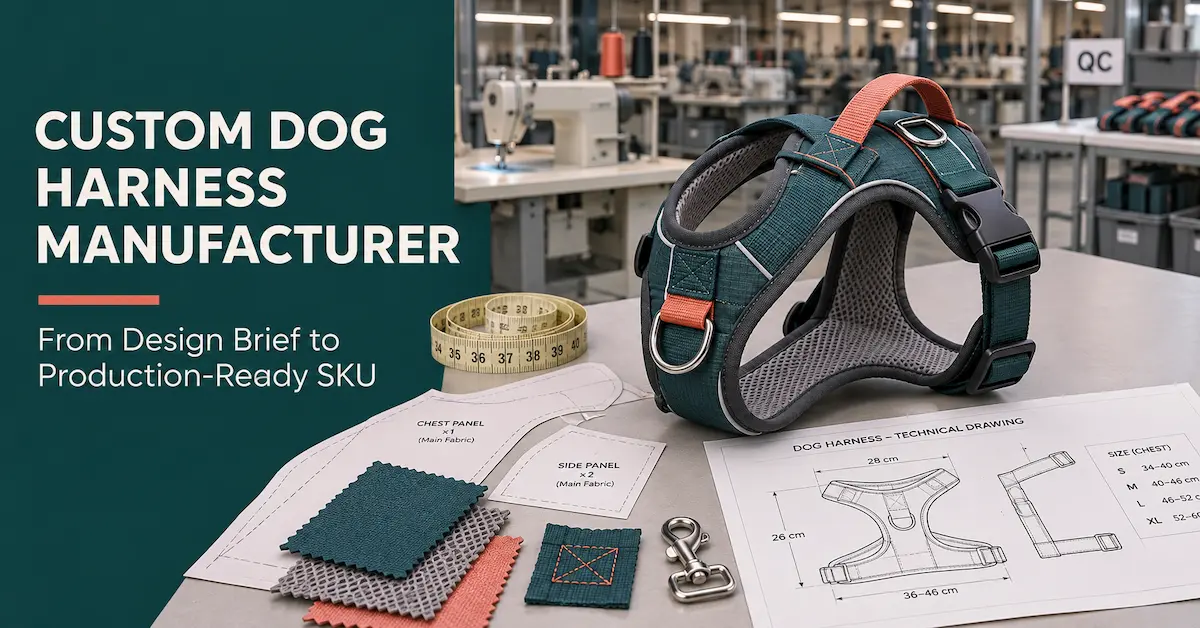
The technical pack is the bridge between the brand's product language and the factory's production instructions. It should be precise enough to prevent guesswork and simple enough that purchasing, sampling, sewing, inspection, and packaging teams can use the same information. A polished rendering is not a technical pack.
Product architecture and measurement map
Include front, back, side, and inside views with named components. Show where each dimension starts and ends. Record finished dimensions, usable adjustment ranges, strap widths, panel dimensions, hardware positions, and tolerances. Distinguish body measurements from finished-product measurements; a total strap length is not the same as a usable chest range.
Bill of materials
The bill of materials should identify the outer fabric, lining, mesh, padding, webbing, binding, thread, buckles, adjusters, rings, labels, logo applications, and packaging. Where an exact supplier code is not yet confirmed, state the required function and approval method. Mark critical components that cannot be substituted without written review.
Workmanship instructions
Show structural seams, cosmetic seams, stitch direction, reinforcement zones, fold lengths, edge distances, and acceptable thread finish. Identify areas where multiple material layers create bulk. If a D-ring or buckle is load-bearing, show how the webbing passes through the hardware and where reinforcement begins and ends.
Artwork and branding controls
Provide vector artwork, color references, logo size, position, orientation, and allowable placement tolerance. State whether the logo is printed, heat transferred, woven, embroidered, molded, or applied as a patch. Approve the physical result on the selected surface because the same artwork can look and feel different on webbing, mesh, padded fabric, or curved panels.
Production-readiness rule: if the sample contains a feature that is missing from the technical pack, the pack is incomplete. If the technical pack specifies a feature that is absent from the approved sample, the approval is unresolved.
Engineer Fit Before Expanding the Size Range
Fit is a system involving panel shape, strap path, adjustment travel, hardware position, and body proportions. Scaling every dimension by the same percentage often creates poor results. Buckles become too large for small sizes, panels become too wide near the shoulder, or adjustment ranges stop matching the customer measurement chart.
Establish one base size
Choose a commercially important middle size as the base pattern. Confirm how the harness sits at the minimum, middle, and maximum approved adjustment positions. Review shoulder clearance, chest-panel position, strap overlap, buckle access, leash-ring alignment, and whether any edge approaches a high-friction area.
Create grading rules instead of copying ratios
For each size transition, decide which dimensions scale and which components change. Strap width, buckle size, ring size, padding thickness, panel coverage, and reinforcement may need different rules. Ask the custom dog harness manufacturer to return the proposed grading table with finished-product tolerances and the corresponding customer body ranges.
Approve edge sizes
The smallest and largest sizes usually reveal grading problems first. A small size can become bulky when standard hardware is reused, while a large size can expose weak reinforcement or insufficient adjustment. Physical approval of at least the base size and technically critical edge sizes provides more useful evidence than approving one sample and assuming the remaining sizes will scale automatically.
Freeze Materials and Hardware as a Connected System
Materials should be selected against the intended application, not by isolated adjectives. “Premium nylon,” “breathable mesh,” and “strong buckle” are not purchase specifications. Each material affects the adjacent components and the finished product's fit, weight, feel, cleanability, appearance, and cost.
Webbing, binding, and soft materials
Record material family, width, thickness or weight where relevant, weave, hand feel, color method, and tolerance. For mesh, padding, and lining, identify the layer sequence and which surface contacts the dog. Ask how moisture, cleaning, compression, and repeated flexing may affect the approved construction. If a printed process changes flexibility or surface feel, review it on the actual sample.
Buckles, sliders, and rings
Hardware should match webbing width, product size, load path, and customer use. Confirm component dimensions, material, finish, operation, and installation direction. A buckle that looks equivalent may have a different inner geometry and change strap movement. A heavier metal component may shift balance or make a small harness unnecessarily bulky.
Thread and reinforcement
Thread choice and stitch configuration should reflect the material stack and stress zone. The correct question is not whether a seam “looks strong,” but whether the agreed construction can be produced consistently without skipped stitches, puckering, edge damage, or insufficient reinforcement. Define the inspection evidence required for critical attachment areas.
Control substitutions before they happen
Mark critical materials and components in the bill of materials. Require the manufacturer to explain why a substitution is proposed, how the replacement differs, which claims or dimensions may be affected, and whether a new sample is needed. This protects the approved fit and retail promise when a supplier or material lot changes.
Use Design-for-Manufacture Review Before Sampling
A design-for-manufacture review identifies features that are visually attractive but difficult to produce reliably. The objective is not to simplify every design. It is to understand the production cost and variation created by each choice before the buyer approves the appearance.
Check seam access and material buildup
Curved panels, narrow channels, multiple folded layers, and hardware placed close to an edge can limit sewing access. Excess thickness can change seam quality or create a stiff contact area. Ask the sample team to identify difficult operations and propose measurable alternatives rather than making unrecorded adjustments at the machine.
Check artwork repeat and alignment
A continuous pattern may cross webbing, binding, or several cut panels. Define where pattern alignment matters and where random placement is acceptable. Exact alignment can increase material waste and labor. A brand should decide which visual relationships are essential to the product identity and price them accordingly.
Check component availability
A custom color, unusual width, exclusive mold, or specialty finish may create a separate minimum purchase quantity and a longer material lead time. The custom dog harness manufacturer should identify these dependencies before the final sample so the buyer does not approve a product that cannot be ordered at the intended SKU quantity.
Plan Three Distinct Sample Gates
One sample cannot efficiently answer every development question. Separating concept, functional, and pre-production approval makes feedback clearer and prevents the brand from paying for final branding before the structure is stable.
| Sample gate | Primary purpose | What may remain temporary | Approval output |
|---|---|---|---|
| Concept sample | Review silhouette, architecture, panel coverage, access, and overall direction | Color, logo, packaging, or selected materials | Approved structural direction and a documented change list |
| Functional sample | Review fit range, material stack, hardware operation, adjustment, and agreed functional checks | Final retail packaging or noncritical decoration | Confirmed construction, materials, size logic, and validation plan |
| Pre-production sample | Confirm the exact revision intended for bulk production | Nothing affecting product, branding, instructions, or pack-out | Signed approval linked to the final technical pack and commercial terms |
Every sample should have a revision, date, size, color, material status, and approval status. If a temporary component is used, label it. Photographs can support the record, but they should not replace physical review of hand feel, thickness, adjustment, component operation, color, and fit.
Validate the Exact Product Claim
Testing should answer a defined product question. A generic request for a “safety certificate” does not tell the manufacturer which product function needs evidence. The validation plan should connect each retail claim and known failure mode to the exact sample revision, method, result, and acceptance rule.
| Validation area | Question to answer | Evidence to retain |
|---|---|---|
| Dimensions and fit | Does every approved size match the finished dimensions and usable body range? | Measurement method, tolerance, sample results, and approved size chart |
| Adjustment | Do straps remain usable and stable at boundary positions? | Adjustment checks, observations, and accepted limitations |
| Hardware operation | Do buckles, sliders, and rings operate as intended in the full assembly? | Component reference, assembly check, and agreed functional record |
| Structural connection | Do critical seams and attachment points meet the project's defined requirement? | Sample identity, method, result, and failure observation where applicable |
| Appearance | Do color, pattern, logo, stitching, and finish match the approved references? | Color and artwork approval, placement tolerance, and defect criteria |
| Care and use | Can the product support the cleaning and use instructions intended for packaging? | Approved care wording and evidence tied to the selected configuration |
| Packaging | Does the pack contain the correct product, size, barcode, instructions, and quantity? | Pack-out standard, barcode check, carton data, and packaging revision |
Do not transfer a result from one harness to another with different materials, hardware, or construction. Do not convert a component result into a universal dog-weight claim without evaluating the complete assembly and intended use. When no product-specific evidence exists, keep the public wording narrow and mark the requirement for confirmation.
Connect Factory Evidence to the Development Project
QQPETS identifies itself on its About Us page as a China-based producer specializing in custom dog harnesses, collars, and leashes. The page states that the company began in 2008, employs more than 200 skilled professionals, and operates a 5,000 m² factory with heat-transfer printing, screen printing, weaving, cutting, sewing, and packaging departments. It also lists ISO 9001, BSCI, SGS, and OEKO standards and says the company serves customers in more than 100 countries.
These facts establish entity and capability context: who the company is, where it operates, which product families it makes, and which processes it says it controls. They do not automatically prove the performance of a new custom harness. The buyer should connect the selected design to the exact processes, materials, sample records, and inspection points used for that SKU.
The current adjustable dog harness reference provides a product-level starting point. It describes breathable mesh lining, adjustable straps, quick-release buckles, logo and pattern customization, packaging options, and a published MOQ of 30–40 pieces for that reference. The same page states more than 100 machines and monthly capacity of 300,000 pieces. Those details should be treated as evidence for the published reference and company context, not as automatic terms for a new architecture.
Evidence boundary: company pages support factory identity, general processes, stated standards, and broad customization capability. A new custom dog harness still requires its own confirmed BOM, size chart, approved samples, validation records, MOQ, lead time, packaging, and change-control agreement.
Transfer the Approved Design Into Bulk Production
Sample approval is not the end of development. The manufacturer must transfer the approved information to purchasing, cutting, printing, sewing, assembly, inspection, and packaging. A production-ready SKU is one that different teams can build and check against the same reference.
Freeze the production packet
The packet should include the technical pack revision, BOM, approved sample identity, size chart, material and component references, artwork, packaging files, workmanship standard, inspection criteria, and accepted deviations. Any unresolved point should have an owner and due date before bulk material is released.
Use a first-article check
At the start of production, review finished units from the actual bulk materials and processes. Confirm dimensions, strap routing, hardware, seam construction, artwork, labels, and pack-out before the entire lot advances. A first-article check can detect a transferred instruction error while correction is still practical.
Inspect during production, not only after it
Incoming checks can confirm materials and components. In-process checks can verify cutting, printing, seam construction, size identification, and hardware orientation. Final checks can verify finished dimensions, appearance, function, labels, packaging, and quantity. The inspection plan should focus on the known risks of the selected architecture, not a generic checklist used for every pet product.
Close the loop after the first order
Record production defects, packing errors, customer feedback, returns, and fit questions by size and revision. Decide which observations require a specification change and which require clearer retail instructions. A controlled engineering change should create a new revision rather than silently altering the approved product.
Understand MOQ, Cost, and Lead-Time Dependencies
A final quotation is meaningful only when the product revision and order structure are clear. MOQ may be driven by the harness platform, webbing or fabric purchase, custom color, printed artwork, hardware finish, packaging, and the number of sizes and colors. Ask for the MOQ by actual SKU split and for the minimum purchase conditions behind it.
| Commercial driver | Why it changes the project | Question for the manufacturer |
|---|---|---|
| New pattern and size grading | Adds development, sample, and approval work | Which sizes require physical samples, and what is included in the development fee? |
| Custom material or color | May create a supplier-level purchase minimum and longer preparation time | What is the material MOQ, and can unused material be carried into a reorder? |
| Special hardware | Can require a separate color, finish, mold, or supplier order | Is the component standard, customized, or exclusive, and what is its lead time? |
| Multiple sizes and colors | Increases SKU setup, packing, inspection, and inventory complexity | Can quantities be mixed, and which minimum applies per size or color? |
| Retail packaging | Adds artwork, proofing, barcode, packing labor, dimensions, and carton implications | Is packaging included in unit price, and what is its separate MOQ? |
| Validation and documents | May require extra samples, time, or third-party work | Which records already exist, and which are project-specific costs? |
Separate development lead time from bulk lead time. Development may include feasibility review, pattern work, material sourcing, sample rounds, validation, and final approval. Bulk timing may begin only after deposit, artwork approval, material readiness, and pre-production sample approval. A schedule should name the start event and show how buyer changes affect delivery.
Align Packaging and Product Claims With the Approved SKU
Packaging is part of the product specification because it tells customers how to choose, use, and care for the harness. The final pack should use the approved size range, measurement method, material wording, care instructions, leash-attachment purpose, warnings where appropriate, and country- or channel-specific information supplied by the buyer.
Do not finalize packaging before the product architecture and material stack are stable. A late change to a buckle, lining, strap length, or care method can make the printed instruction inaccurate. Keep the packaging revision linked to the same product revision used by production and inspection.
Make the size chart operational
The chart should tell the customer where and how to measure, show the recommended body range, and explain what to do at a boundary. Product teams should verify that the chart matches the approved finished harness rather than copying ranges from an earlier model.
Keep claims narrower than evidence
Words such as no-pull, reflective, waterproof, escape-resistant, breathable, or heavy-duty imply specific functions. Define what the claim means for the selected product and retain evidence appropriate to that wording. If the feature is a design intention rather than a validated result, use accurate descriptive language instead of an absolute promise.
Protect Design Files and Revision Ownership
Before releasing original artwork, patterns, or unique construction details, agree how files may be used, who can access them, and whether any element is exclusive. The agreement should distinguish the brand's original IP from the manufacturer's existing platform, production knowledge, standard components, and improvements developed during the project.
Revision ownership is equally important. Maintain a change log showing the request, reason, affected parts, approval, date, cost impact, and implementation order. If the brand changes artwork while the factory changes a buckle, both changes should appear in the same controlled revision. This prevents two valid but incompatible versions from entering production.
Common Development Mistakes and Their Business Impact
- Quoting before defining the development route: suppliers price different scopes, so the cheapest offer is not comparable.
- Approving only the middle size: grading problems remain hidden until small and large sizes reach customers.
- Using material adjectives instead of a BOM: repeat orders can change feel, fit, and appearance without an obvious product-name change.
- Finalizing artwork before structure: revised seams and hardware positions force logo or pattern changes late in the project.
- Treating a concept sample as pre-production approval: temporary components become accidental production specifications.
- Testing without a defined question: a report is collected but does not support the intended product claim.
- Leaving packaging until after quotation: final cost, carton size, barcode work, and lead time increase unexpectedly.
- Accepting substitutions through chat messages: the BOM, sample, and production order stop describing the same product.
These mistakes are expensive because they appear after the brand has invested in artwork, inventory, listings, and launch dates. A disciplined custom dog harness manufacturer should expose these dependencies early and give the buyer clear approval gates.
Pre-Production Checklist for Buyers
- Use case: target market, dog profile, activity, channel, and customer problem are defined.
- Development route: standard platform, adapted platform, or new architecture is recorded.
- Technical pack: drawings, measurement map, BOM, workmanship, and artwork are revision controlled.
- Fit: base size, edge sizes, body ranges, adjustment limits, and tolerances are approved.
- Materials: actual webbing, fabric, mesh, padding, lining, thread, and hardware are confirmed.
- Samples: concept, functional, and pre-production status are clearly separated.
- Validation: each claim has a defined question, method, product revision, and acceptance rule.
- Commercials: sample fees, MOQ by SKU, unit-price basis, packaging, and lead-time start are confirmed.
- Production transfer: approved sample, packet, first-article check, and inspection plan agree.
- Change control: substitutions and revisions require documented buyer review.
Frequently Asked Questions
What should I send to a custom dog harness manufacturer?
Send the target market, intended application, dog profile, reference direction, required size range, materials, hardware functions, branding, packaging, target quantity, launch timing, and known customer pain points. Mark which elements are mandatory and which the manufacturer may propose. A picture can support the discussion but should not replace measurements and product requirements.
Can a manufacturer customize an existing harness instead of creating a new one?
Yes. An existing platform can often support custom colors, patterns, logos, labels, packaging, selected materials, hardware, or size adjustments. Ask which changes require a new fit review or sample. Adapting a proven platform is often appropriate when launch speed and controlled risk matter more than a fully original architecture.
How many samples are needed before bulk production?
There is no universal number. The project may use concept, functional, revised, size-set, color, packaging, and pre-production samples. The correct count depends on the novelty of the architecture, number of sizes, material availability, branding, and validation requirements. Each sample should answer a named approval question.
What belongs in a dog harness technical pack?
Include product views, named components, finished dimensions, body ranges, tolerances, strap widths, adjustment limits, BOM, hardware references, seam and reinforcement instructions, artwork, labels, packaging, inspection criteria, sample identity, and revision history.
How should custom harness sizes be approved?
Approve a base size at minimum, middle, and maximum adjustment positions, then review technically critical edge sizes. Confirm customer body ranges, finished dimensions, hardware scale, panel coverage, strap overlap, and tolerances. Do not assume every size can be created by applying one proportional scale factor.
What affects MOQ for a custom dog harness?
MOQ can be influenced by the platform, custom webbing or fabric, colors, printing, hardware finish, number of sizes, labels, packaging, and component supplier minimums. Request the MOQ by actual SKU and ask which material purchase conditions create it. A published MOQ for one reference model does not automatically apply to a new design.
How long does custom harness development take?
Timing depends on feasibility review, pattern work, materials, hardware, artwork, sample rounds, size approval, validation, packaging, and buyer feedback. Ask for a stage-based schedule rather than one total number. Bulk lead time should begin from a named event such as final sample approval and material readiness.
How can a brand protect an original harness design?
Use appropriate confidentiality and IP agreements, identify the brand's original artwork and design files, define permitted use, limit access, and record what comes from the manufacturer's existing platform. Maintain dated revisions and agree how samples, tooling, patterns, and unused branded materials are handled.
What evidence should the manufacturer provide before production?
Request the approved product specification, BOM, size chart, sample record, material and component references, artwork approval, packaging revision, inspection plan, and product-specific validation records relevant to the claims. Company certificates provide context but do not replace evidence for the exact SKU.
Can QQPETS develop matching harness, collar, and leash products?
QQPETS presents harnesses, collars, and leashes within its current product and customization scope. A coordinated collection can share visual direction, but each item still needs separate dimensions, materials, hardware, function, sample approval, packaging, MOQ, and quality controls. Confirm the exact scope for the planned collection through the QQPETS Contact Us page.
Conclusion
A successful custom harness program is not created by adding more customization choices. It is created by controlling the decisions that connect the market need to the factory floor. Choose the right development route, build a usable technical pack, engineer and grade fit, freeze connected materials and hardware, separate sample gates, validate the exact product claims, and transfer one approved revision into production.
QQPETS's published company information supports its identity as a China-based custom dog harness manufacturer with printing, weaving, cutting, sewing, packaging, and related pet-walking product capabilities. Its adjustable harness page provides useful reference-level information about materials, adjustment, customization, packaging, capacity, and MOQ. Your new SKU still requires project-specific technical, sample, commercial, and validation confirmation.